

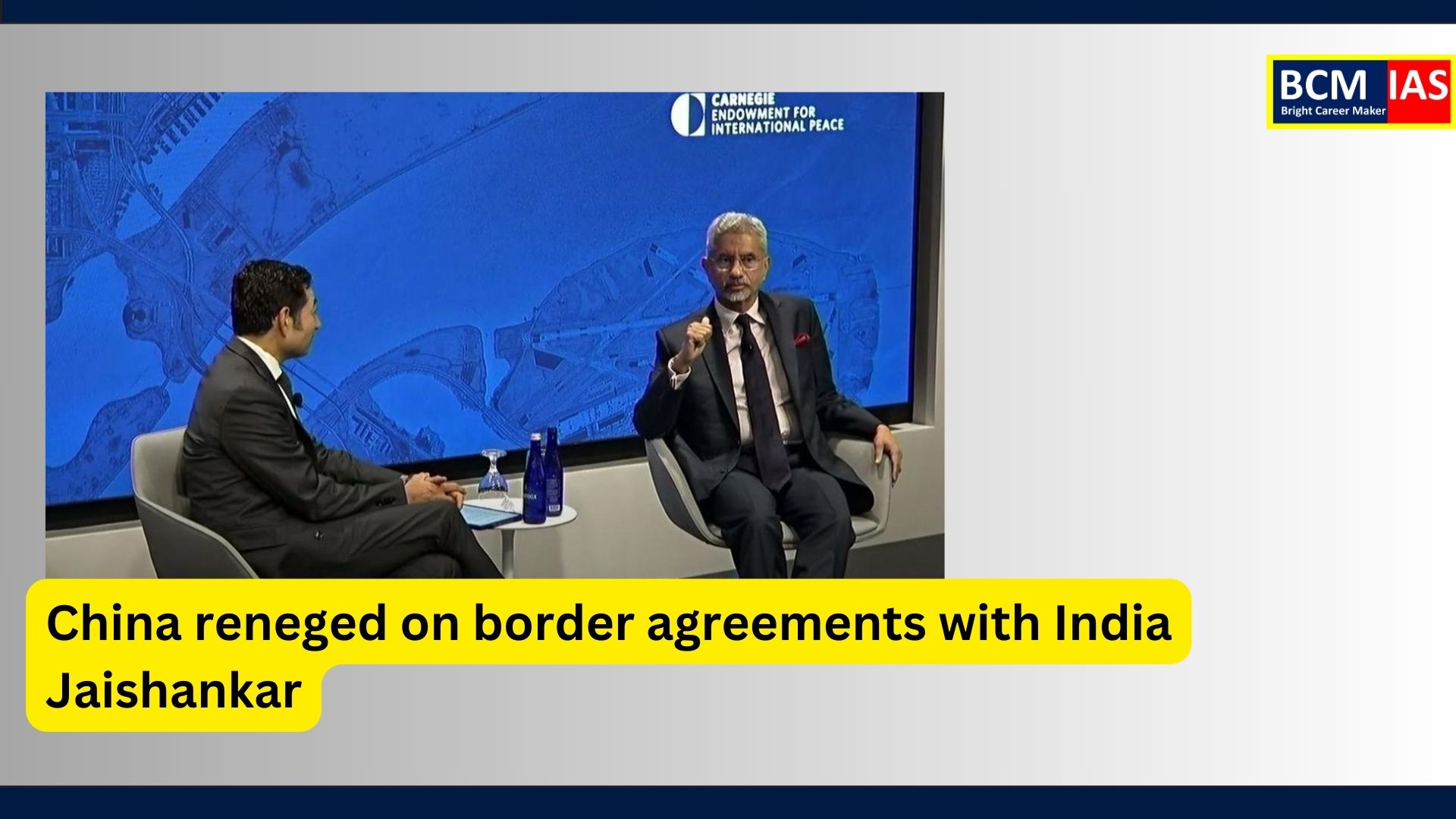
China reneged on border
agreements with India: Jaishankar
The statement made by External Affairs Minister S. Jaishankar
addresses multiple significant aspects of India’s foreign policy, specifically
concerning China, U.S.-India relations, and global economic dynamics. Below is
an analysis of the main points:
1.
India-China Border Tensions
- Background: The root cause of ongoing tensions between India and
China is linked to the violation of border agreements. In 2020, there were
clashes between the Indian and Chinese militaries along the Line of Actual
Control (LAC), which resulted in both nations moving thousands of troops
to the border. These actions undermined several earlier agreements aimed
at maintaining peace and stability in border areas.
- Violation of Agreements: Jaishankar explicitly stated that China reneged
on agreements designed to ensure tranquility at the border, which India
had respected. The violation of these agreements in 2020, including those
related to troop disengagement, led to a direct breach of trust.
- Current
Status: Both
nations continue forward deployments of their soldiers along the LAC, and
as long as this situation persists, tensions are likely to remain.
Jaishankar emphasized that these military deployments cast a
"shadow" over the broader relationship between the two nations,
impacting diplomacy, trade, and strategic cooperation.
2.
Impact of Border Tensions on Bilateral Relations
- The
minister underlined that while border tensions are an immediate concern,
they are not isolated from other aspects of the India-China relationship.
He pointed out that the unresolved issue of troop deployments hampers
progress in other spheres. The continued military tension between India
and China overshadows diplomatic engagement and mutual trust, and until
the military standoff is resolved, this strain will persist.
3.
India's Trade Relations with China
- Autonomous Trade Dynamics: Despite ongoing tensions, Jaishankar noted that
trade between India and China continues to flourish. This is because
India's consumption and manufacturing sectors inevitably rely on imports
from China. As the world’s largest manufacturing hub, China is deeply
embedded in global supply chains, which makes trade with China almost
"autonomous."
- Pragmatic Economic Relations: This underscores the complex
nature of India’s relationship with China—while military and political
tensions are high, economic relations remain robust. This indicates a
pragmatic approach where India separates strategic concerns from economic
realities.
4.
U.S.-India Relations and Democracy
- Jaishankar
also touched upon the sensitive subject of U.S. commentary on the state of
democracy in India. The Indian government has previously responded to
criticisms from the U.S. regarding democratic norms and human rights by
framing them as part of American “vote bank politics.” Jaishankar
reinforced that democracies should be mutually respectful and avoid
unnecessary interference in each other’s internal affairs.
- Mutual Respect in Democracies: He argued against the notion
that one democracy can critique another without it being seen as
interference, particularly when it comes to promoting democratic values
globally. This indicates India’s preference for a more balanced dialogue
between democratic nations, where mutual respect is emphasized.
5.
Clarification on De-dollarisation and Economic Alignment
- Jaishankar
clarified that India does not have any agenda to de-dollarise the world
economy. The speculation surrounding India’s engagement in alternative
currency settlements, particularly in trade with Russia and Iran, stems
from practical necessities rather than a political agenda. These
alternatives were developed as workarounds due to U.S. sanctions, not as
part of a broader economic strategy against the dollar.
- Global Rebalancing and Multi-Alignment: India’s shift towards
multi-alignment reflects the evolving global order where countries,
including India, must navigate complex geopolitical and economic
landscapes. Multi-alignment allows India to engage with various global
players while maintaining strategic autonomy, particularly in a world
where economic sanctions and geopolitical rivalries (like those involving
Russia) complicate traditional trade and financial systems.
Conclusion
The statements by Jaishankar shed light on the intricate and
evolving nature of India’s foreign policy. The key takeaway is India’s
strategic autonomy, where military tensions with China coexist with strong
economic ties, and where India adopts a multi-alignment strategy to balance its
relationships with global powers like the U.S., Russia, and China. This policy
reflects India’s determination to maintain its sovereignty, prioritize its
national interests, and navigate an increasingly multipolar world.
India’s forward military deployments and unresolved border
issues with China remain a central concern, and without a diplomatic solution,
these tensions will continue to strain broader bilateral relations.
Simultaneously, India’s engagement in trade and its handling of the U.S.
criticisms reflect a pragmatic approach to navigating global dynamics.
Mains Qn And Ans
"India-China relations have been strained
due to border tensions in recent years. Analyze the key reasons behind the
strain, and suggest measures for de-escalation."
Introduction:
India-China relations have been historically complex,
influenced by geopolitical factors, border disputes, and strategic interests.
Since 2020, tensions have escalated due to the clashes along the Line of Actual
Control (LAC) in Ladakh, leading to a deterioration in the relationship between
the two Asian giants. The violation of border agreements, mutual distrust, and
differing geopolitical interests have contributed to the present situation.
Resolving these tensions is critical not only for regional stability but also
for broader diplomatic and economic cooperation.
Key
Reasons Behind Strained Relations:
1. Border
Violations and LAC Clashes:
o The primary
cause of strain is China’s violation of previously agreed protocols regarding
troop deployment along the LAC. The 2020 Galwan Valley clashes marked a
significant departure from established norms, leading to a rapid military
buildup on both sides.
o The agreements,
including the 1993 and 1996 border peace agreements, were meant to ensure
tranquility, but China’s aggressive posturing and the forward deployment of
troops triggered tensions.
2. China’s
Assertiveness in the Region:
o China’s growing
assertiveness, particularly its Belt and Road Initiative (BRI) and claims in
the South China Sea, demonstrate its intent to expand its influence. This
assertiveness has also extended to India’s borders, with China increasingly
testing India’s military and diplomatic resolve.
o The construction
of infrastructure close to the LAC and frequent incursions by the People’s
Liberation Army (PLA) into disputed areas have exacerbated tensions.
3. India’s
Strengthening of Regional Alliances:
o India’s closer
ties with the Quad (U.S., Japan, and Australia) and its Indo-Pacific strategy
have been viewed by China as an effort to counterbalance its influence. This
has led to strategic unease in Beijing, contributing to the geopolitical
rivalry.
o India’s
infrastructure development along the LAC and its broader defense cooperation
with Western powers signal India’s intention to bolster its security against
perceived threats from China.
4. Economic
Dependencies vs. Strategic Rivalry:
o While the
military and diplomatic relationship has been strained, trade between India and
China remains robust, with China being India’s largest trading partner. This
dichotomy presents a challenge for both countries, as mutual economic
dependence coexists with geopolitical rivalry.
o However, India’s
efforts to reduce dependency on Chinese imports and encourage domestic
manufacturing (Atmanirbhar Bharat) have led to friction in economic relations.
Suggested
Measures for De-escalation:
1. Diplomatic
Engagement and Confidence-Building Measures (CBMs):
o Resuming regular
diplomatic talks and military-level engagements is critical. Existing
agreements, such as the 2005 Protocol on Modalities for the Implementation of
CBMs, can be revived and expanded to ensure greater transparency and
communication between the militaries.
o Establishing
direct military hotlines and mechanisms to avoid misunderstandings during
patrols could prevent future clashes.
2. Revival
of Border Talks:
o A long-term
solution to the border dispute requires political will. Both sides should
revive the stalled border negotiation process, particularly under the framework
of the Special Representatives mechanism on boundary talks.
o Clarifying the
alignment of the LAC and demarcating sectors of conflict can help reduce the
possibility of future skirmishes.
3. Focus
on Economic Cooperation:
o Despite
tensions, the economic relationship remains vital for both nations. Enhancing
cooperation in areas like trade, investment, technology, and infrastructure,
while managing strategic concerns, can help build trust.
o India could also
seek to balance its economic relationship with China by diversifying its trade
partners and promoting local industries.
4. People-to-People
Contacts:
o Expanding
cultural, academic, and tourism exchanges can foster better mutual
understanding. Strengthening people-to-people ties through platforms like BRICS
and the Shanghai Cooperation Organisation (SCO) could improve relations beyond
the strategic level.
5. Regional
Stability and Multilateral Forums:
o Both India and
China are key players in the Asian region. Working together on global issues
like climate change, counterterrorism, and regional stability through
multilateral forums (G20, SCO) could help reduce hostilities.
o Confidence-building
initiatives through regional platforms, such as the Asian Infrastructure
Investment Bank (AIIB), could also foster positive cooperation.
Conclusion:
India-China relations are at a critical juncture, with
unresolved border issues and strategic rivalry complicating the relationship. A
multi-faceted approach, combining diplomacy, economic cooperation, and military
disengagement, is essential to de-escalate tensions. Both countries must
prioritize peace and stability in their interactions, as prolonged tensions
will not only strain bilateral relations but also affect regional and global
stability. Strategic patience and engagement are key to resolving this protracted
conflict.
MCQs
1.
Which of the following is a key reason for the strain
in India-China relations in recent years?
- (a)
China's violation of the 1993 and 1996 border agreements along the Line of
Actual Control (LAC)
- (b) India's
entry into the United Nations Security Council (UNSC)
- (c)
India's diplomatic alignment with Russia
- (d)
India’s refusal to participate in the Belt and Road Initiative (BRI)
Answer: (a)
Explanation: The primary reason for the recent tensions is China’s violation
of the agreements along the LAC, particularly seen in the 2020 Galwan Valley
clashes.
2.
What was one of the key mechanisms established between
India and China to maintain peace along the border before the 2020 clashes?
- (a)
The Panchsheel Agreement
- (b)
The 1993 and 1996 Border Peace Agreements
- (c)
The Shanghai Cooperation Organisation Treaty
- (d)
The BRICS Forum Agreement
Answer: (b)
Explanation: The 1993 and 1996 agreements were established between India and
China to maintain peace and tranquility along the border and prevent escalation
of conflicts.
3.
Which of the following terms refers to the primary
reason why tensions remain high between India and China along the Line of
Actual Control (LAC)?
- (a)
Non-alignment policy
- (b)
Forward deployment of troops
- (c)
India’s membership in the Quad
- (d)
Trade imbalances between the two countries
Answer: (b)
Explanation: The forward deployment of troops on both sides of the LAC,
especially after the 2020 clashes, is a significant reason for continued
tensions.
4.
India’s approach to foreign policy in the current
global environment has shifted from non-alignment to which of the following
strategies?
- (a)
Multi-alignment
- (b)
Isolationism
- (c)
Neoliberalism
- (d)
Strategic neutrality
Answer: (a)
Explanation: India’s foreign policy now focuses on multi-alignment, where it
engages with multiple countries and alliances based on national interests,
unlike the earlier non-alignment strategy.
5.
Which of the following is NOT a measure suggested to
de-escalate the border tensions between India and China?
- (a)
Revival of diplomatic border talks through the Special Representatives
mechanism
- (b)
Establishment of military hotlines for better communication
- (c)
Complete economic disengagement between India and China
- (d)
Confidence-building measures through multilateral platforms like the SCO
Answer: (c)
Explanation: While India seeks to reduce its economic dependency on China,
complete disengagement is neither suggested nor feasible. Instead, diplomatic
talks and confidence-building measures are recommended for de-escalation.


Comments on “China reneged on border agreements with India: Jaishankar”