


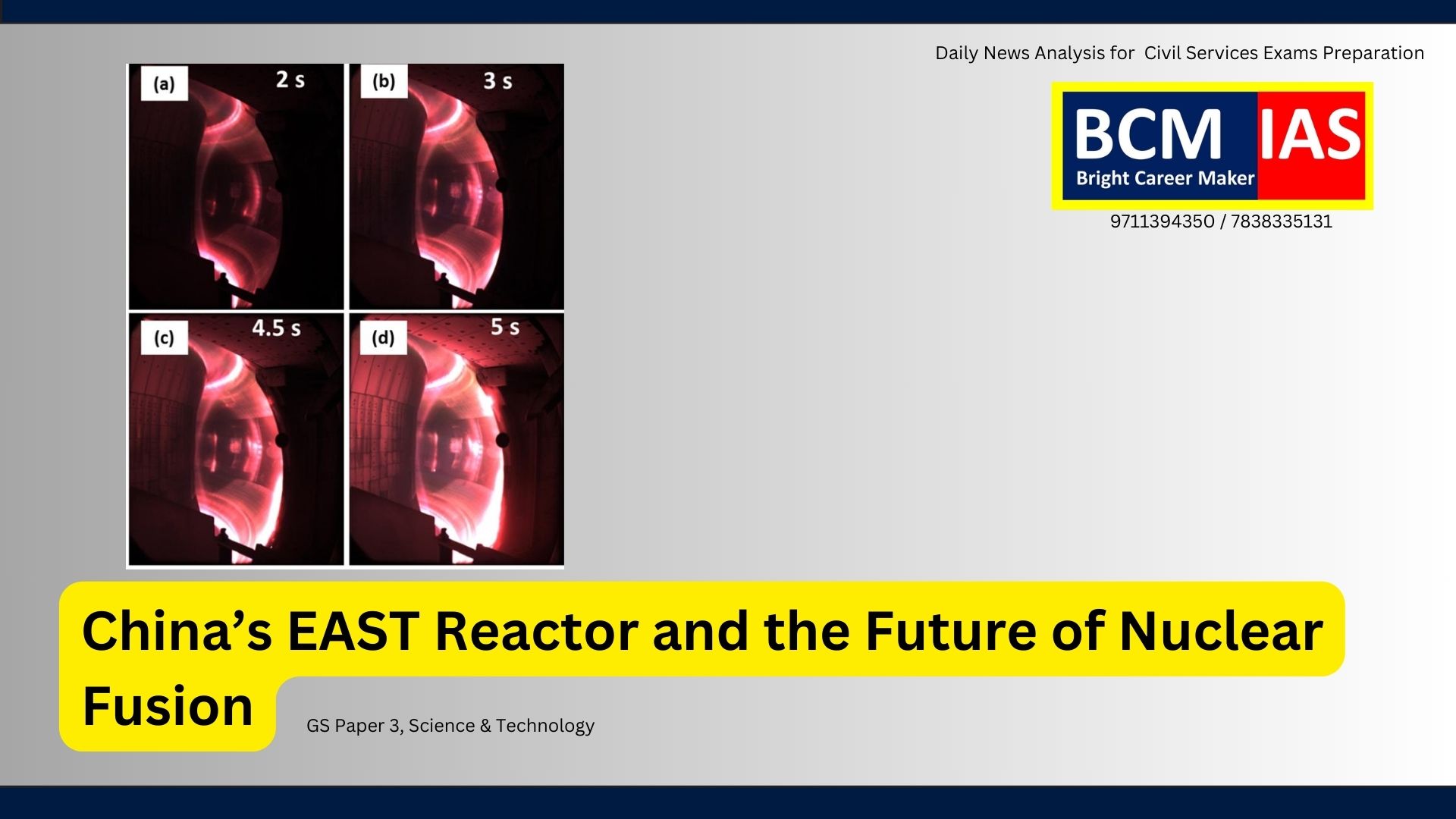
China’s
EAST Reactor and the Future of Nuclear Fusion
The Experimental Advanced
Superconducting Tokamak (EAST) is a nuclear
fusion reactor in China that has made a significant
breakthrough by maintaining a plasma at 100 million degrees Celsius for
1,066 seconds. This is important because nuclear fusion
could become a clean, nearly limitless source of energy in
the future.
1. What is Nuclear Fusion and Why is it Important?
- Fusion
happens when two
atomic nuclei combine to form a new nucleus, releasing huge amounts of energy.
- It
is the same process that powers the Sun
and other stars.
- Unlike
nuclear fission
(used in current nuclear power plants), fusion:
- Does
not produce harmful radioactive waste
- Generates
much more energy per unit of fuel
- Uses
abundant fuel sources, mainly hydrogen isotopes (Deuterium and
Tritium)
If we can control
fusion on Earth, we can get clean
energy with minimal environmental damage.
2. The Challenge of Achieving Fusion Energy
Fusion is very difficult because:
- Extreme
temperatures required → To make fusion
happen, we need temperatures of 100
million degrees Celsius (hotter than the Sun!).
- Plasma
needs to be controlled → At such high
temperatures, matter
exists as plasma (a state where atoms are stripped of
electrons). Controlling this plasma inside a reactor is very hard.
- Fuel
availability → Deuterium is abundant in
seawater, but Tritium
is rare and difficult to produce.
To solve these challenges, scientists are
experimenting with different reactor designs.
3. What is a Tokamak and How Does it Work?
EAST is a Tokamak, a doughnut-shaped
reactor that uses magnetic
fields to trap superheated plasma.
🔹 How
does a Tokamak Work?
1.
Hydrogen gas
(Deuterium/Tritium) is heated to millions of degrees,
turning it into plasma.
2.
Super-powerful electromagnets
create a magnetic field, confining the plasma so
that it doesn’t touch the reactor walls.
3.
The nuclei in the plasma
move at high speeds and collide, overcoming their natural
repulsion.
4.
Fusion occurs, releasing
enormous energy, which can be used to generate electricity.
📌
EAST is unique because it uses both toroidal and poloidal magnetic
fields to better control the plasma.
4. EAST’s Achievements and Why They Matter
- EAST
set a new record
by sustaining a 100
million °C plasma for 1,066 seconds (almost 18 minutes).
- Previous
records:
- 2016:
Sustained plasma for 60
seconds
- 2017:
Sustained plasma for 100
seconds
- 2023:
Maintained plasma for 403
seconds
- These
records show steady
progress in sustaining nuclear fusion, which is crucial
for future reactors like ITER.
5. The ITER Project and Its Challenges
🔹 What
is ITER?
- ITER
(International Thermonuclear Experimental Reactor)
is a global fusion
megaproject involving India, China, the EU, the US, Russia, Japan, and
South Korea.
- It
aims to build the
first fusion reactor that produces more energy than it consumes.
🔹 Challenges
with ITER:
- Delays
& Cost Overruns → It was launched in
2007, but its first plasma is expected only by 2033.
- High
Costs → With a budget of over €18 billion, it
is called the most
expensive science experiment ever.
- Tritium
Shortage → ITER will require large amounts of tritium,
which is hard to produce.
📌
EAST’s success is important for ITER, as
it validates many of the technologies
that ITER will use.
6. Alternative Fusion Approaches
Scientists are also exploring other
ways to achieve fusion besides Tokamaks.
🔹 1.
Stellarator:
- A
different type of magnetic confinement reactor.
- More
complex design but does not need external current.
🔹 2.
Laser Fusion (Inertial Confinement Fusion):
- Uses
powerful lasers to
compress a small fuel pellet (Deuterium & Tritium)
until fusion occurs.
- The
National Ignition
Facility (NIF) in the US achieved fusion ignition in 2022,
producing more
energy than was put in.
📌 Which method will be
successful in the future remains uncertain, but fusion energy is
closer than ever before.
Key
Points-
- Energy
Security: If fusion works, it can provide clean,
unlimited energy, reducing dependence on fossil fuels.
- Climate
Change: Fusion does not produce greenhouse gases or
long-lived radioactive waste.
- India’s
Role: India is a partner in ITER, contributing materials, designs,
and scientific expertise.
- Scientific
Innovation: Understanding fusion technology is crucial
for future energy solutions.
MCQs for Practice-
1.
Which of the following statements about nuclear fusion is correct?
(a) Nuclear fusion releases
energy by splitting heavy atomic nuclei.
(b) Fusion requires
extremely high temperatures to overcome the electrostatic repulsion between
atomic nuclei.
(c) Nuclear fusion produces
long-lived radioactive waste, making it environmentally hazardous.
(d) Fusion energy is already
being commercially used for electricity generation.
✅ Answer: (b) Fusion requires
extremely high temperatures to overcome the electrostatic repulsion between
atomic nuclei.
📌 Explanation:
- Fusion
is different from fission → It combines two lighter nuclei
instead of splitting heavy ones.
- Fusion
requires high temperatures (above 100 million °C)
to overcome repulsion
between positively charged nuclei.
- Fusion
does not produce long-lived radioactive waste
(unlike fission).
- It
is not yet commercially viable, as existing reactors
(like EAST) are still in experimental stages.
2.
Consider the following statements regarding nuclear fusion and nuclear fission:
1. Both processes release energy, but
fusion generates significantly more energy per reaction than fission.
2.
Fusion requires the presence of heavy elements like uranium, whereas fission
works with lighter elements like hydrogen.
3.
Unlike fission, fusion does not produce greenhouse gases or long-lived nuclear
waste.
Which of the
above statements is/are correct?
(a) 1 and 3
only
(b) 2 only
(c) 1 and 2
only
(d) 1, 2,
and 3
✅ Answer: (a)
1 and 3 only
📌 Explanation:
- Statement
1 is correct → Fusion releases more energy per reaction
than fission (which is why it powers the Sun).
- Statement
2 is incorrect → Fission uses heavy elements like Uranium &
Plutonium, while Fusion uses lighter elements like Hydrogen isotopes (Deuterium
& Tritium).
- Statement
3 is correct → Fusion is cleaner, as it does not produce greenhouse gases or
long-lived radioactive waste.
3.
What is the primary challenge in making nuclear fusion a viable energy source?
(a) Limited
availability of Uranium and Plutonium
(b)
Extremely high temperatures required for fusion to occur
(c)
Difficulty in controlling chain reactions in fusion
(d) High
greenhouse gas emissions from fusion reactors
✅ Answer: (b)
Extremely high temperatures required for fusion to occur
📌 Explanation:
- Fusion
requires extreme temperatures (100 million °C or more)
to make atomic nuclei collide and fuse.
- Uranium
& Plutonium are not used in fusion (option a is incorrect).
- Fusion
does not have chain reactions like fission
(option c is incorrect).
- Fusion
does not produce greenhouse gases (option d is
incorrect).
4.
In the context of nuclear fusion, what is the role of a tokamak reactor?
(a) It uses
chemical reactions to generate energy.
(b) It uses
a magnetic field to confine and control superheated plasma for fusion
reactions.
(c) It
generates electricity using conventional steam turbines.
(d) It is
designed for the controlled splitting of heavy atomic nuclei.
✅ Answer: (b)
It uses a magnetic field to confine and control superheated plasma for fusion
reactions.
📌 Explanation:
- Tokamaks
(like EAST & ITER) use powerful magnetic fields to confine plasma,
preventing it from touching the reactor walls.
- They
do not use chemical reactions (option a is incorrect).
- They
are still experimental and not yet producing electricity (option c is
incorrect).
- Fission
reactors split atomic nuclei, not fusion reactors (option d is incorrect).
5.
The International Thermonuclear Experimental Reactor (ITER) is significant
because:
(a) It aims
to achieve nuclear fission energy at a large scale.
(b) It will
be the first fusion reactor to generate net energy.
(c) It uses
a laser-based system instead of magnetic confinement.
(d) It is
the world’s first commercially operational fusion power plant.
✅ Answer: (b)
It will be the first fusion reactor to generate net energy.
📌 Explanation:
- ITER
is an international project aiming to produce more energy from fusion than
is required to sustain the reaction.
- It
focuses on fusion, not fission (option a is incorrect).
- It
uses a magnetic confinement system, not lasers (option c is incorrect;
laser-based fusion is tested in the U.S. at NIF).
- It
is still under construction and will not be commercially operational for
decades (option d is incorrect).


Comments on “China’s EAST Reactor and the Future of Nuclear Fusion”