


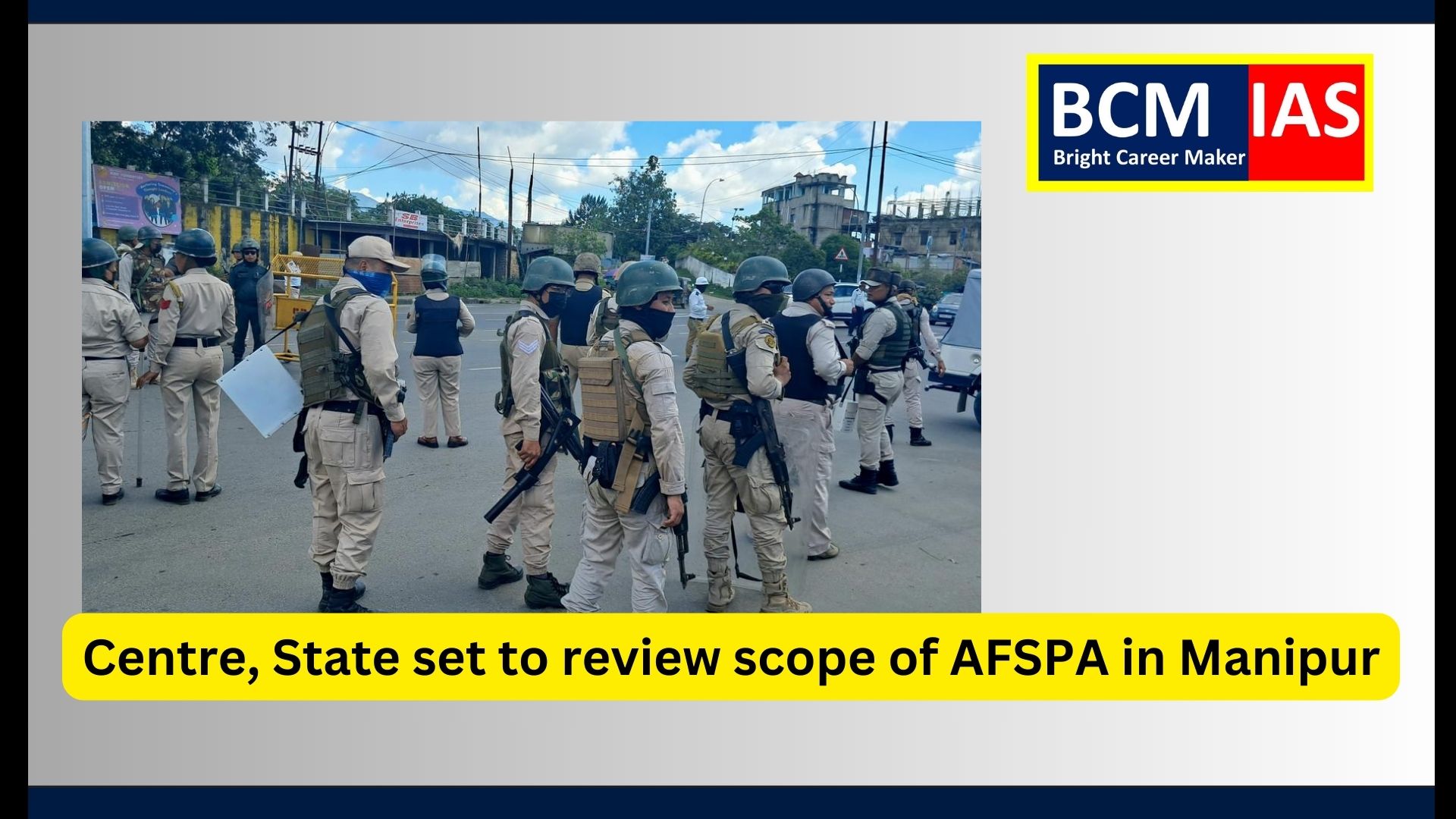
Centre, State set to review scope of AFSPA
in Manipur
The news article focuses on the potential review of the Armed
Forces Special Powers Act (AFSPA) in Manipur, a state that has been grappling
with ethnic violence and security challenges. The Centre and the State
government are set to evaluate the need for extending or modifying AFSPA’s
scope, which remains a contentious issue due to its impact on security, civil
liberties, and ethnic tensions.
Background and Current
Context:
- AFSPA's
Role: AFSPA
allows security forces sweeping powers to maintain public order in areas
declared "disturbed." It is often extended in conflict-ridden
regions, such as parts of Manipur, to empower the armed forces in
counter-insurgency operations. The law has been controversial due to its
alleged misuse and concerns over human rights violations.
- Geographical
Scope of AFSPA in Manipur:
- Hill
Districts:
AFSPA remains enforced in all hill districts, largely inhabited by tribal
groups such as the Kuki-Zo and Naga communities, who have experienced
ethnic tensions and insurgent activity.
- Valley
Districts:
AFSPA was gradually withdrawn from the valley districts since 2022 due to
perceived improvements in the security situation. The valley districts
are predominantly inhabited by the Meitei community.
- Ethnic
Violence: Since
May 2023, Manipur has witnessed severe ethnic violence between the tribal
Kuki-Zo and Meitei communities, resulting in at least 237 deaths. The
situation has exacerbated tensions and complicated the security landscape.
Insurgent groups, particularly those operating from Myanmar, have
reportedly taken advantage of the unrest, leading to increased incidents
of extortion, abductions, and armed militancy.
Key Issues and Diverging
Views:
1.
Centre’s Concern: The Union government appears concerned about the
increasing number of armed individuals, both in the hill and valley regions,
and the rise in security incidents such as abductions and extortion. The
government believes that the absence of AFSPA in the valley districts makes it
harder for security forces to operate effectively.
2.
State’s Perspective: The Manipur government, led by Chief Minister N.
Biren Singh, argues that the situation is under control and not comparable to
the severe instability seen in the 1990s. The State claims that the police are
actively handling the situation, evidenced by arrests and enforcement actions.
The government also seems resistant to re-imposing AFSPA in the valley
districts, even though it acknowledges ongoing violence and unrest.
3.
Differing Impact on Valley and Hill Districts: The hill districts, still under
AFSPA, remain sensitive due to ongoing insurgencies and the activities of
militant groups like the Kuki-Zo, who are in a suspension of operations pact
with the Union Home Ministry. Meanwhile, the valley districts, where AFSPA is
not enforced, are home to banned Meitei insurgent groups. The absence of AFSPA
in these areas has raised concerns about the military’s ability to deal with
the violence effectively.
Analysis:
- Security
vs. Civil Liberties: AFSPA is often seen as a double-edged sword. While it enables
security forces to respond quickly to insurgency threats, its imposition
also raises concerns about human rights violations and the alienation of
local populations. The debate in Manipur echoes these larger concerns, as
both the Central and State governments grapple with balancing security
needs against civil liberties and local autonomy.
- Ethnic
Dimension: The
ethnic violence between the Kuki-Zo and Meitei communities further
complicates the security scenario in Manipur. The divergent needs and
security concerns of these groups—one in hill areas with AFSPA and the
other in the valley without it—illustrate how ethnicity influences
governance and security policy in the state.
- Insurgency
and Cross-Border Challenges: The resurgence of insurgent groups, many of which
operate from neighboring Myanmar, adds an international dimension to the
crisis. The involvement of groups advocating secession complicates both
internal security and diplomatic efforts with neighboring countries.
- Future
of AFSPA: The
ongoing violence and insurgency activity will likely compel the Centre to
reconsider AFSPA’s reintroduction in valley districts. However, there is
political resistance from the State government and local communities.
Chief Minister Biren Singh’s statement in the Assembly reflects the
difficulty of using AFSPA as a blanket solution for law and order,
especially when ethnic tensions are deeply entrenched.
Conclusion:
The review of AFSPA in Manipur highlights the challenges of
governance in conflict-ridden regions. The Centre and the State must work
together to ensure that security operations do not exacerbate existing ethnic
tensions while also addressing the law and order situation effectively. The
decision on whether or not to reintroduce AFSPA in the valley districts will
require careful consideration of both immediate security needs and long-term
peace-building efforts.
MCQs for Practice
1.
What is the primary reason for the Centre's concern regarding
the absence of AFSPA in the valley districts of Manipur?
a) Increasing number of armed men and difficulty in military operations
b) Declining economic activity in the valley
c) Increased insurgent activity in the hill districts
d) Lack of police presence in the valley districts
Answer: a) Increasing number of armed men and difficulty in military operations
2.
Which of the following ethnic groups is primarily
concentrated in the hill districts of Manipur?
a) Meitei
b) Naga and Kuki-Zo
c) Assamese
d) Garo
Answer: b) Naga and Kuki-Zo
3.
What was the main reason for the gradual withdrawal of
AFSPA from Manipur's valley districts starting in 2022?
a) Public protests against AFSPA
b) Significant improvement in the security situation
c) The imposition of new anti-insurgency laws
d) Pressure from international organizations
Answer: b) Significant improvement in the security situation
4.
Which of the following statements is true about the
insurgent groups operating in Manipur?
a) All insurgent groups in Manipur have peace agreements with the government.
b) Kuki-Zo militant groups are in a suspension of operations pact with the
government.
c) Meitei insurgent groups have taken full control of the hill districts.
d) Insurgent groups only operate in the valley districts.
Answer: b) Kuki-Zo militant groups are in a suspension of operations pact with
the government.
5.
Why is the National Investigation Agency (NIA)
involved in the current situation in Manipur?
a) To investigate local political corruption in the state government
b) To investigate transnational conspiracy by Myanmar-based terror outfits
c) To assess the effectiveness of the AFSPA in the hill districts
d) To provide legal assistance to arrested insurgents
Answer: b) To investigate transnational conspiracy by Myanmar-based terror
outfits


Comments on “Centre, State set to review scope of AFSPA in Manipur”