


Buddhism’s Global Legacy
GS Paper - 1 | Indian Heritage Sites
Source:
Indian Express
Why in News?
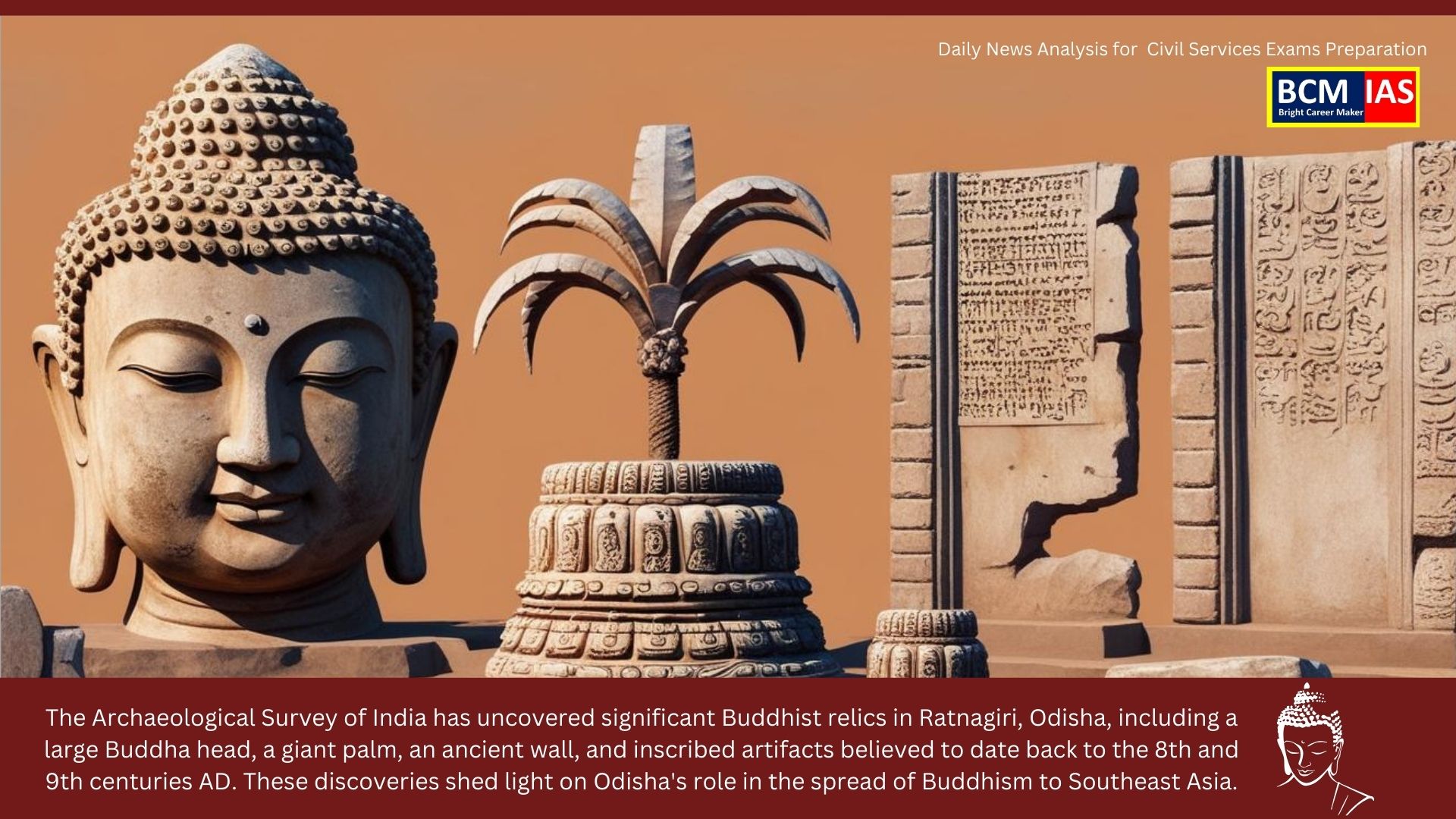
The Archaeological Survey of India has
uncovered significant Buddhist relics in Ratnagiri, Odisha, including a large
Buddha head, a giant palm, an ancient wall, and inscribed artifacts believed to
date back to the 8th and 9th centuries AD. These discoveries shed light on
Odisha's role in the spread of Buddhism to Southeast Asia.
How Odisha Contributed to the Spread of
Buddhism:
1. Role
of Buddha's Disciples:
o Merchant
brothers Tapassu and Bhallika from Utkala played key roles in popularizing
Buddhism.
2. Mauryan
Influence:
o Emperor
Ashoka’s 261 BCE invasion of Kalinga led to his embrace of Buddhism, which he
propagated across South and Southeast Asia.
3. Hiuen
Tsang’s Visit:
o The
Chinese Buddhist monk Hiuen Tsang visited Odisha in 638-639 AD, documenting
insights into the region’s lifestyle, culture, and Buddhist heritage.
4. Historical
Sites:
o Odisha
boasts over 100 ancient Buddhist sites, including Ratnagiri, Udaygiri, and
Lalitgiri (the Diamond Triangle).
o Ratnagiri
was a major center for Mahayana and Vajrayana Buddhism from the 7th to 10th
centuries.
o Unique
Buddha sculptures with intricate hairstyles were discovered here.
5. Maritime
and Trade Links:
o Odisha’s
trade with Bali, Java, Sumatra, and Sri Lanka facilitated the spread of
Buddhism to Southeast Asia.
o The
Baliyatra festival commemorates these maritime ties.
6. Bhaumakara
Dynasty:
o Buddhism
flourished under the Bhaumakara dynasty (8th-10th centuries), enriching
Odisha’s Buddhist heritage.
Key Buddhist Traditions:
1. Mahayana
(Great Vehicle):
o Origin:
4th Buddhist Council (72 AD) in Kashmir during Kanishka’s reign.
o Features:
Idol worship, Bodhisattva ideals.
o Spread:
Central Asia, East Asia, Southeast Asia.
2. Vajrayana
(Thunderbolt Vehicle):
o Practices:
Tantric rituals, mantras, and visualizations.
o Regions:
Himalayas, Tibet, Nepal, Bhutan.
3. Hinayana
(Lesser Vehicle):
o Emphasis:
Nirvana through self-discipline and meditation.
o Ideal:
Arhat achieving enlightenment.
Nalanda University: A Beacon of Knowledge
1. Foundation:
o Established
by Emperor Kumaragupta I in the 5th century CE.
2. Legacy:
o Flourished
under the Pala dynasty.
o Attracted
scholars from Korea, Japan, China, Tibet, and Southeast Asia.
3. Academics:
o Subjects:
Medicine, Ayurveda, Buddhism, mathematics, astronomy, philosophy.
o Library:
Over nine million palm-leaf manuscripts.
4. Destruction:
o Destroyed
in 1193 by Bakhtiyar Khilji, leading to the loss of invaluable knowledge.
Spread of Buddhism to Southeast Asia:
1. Cultural
Crossroads:
o Indian
traders and monks facilitated Buddhism’s spread to regions like Sumatra and
Vietnam.
2. Legitimacy
of Rulers:
o Southeast
Asian rulers adopted Buddhism to bolster their authority.
3. Fusion
with Local Beliefs:
o Buddhism
often blended with indigenous traditions and Hinduism, as seen in Angkor Wat
(Cambodia) and Borobudur (Indonesia).
Prominent Buddhist Sites in India:
1. Bihar:
o Bodh
Gaya: Buddha’s enlightenment under the Bodhi tree (Mahabodhi Temple).
o Vaishali:
Buddha’s final sermon.
o Nalanda:
Ancient global learning hub.
2. Uttar
Pradesh:
o Sarnath:
Buddha’s first sermon (Dhamek Stupa).
o Kushinagar:
Buddha’s Parinirvana (Ramabhar Stupa).
3. Himachal
Pradesh:
o Dharamshala:
Tibetan Government-in-Exile, Dalai Lama’s residence.
4. Maharashtra:
o Ellora
and Ajanta Caves: UNESCO sites showcasing Buddhist art and architecture.
5. Madhya
Pradesh:
o Sanchi
Stupa: Famous for its Buddhist stupas and monasteries.
Conclusion:
Odisha’s rich Buddhist heritage, exemplified
by sites like Ratnagiri, and India’s contributions to the global spread of
Buddhism highlight its profound cultural and spiritual influence. From
Nalanda’s scholarly legacy to the architectural marvels across Southeast Asia,
Buddhism’s enduring impact underscores India’s pivotal role in shaping world
heritage and religion.
MCQs
1. With reference to the Buddhist councils, consider the following
statements:
1. The First
Buddhist Council was held at Vaishali.
2. The Third
Buddhist Council was convened during the reign of Emperor Ashoka.
3. The
Fourth Buddhist Council led to the division of Buddhism into Mahayana and
Hinayana.
Which of the statements given above is/are correct?
(a) 1 and 2 only
(b) 2 and 3 only
(c) 3 only
(d) 1, 2 and 3
Ans: (b)
2. With reference to the cultural and religious history of India,
consider the following sects:
1. Theravada
2. Mahayana
3. Vajrayana
Which of these Buddhist sects are primarily associated with tantric
practices and rituals?
(a) 1 only
(b) 2 only
(c) 3 only
(d) 1, 2, and 3
Ans: (c)
3. With reference to the Buddhist doctrine, consider the following
statements:
1. The
concept of Bodhisattva is central to Mahayana Buddhism.
2. Nirvana
in Buddhism refers to the attainment of moksha similar to that in Hinduism.
3. The
Eightfold Path is a practical guide to ethical and mental development.
Which of the statements given above is/are correct?
(a) 1 and 3 only
(b) 2 and 3 only
(c) 1 only
(d) 1, 2, and 3
Ans: (a)
4. With reference to ancient Buddhist architecture, which of the
following statements is correct?
(a) Ajanta caves were primarily built during the Mauryan period.
(b) Sanchi Stupa is associated with Emperor Ashoka's reign.
(c) Borobudur temple is located in Sri Lanka.
(d) Ellora caves depict only Buddhist art.
Ans: (b)
5. With reference to the Buddhist text Tripitaka, consider the following
statements:
1. It is
composed in Pali and Sanskrit.
2. It is
divided into Vinaya Pitaka, Sutta Pitaka, and Abhidhamma Pitaka.
3. The
Abhidhamma Pitaka deals with monastic rules.
Which of the statements given above is/are correct?
(a) 1 and 2 only
(b) 2 and 3 only
(c) 1 and 3 only
(d) 1, 2, and 3
Ans: (a)
Mains Practice Question:
How did the Mahayana and
Vajrayana schools of Buddhism influence the cultural and religious landscape of
India and Asia?
Answer:
The Mahayana and Vajrayana schools of
Buddhism played a transformative role in shaping the cultural and religious
dynamics of India and Asia by expanding the philosophical foundation of
Buddhism and integrating it with local traditions, thereby creating a rich
legacy of art, architecture, and spiritual practices.
1. Influence of Mahayana Buddhism
Philosophical
Expansion:
- Mahayana
Buddhism, meaning the “Great Vehicle,” redefined Buddhist thought by emphasizing
the Bodhisattva
ideal, which focuses on compassion and selflessness.
Unlike the individual enlightenment emphasized in earlier traditions,
Mahayana urged practitioners to delay nirvana to help others achieve
spiritual liberation.
- The
concept of Buddha
Nature, which holds that all beings have the potential for
enlightenment, democratized the spiritual journey and fostered
inclusivity.
Art and Iconography:
- Mahayana
introduced idol
worship, with large-scale images of the Buddha and
Bodhisattvas like Avalokiteshvara (compassion), Manjushri (wisdom), and
Maitreya (future Buddha).
- This
fostered monumental art forms, such as the Bamiyan Buddhas (Afghanistan)
and stupas like Sanchi and Amaravati in India.
Spread Across Asia:
- Mahayana
Buddhism traveled via the Silk Road to Central Asia, China, Japan, and Korea:
- In
China,
it harmonized with Confucian ethics and Daoist practices, giving rise to
distinct sects like Chan (Zen in Japan).
- In
Japan,
it merged with Shinto beliefs, influencing rituals, festivals, and
aesthetics.
- In
Korea,
Mahayana shaped the cultural identity with elaborate temple complexes
like Bulguksa.
Education and
Learning:
- Centers
like Nalanda University, supported by Mahayana principles, became hubs for
scholars across Asia, spreading Buddhist philosophy and scientific
knowledge.
2. Influence of Vajrayana Buddhism
Philosophical and
Ritualistic Practices:
- Vajrayana,
the “Thunderbolt Vehicle,” introduced esoteric tantric practices that
combined meditation, mantra chanting, mudras, and visualization techniques
to achieve spiritual progress swiftly.
- It
emphasized the union of wisdom
and compassion and a pragmatic approach to enlightenment,
often seen as an extension of Mahayana ideals.
Integration with
Himalayan Culture:
- Vajrayana
flourished in the Himalayan regions of Tibet, Nepal, and Bhutan, blending
with local Bon traditions and shaping the unique Tibetan Buddhist
tradition.
- Monasteries
like Hemis
and Tashilhunpo
became spiritual and political centers, deeply embedded in regional
governance and society.
Artistic
Contributions:
- Vajrayana
art emphasized intricate mandalas
(cosmic diagrams), thangka
paintings, and elaborate sculptures depicting deities and
mystical symbols.
- The
architecture of monasteries in regions like Ladakh and Bhutan reflects
Vajrayana’s spiritual ethos.
Global Influence:
- Vajrayana’s
distinct approach resonated beyond India, influencing Mongolia and
parts of China,
where it merged with existing Mahayana traditions.
- The
Dalai Lama, a spiritual leader of Vajrayana Buddhism, remains a global
symbol of peace and compassion.
3. Common Cultural Impact
Educational
Influence:
- Both
Mahayana and Vajrayana schools contributed to the establishment of universities like Nalanda,
Vikramashila, and Taxila, which disseminated knowledge
across Asia.
Art and Architecture:
- The
stupas of Sanchi,
Borobudur
in Indonesia, and the cave temples of Ajanta and Ellora are enduring
legacies of Buddhist influence.
- The
blend of Buddhist themes with local traditions resulted in architectural
marvels like Angkor
Wat (Cambodia) and Dambulla
Cave Temple (Sri Lanka).
Social and Political
Integration:
- The
adoption of Buddhist principles by rulers such as Emperor Ashoka, Kanishka, and Sri Lankan kings
inspired governance based on compassion and non-violence.
- Southeast
Asian monarchs legitimized their rule by aligning with Buddhist ideals,
fostering stability and cultural unity.
Conclusion:
Mahayana and Vajrayana schools of Buddhism profoundly
influenced the religious, cultural, and social landscapes of India and Asia. By
integrating local traditions, promoting education, and inspiring artistic
excellence, they transformed Buddhism into a global spiritual force. The
enduring legacy of these schools is reflected in the rich cultural heritage of
Asia and the continued relevance of Buddhist principles in modern societies.


Comments on “Buddhism’s Global Legacy”