


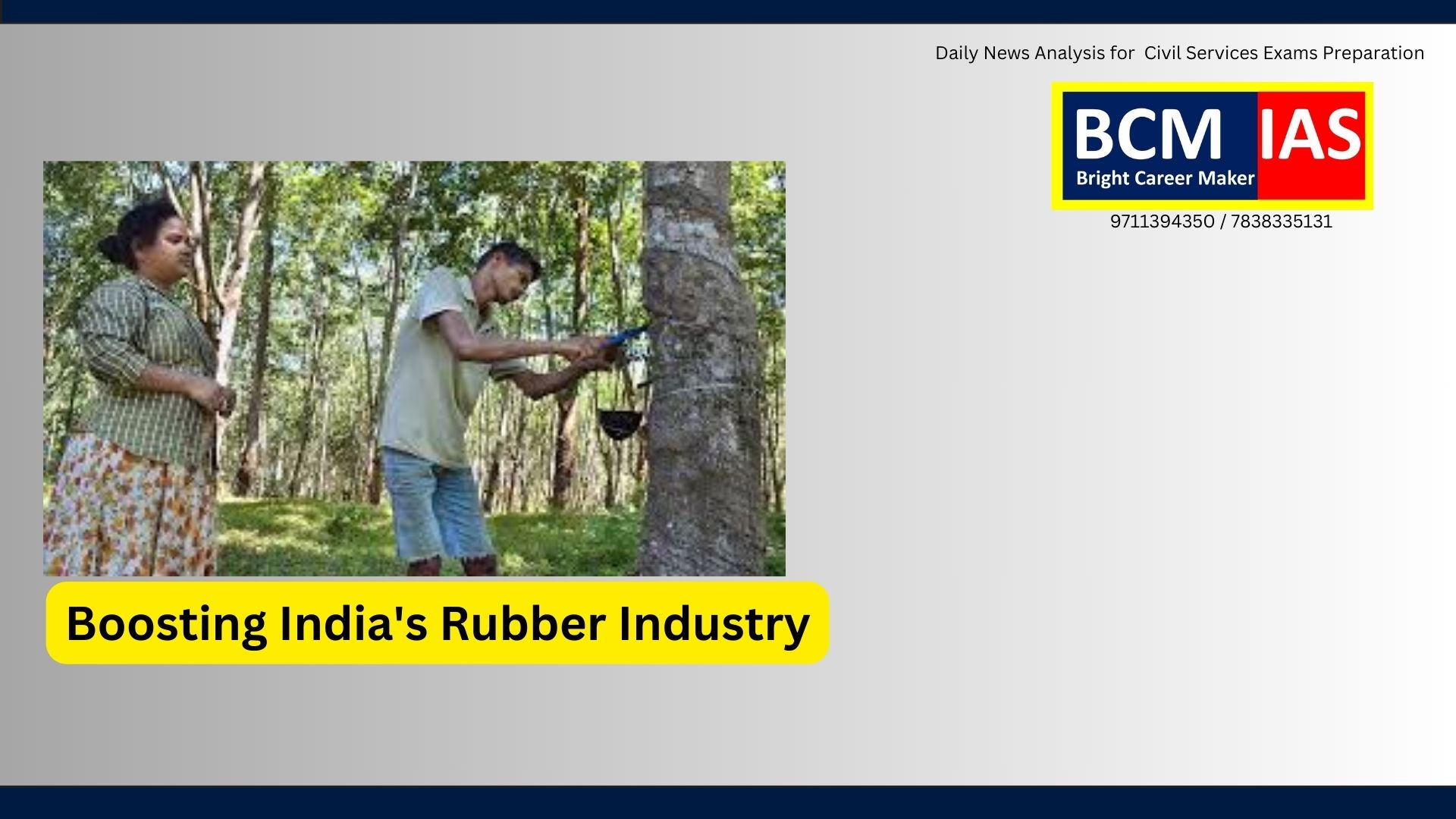
Boosting India's Rubber Industry
The article highlights the challenges and
initiatives in India's rubber industry, focusing on sustainable production,
global competitiveness, and alignment with international regulations like the European
Union Deforestation Regulation (EUDR). It also evaluates
the role of the National Rubber Policy (NRP) 2019 in
addressing these issues.
Key Issues in India's
Rubber Industry
1. Global
Challenges:
o EUDR
Compliance:
§ The European Union Deforestation
Regulation (EUDR) mandates that commodities like rubber
entering the EU market must be deforestation-free.
§ This
creates compliance burdens, especially for small and medium enterprises (SMEs),
and acts as a non-tariff
barrier, slowing India-EU Free Trade Agreement (FTA) negotiations.
o Import
Dependency:
§ India
imported over 5,28,677
tonnes of natural rubber in 2022-23, primarily from Southeast
Asia, highlighting gaps in domestic production.
o Sustainability
and Quality:
§ Global
markets demand sustainable
and traceable rubber production, which requires significant
policy and technological interventions.
2. Domestic
Challenges:
o Untapped
Plantations:
§ Approximately
20-25% of rubber
plantations in India are underutilized due to absentee
landlords and high production costs.
o Fragmented
Market:
§ Inefficient
marketing systems and price fluctuations discourage farmers from cultivating
rubber.
o Productivity
Issues:
§ Traditional
methods, lack of high-yield varieties, and limited R&D investment affect
productivity.
Recent Initiatives in
the Rubber Industry
1. Indian
Sustainable Natural Rubber (iSNR):
o Facilitates
compliance with EUDR
standards through traceability and certification of rubber
products.
o Promotes
sustainable production practices, boosting India’s global market reputation.
2. INR
Konnect Platform:
o A
web-based initiative targeting untapped plantations.
o Connects
absentee landlords with adopters to enhance plantation productivity and address
market inefficiencies.
3. mRube:
o A
digital marketing platform launched by the Rubber Board to improve trade efficiency
and market transparency.
4. Subsidy
Reforms:
o Government
plans to increase subsidies for rubber cultivation, making it economically
viable for farmers.
5. Research
and Development (R&D):
o Investment
in high-yield, disease-resistant rubber varieties and advanced agro-management
practices.
National Rubber
Policy (NRP) 2019
The NRP 2019,
launched by the Ministry of Commerce & Industry, is a comprehensive
framework aimed at strengthening the rubber value chain in India.
Key Objectives:
1.
Value Chain Development:
o Promotes
rubber cultivation, processing, and product manufacturing.
2.
Sustainability:
o Emphasizes
environmentally sustainable practices to align with global standards.
3.
Productivity Enhancement:
o Encourages
the adoption of high-yield varieties and modern farming techniques.
4.
Domestic Self-Reliance:
o Aims
to achieve 2 million
tonnes of natural rubber production by 2030.
5.
Export Promotion:
o Seeks
to position India as a global hub for rubber-based products.
Policy Interventions:
- Recognizing
natural rubber as an agricultural product to avail subsidies.
- Expanding
plantations to non-traditional regions like the Northeast.
- Strengthening
domestic manufacturing and aligning processed rubber with international
quality standards.
Way Forward
1. Compliance
with Global Standards:
o Accelerate
initiatives like iSNR to meet EUDR and other international sustainability
benchmarks.
o Introduce
government-backed certification schemes to reduce the compliance burden on
SMEs.
2. Increase
Productivity:
o Encourage
mixed farming
and promote high-yield varieties, especially in the Northeast.
o Train
farmers in efficient tapping techniques to enhance latex extraction.
3. Expand
Domestic Production:
o Develop
untapped plantations through initiatives like INR Konnect.
o Increase
R&D investment to create climate-resilient and disease-resistant rubber
varieties.
4. Market
Expansion:
o Leverage
digital platforms like mRube to connect farmers and buyers.
o Explore
new export markets to reduce reliance on traditional buyers like the EU and
U.S.
5. Resolve
Bilateral Issues:
o Address
trade barriers like EUDR in the ongoing India-EU
FTA negotiations.
Conclusion
India's rubber industry is at a critical
juncture, balancing challenges like EUDR compliance and import dependency with
opportunities for sustainable growth. Through initiatives like iSNR, INR
Konnect, and the National Rubber Policy 2019,
India is making strides to enhance domestic production, promote sustainability,
and achieve global competitiveness. However, proactive policymaking,
innovation, and international collaboration will be key to realizing the full
potential of the industry.
Mains PYQ-
Q.Why indentured labour was taken by the British from India to
other colonies? Have they been able to preserve their cultural identity over
there? (2018)
The
British took indentured laborers from India to other colonies during the 19th
and early 20th centuries to meet labor demands in sugar plantations, railways,
mines, and other industries in the Caribbean, Africa, Southeast Asia, and the
Pacific.
Reasons for Indentured Labor Migration
1.
Abolition
of Slavery:
- After slavery was abolished in
British colonies (1833), plantations faced severe labor shortages,
particularly in sugar production.
2.
Economic
Hardship in India:
- Famines, poverty, and
unemployment in India forced many to seek opportunities abroad, despite
exploitative conditions.
3.
Recruitment
Policies:
- The British established a
structured system to recruit Indian laborers, offering contracts of 5-7
years with the promise of wages, free passage, and return to India after
completion.
4.
Strategic
Use of Indians:
- Indians were seen as a cheap,
docile, and skilled workforce, making them ideal for work in colonies
like Mauritius, Fiji, Trinidad, Guyana, and South Africa.
Preservation of Cultural Identity
Despite
facing harsh working conditions and cultural alienation, Indian indentured
laborers were largely successful in preserving their cultural identity through:
1.
Religious
Practices:
- Hindus and Muslims carried their
faith abroad, building temples, mosques, and gurudwaras, which remain
vibrant centers of culture.
2.
Language
and Festivals:
- Indian languages (e.g.,
Bhojpuri, Tamil) and festivals like Diwali, Holi, and Eid became
integral parts of cultural life in these regions.
3.
Cuisine
and Clothing:
- Indian food, spices, and
traditional clothing influenced local cultures, blending into a unique
Indo-Caribbean or Indo-Fijian identity.
4.
Community
Solidarity:
- Laborers formed tight-knit
communities, ensuring the transmission of traditions, values, and social
practices to future generations.
Challenges to Cultural Identity
1.
Cultural
Assimilation:
- Over time, some communities
adopted local languages, customs, and practices, leading to dilution of
traditional Indian identity.
2.
Discrimination
and Marginalization:
- Indentured laborers often faced
racial discrimination and socio-economic marginalization, which impacted
their ability to assert their identity.
Conclusion
Indentured
labor migration from India served the British colonial agenda but laid the
foundation for vibrant Indian diasporic communities worldwide. Despite
adversities, these communities have preserved their cultural identity through
religion, language, and traditions, enriching the cultural mosaic of their
adopted countries. However, assimilation and discrimination have also posed
challenges to the unaltered preservation of their heritage.
MCQs
Question 1:
Rubber is native to which of the following regions?
a) Southeast Asia
b) Africa
c) South America
d) India
Answer: c)
South America
Question 4:
Which of the following climatic conditions is ideal for rubber cultivation?
1.
Temperature range of 20°C to 35°C
2.
Annual rainfall exceeding 200 cm
3.
Sandy soils with high salinity
Options:
a) 1 and 2 only
b) 2 and 3 only
c) 1 and 3 only
d) 1, 2, and 3
Answer: a)
1 and 2 only
Question 5:
Which of the following states is the largest producer of natural rubber in
India?
a) Tamil Nadu
b) Kerala
c) Tripura
d) Assam
Answer: b)
Kerala
Question 2:
The National Rubber Policy 2019 aims to:
1.
Expand rubber plantations to non-traditional
areas.
2.
Recognize rubber as an agricultural product
for subsidy benefits.
3.
Promote export of rubber-based products.
Options:
a) 1 and 2 only
b) 2 and 3 only
c) 1 and 3 only
d) 1, 2, and 3
Answer: d)
1, 2, and 3
Question 3:
Match List-I with List-II and select the correct answer using the code given
below:
List-I
(Board) | List-II
(Headquarters)
A. Coffee Board | 1. Bengaluru
B. Rubber Board | 2. Kottayam
C. Tea Board | 3. Kolkata
D. Tobacco Board | 4. Guntur
Code:
a) 1 2 3 4
b) 1 3 2 4
c) 1 2 4 3
d) 4 1 3 2
Answer: b)
1 3 2 4


Comments on “Boosting India's Rubber Industry”