


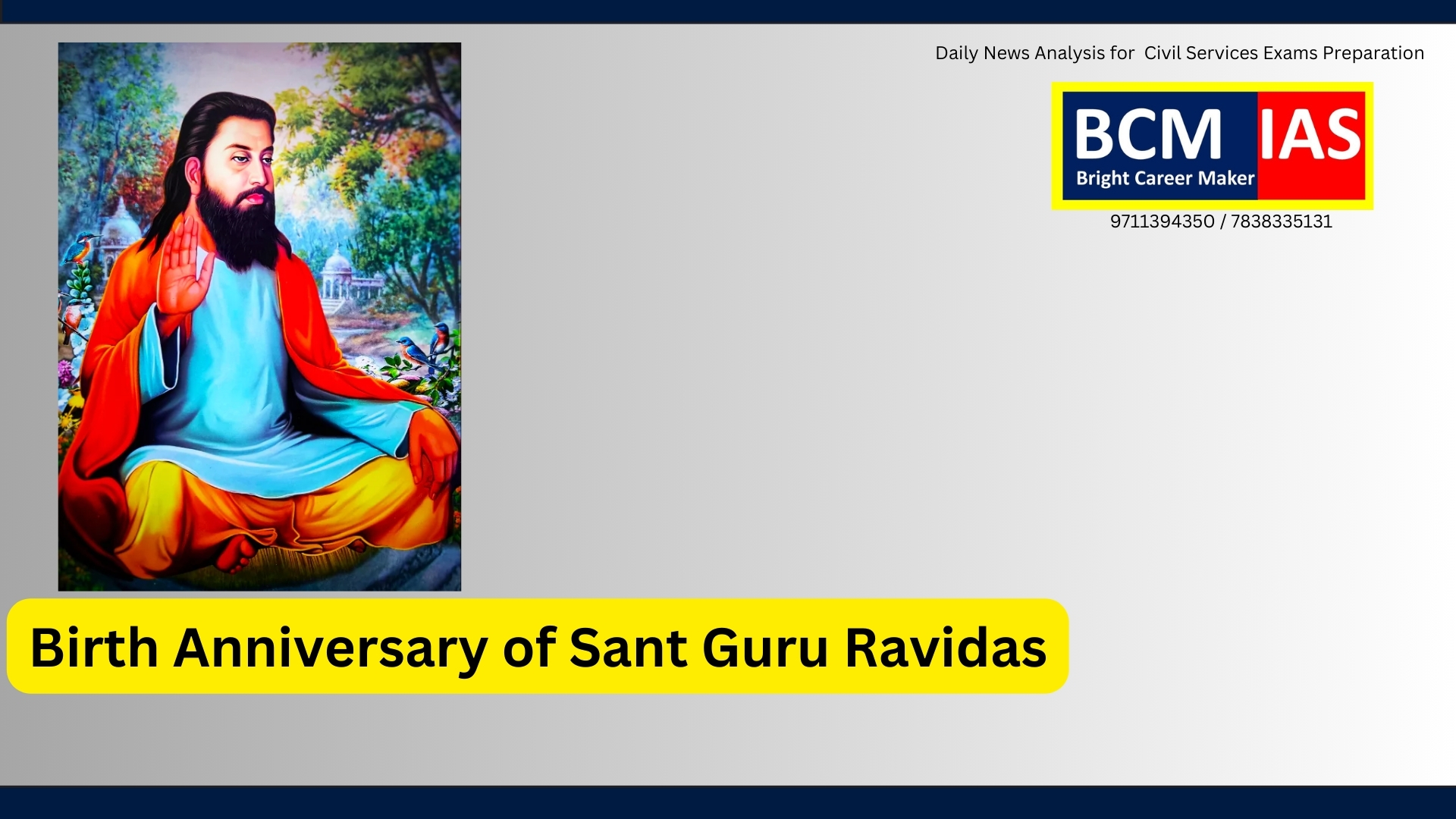
Birth Anniversary of Sant Guru Ravidas
The 648th
birth anniversary of Sant Guru Ravidas is an
important event that highlights the Bhakti
Movement’s impact on Indian society,
particularly in promoting social equality,
spiritual devotion, and anti-caste ideologies. Sant
Guru Ravidas, a prominent Bhakti saint and social
reformer, played a key role in challenging
caste hierarchies and emphasizing the ideals of human dignity, devotion, and
egalitarianism. His teachings remain
significant in regions like Punjab, Himachal
Pradesh, and Haryana, particularly among the Ravidassia
Dalit community.
1. Who Was Sant Guru Ravidas?
A. Early Life and Background
- Born
in 1377 CE in Seer Goverdhanpur, Uttar Pradesh.
- Belonged
to a marginalized
caste, which influenced his focus on equality and social justice.
- Known
by various names, including Raidas,
Rohidas, and Ruhidas.
B. Spiritual and Social
Contributions
- He
was a Bhakti poet and
saint whose hymns
and philosophical verses are included in the Guru Granth Sahib.
- He
was Meera Bai’s
spiritual guide, influencing devotional traditions.
- Advocated
for human dignity,
social justice, and spiritual enlightenment, rejecting
caste-based discrimination.
- His
doctrine of Begumpura
envisioned a society
free of caste, suffering, and inequality.
C. Cultural and Regional
Significance
- His
birth anniversary is widely celebrated, especially in Punjab, Haryana, and Himachal
Pradesh.
- The
Doaba region of
Punjab has a significant Ravidassia Dalit community that
follows his teachings.
2. The Bhakti Movement and Its
Influence
A. Origins and Spread
- A
spiritual and social
reform movement (7th–17th century CE) that emphasized devotion (bhakti) to a personal god,
rejecting rituals and
caste-based hierarchies.
- Influenced
Hinduism, Sikhism,
and Sufism, bridging religious and social gaps.
B. Key Bhakti Saints
- North
India: Kabir, Guru Nanak, Meera Bai,
Surdas, and Tulsidas.
- South
India: Alvars and Nayanars (Tamil Nadu),
Ramanuja, Basava, and Purandaradasa.
C. Legacy of the Bhakti
Movement
- Encouraged
spiritual democracy,
where anyone,
irrespective of caste or gender, could worship directly.
- Reduced
Brahmanical dominance by opposing ritualistic Hinduism.
- Played
a role in shaping
Sikhism, with Guru Ravidas’s hymns becoming part of the Guru Granth Sahib.
3. Analysis of Sant Guru
Ravidas’s Relevance Today
A. Social Reforms and Dalit
Empowerment
- His
teachings continue to inspire Dalit
rights movements.
- The
Ravidassia community
in Punjab upholds his anti-caste
ideology and spiritual vision.
- Political
parties often recognize his legacy
during elections, highlighting his contribution to social justice.
B. Interfaith Influence
- His
works bridge Hindu
and Sikh traditions, fostering religious harmony.
- His
philosophy of
universal brotherhood is relevant in contemporary debates
on social inclusivity.
C. Modern Celebrations and
Political Significance
- His
birth anniversary is
a major event in North India, with political leaders
paying tribute to his legacy.
- The
celebration reinforces
the importance of Bhakti saints in shaping India's socio-religious fabric.
4. Conclusion
Sant Guru Ravidas’s teachings
remain deeply relevant in contemporary India,
particularly in the context of social
justice, caste equality, and spiritual devotion.
His philosophy of Begumpura
envisions an ideal society free from
discrimination and oppression, resonating with modern
democratic values. As a key figure in the Bhakti
Movement, his influence extends across Hindu,
Sikh, and Dalit traditions, reinforcing the
enduring impact of Bhakti saints in Indian history and
society.
MCQs
1. Sant Guru Ravidas was
associated with which of the following movements?
(a) Arya Samaj Movement
(b) Bhakti Movement
(c) Aligarh Movement
(d) Vaishnavite Movement
Answer: (b)
Bhakti Movement
Explanation:
Sant Guru Ravidas was a prominent saint of the Bhakti
Movement, which emphasized devotion
to a personal god, social equality, and rejection of caste-based hierarchies.
2. Which of the following
statements about Sant Guru Ravidas is correct?
1.
His
hymns are included in the Guru Granth Sahib.
2.
He was
a spiritual guide to Meera Bai.
3.
He was
born in the 11th century in Maharashtra.
(a) 1 and 2 only
(b) 2 and 3 only
(c) 1 and 3 only
(d) 1, 2, and 3
Answer: (a) 1
and 2 only
Explanation:
Sant Guru Ravidas's hymns are included in the Guru
Granth Sahib, and he was the spiritual
guide of Meera Bai. However, he was born in 1377
CE in Uttar Pradesh, not in Maharashtra.
3. The concept of
"Begumpura," as preached by Guru Ravidas, refers to:
(a) A utopian city without
sorrow and discrimination
(b) A new form of devotional singing
(c) A method of religious fasting
(d) A traditional temple worship system
Answer: (a) A
utopian city without sorrow and discrimination
Explanation:
Guru Ravidas envisioned "Begumpura"
as a society free from caste discrimination,
sorrow, and suffering, reflecting his egalitarian
and social justice ideals.
4. Which of the following
regions has a significant Ravidassia community that follows the teachings of
Sant Guru Ravidas?
(a) Kerala and Tamil Nadu
(b) Punjab and Himachal Pradesh
(c) Odisha and West Bengal
(d) Madhya Pradesh and Rajasthan
Answer: (b)
Punjab and Himachal Pradesh
Explanation:
The Doaba region of Punjab
and parts of Himachal Pradesh
have a significant Ravidassia Dalit community,
which adheres to Guru Ravidas’s teachings.
5. Which of the following
statements about the Bhakti Movement is correct?
1.
It
opposed caste discrimination and emphasized devotion to a personal god.
2.
It
influenced Hinduism, Sikhism, and Sufism.
3.
It
originated in the 19th century as a response to colonial rule.
(a) 1 and 2 only
(b) 2 and 3 only
(c) 1 and 3 only
(d) 1, 2, and 3
Answer: (a) 1
and 2 only
Explanation:
The Bhakti Movement
emphasized devotion, equality, and rejection of
caste barriers. It influenced Hinduism,
Sikhism, and Sufism. However, it originated
between the 7th and 17th centuries, much
earlier than colonial rule.


Comments on “Birth Anniversary of Sant Guru Ravidas”