


Daily Current Affairs Analysis
11 June 2024
-------------------------------------------------------------------------------------------------------------
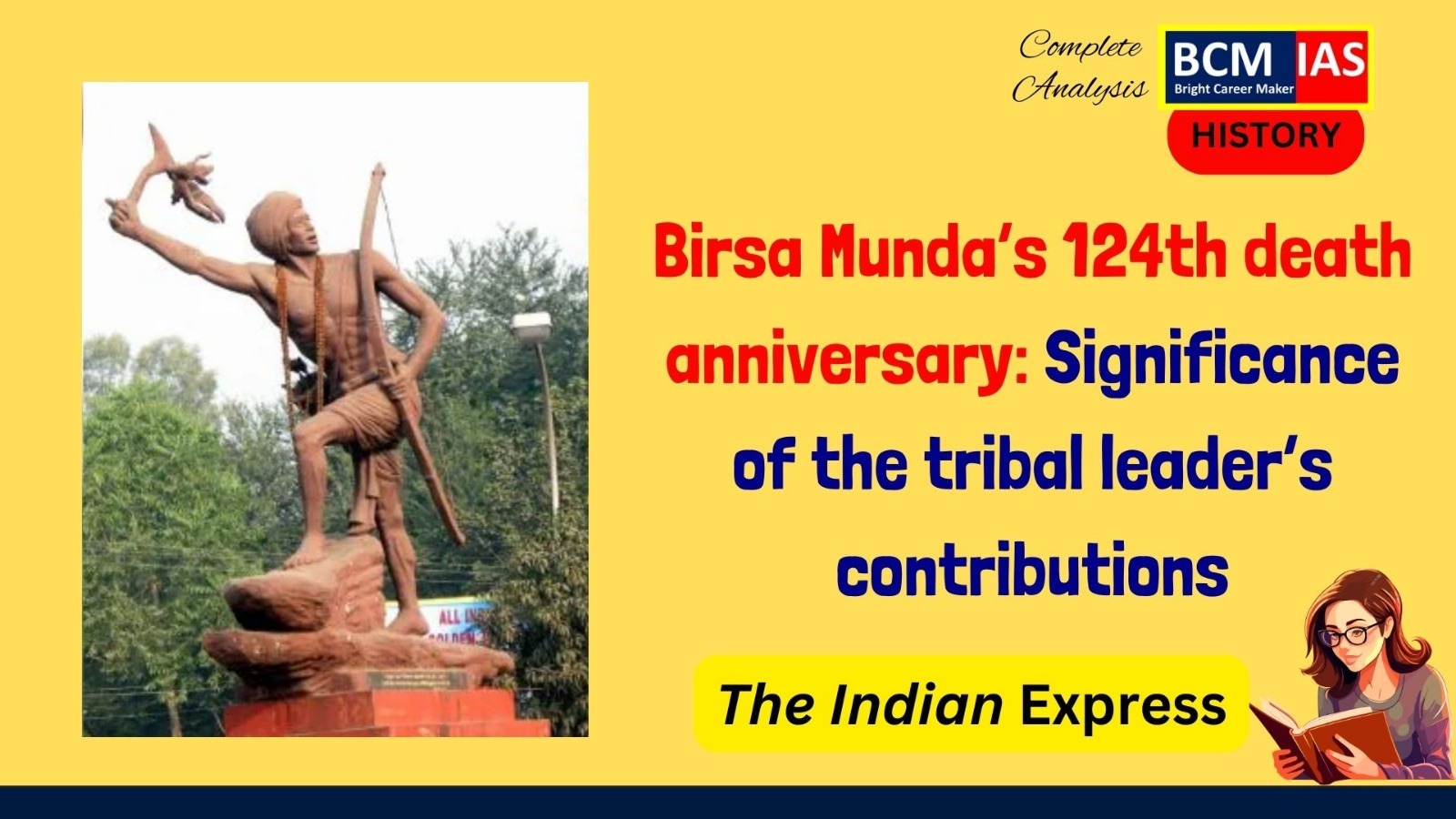
Birsa Munda’s 124th death anniversary: Significance
of the tribal leader’s contributions
Meaning of Headline-
·
This headline commemorates the 124th death anniversary of Birsa
Munda, highlighting his importance as a tribal leader who played a crucial role
in the early resistance against British colonial rule in India.
·
It underscores his contributions to the tribal community, including
his fight against oppressive British policies, his efforts to protect
indigenous land rights, and his enduring legacy as a symbol of tribal identity
and resistance.
Related Topic (as per UPSC
Syllabus)
Prelims:
- History of India: Modern Indian
history from about the middle of the eighteenth century until the present-
significant events, personalities, issues.
- Indian National Movement: The Freedom
Struggle – its various stages and important contributors/contributions
from different parts of the country.
Mains:
- General Studies
Paper I:
o
Indian Heritage and Culture, History and
Geography of the World and Society: Modern
Indian history from about the middle of the eighteenth century until the
present- significant events, personalities, issues.
o
The Freedom Struggle – its various stages and important contributors/contributions from
different parts of the country.
- General Studies
Paper II:
o
Governance, Constitution, Polity, Social
Justice and International relations: Issues
relating to development and management of Social Sector/Services relating to
Health, Education, Human Resources.
- General Studies
Paper III:
o
Economic Development, Biodiversity,
Environment, Security and Disaster Management: Inclusive growth and issues arising from
it.
Interview:
- Questions related to Birsa Munda’s contributions, tribal movements
in India, colonial impact on indigenous communities, and the significance
of preserving tribal heritage.
News
Analysis
Introduction
Birsa Munda, a revered tribal leader,
played a crucial role in the early resistance against British colonial rule in
India. His efforts to mobilize the tribal community and his legacy continue to
inspire and hold significant relevance today. Marking his 124th death
anniversary, we reflect on his life, the struggles he led, and the lasting
impact of his contributions.
Early Life and Background
- Birth and Early Years: Birsa Munda was born on November 15, 1875, in
the Chotanagpur region, which is now part of Jharkhand. His early life was
marked by the upheavals faced by his community due to British colonial
policies.
- Khuntkatti System: Before colonial rule, the Mundas practiced the 'khuntkatti'
system of land ownership, which was based on customary rights and communal
landholding without landlords.
Impact of Colonial Policies
- Permanent Settlement Act (1793): The British
introduced the zamindari system, transforming land ownership and revenue
collection methods. This resulted in the displacement of indigenous people
and the emergence of 'dikus' (outsiders) as landlords.
- Economic Exploitation: The Munda community suffered under various
oppressive policies, including forced labor ('begar'), dependence on
moneylenders, and replacement of traditional clan councils with British
courts.
- Famines and Starvation: The famines of 1896-97 and 1899-1900 exacerbated
the suffering of the tribal communities, leading to widespread starvation.
Rise of Birsa Munda
- Education and Early Influences: Birsa received
his primary education under Jaipal Nag and briefly converted to
Christianity to attend the German Mission school. However, he soon left
the school, disillusioned by the missionary activities.
- Sardari Agitation: His time in Chaibasa exposed him to the peaceful Sardari
agitation against British rule, which influenced his anti-colonial and
anti-missionary stance.
Birsa Munda as a Leader
- Formation of Birsait Sect: Birsa emerged as a charismatic leader,
advocating against superstitions, begging, and animal sacrifices. He
encouraged his followers to worship one God and resist colonial and
missionary influence.
- God-like Status: Revered as 'Bhagwan' (God) and 'Dharti ka Abba' (father of the
earth), Birsa's leadership galvanized the tribal community.
Ulgulan Movement
- Launch of Ulgulan (The Great Tumult): In 1899, Birsa
led the Ulgulan movement, a guerrilla warfare campaign aimed at expelling
British authorities and reclaiming tribal rights.
- Tactics and Goals: He urged the tribals to reject colonial laws and rent payments,
promoting the idea of Birsa Raj (Birsa's rule).
- Suppression and Arrest: The movement was eventually suppressed by the
British. Birsa was arrested on March 3, 1900, and died in jail on June 9,
1900, at the age of 25.
Legacy and Impact
- Legislative Changes: Birsa Munda's movement led to significant legislative changes.
The government repealed the begar system and enacted the Tenancy Act
(1903), recognizing the khuntkatti system. The Chotanagpur Tenancy Act
(1908) further protected tribal land rights by prohibiting the transfer of
tribal land to non-tribals.
- Symbol of Resistance: Birsa Munda remains a symbol of tribal resistance and
empowerment. His life and struggles continue to inspire contemporary
movements for indigenous rights and social justice.
Conclusion
Birsa Munda's contributions to the early
resistance against British colonialism and his efforts to protect tribal land
rights have left an indelible mark on Indian history. His legacy as a leader,
reformer, and symbol of tribal identity continues to resonate, underscoring the
enduring significance of his struggle for justice and autonomy. For UPSC IAS
aspirants, studying Birsa Munda's life offers valuable insights into the
dynamics of colonial resistance and the socio-political fabric of tribal
communities in India.
Mains Probable Question
Question: Discuss the significance of Birsa Munda’s
contributions to the early resistance against British colonial rule and the
impact on tribal communities.
Answer Structure for
UPSC Civil Services Mains Exam
1. Introduction
Birsa Munda, a tribal leader born on
November 15, 1875, in the Chotanagpur region, is a revered figure in Indian
history. His struggle against British colonial rule and the oppressive policies
that targeted tribal communities marked him as a revolutionary. Birsa's life
and legacy are significant not only for the tribal communities of Jharkhand but
also for the broader Indian independence movement. His contributions,
particularly through the Ulgulan movement, laid the foundation for the
recognition and protection of tribal rights in India.
2. Demand of the Question
The demand of the question is to
analyze the significance of Birsa Munda's contributions to the early resistance
against British colonial rule and their impact on tribal communities. This
involves discussing his role in mobilizing the tribal population, his fight
against colonial exploitation and missionary influence, and the broader
implications of his actions on the socio-political landscape of the time.
Mobilization and Leadership
- Emergence as a Leader: Birsa
Munda emerged as a prominent leader at a young age, rallying the tribal
communities against British exploitation. His ability to unify various
tribes under a common cause was a remarkable achievement in itself.
- Formation of Birsait Sect: Birsa
established the Birsait sect, which played a crucial role in mobilizing
the tribal population against colonial rule. His advocacy against
superstitions and social reforms within the community helped strengthen
the movement.
- Resistance through Ulgulan Movement: The
Ulgulan movement, launched by Birsa Munda in 1899, was a significant
uprising aimed at overthrowing British authority. Utilizing guerrilla
warfare tactics, Birsa and his followers resisted the British forces,
emphasizing the need for self-governance and rejection of colonial laws.
Impact on Tribal Communities
- Land Rights and Khuntkatti System: One of
the key issues Birsa Munda fought for was the protection of tribal land
rights. The British zamindari system displaced many tribal communities
from their ancestral lands. Birsa's movement emphasized the restoration of
the khuntkatti system, a traditional form of land ownership that
recognized communal rights.
- Legislative Changes: The
Ulgulan movement led to significant legislative changes. The British
government repealed the begar system of forced labor and enacted the
Tenancy Act (1903) and the Chotanagpur Tenancy Act (1908), which
recognized and protected tribal land rights.
- Cultural and Social Reforms: Birsa
Munda's efforts extended beyond political resistance. He urged his
followers to abandon superstitions, avoid begging, and reject animal
sacrifices. These reforms aimed at strengthening the social fabric of the
tribal communities and fostering a sense of unity and identity.
3. Way Forward
Recognizing Tribal Contributions
- Historical Recognition: It is
crucial to ensure that the contributions of tribal leaders like Birsa
Munda are adequately recognized in historical narratives. This involves
including their stories in educational curricula and public
commemorations.
- Preservation of Heritage:
Efforts should be made to preserve the cultural and historical heritage of
tribal communities. This includes protecting traditional practices,
languages, and art forms that are integral to their identity.
Policy and Legislative Support
- Land Rights Protection:
Continued vigilance is needed to protect the land rights of tribal
communities. Policies should be designed to prevent land alienation and
ensure that tribal lands are not usurped by non-tribal entities.
- Social and Economic Development: There
should be a focused approach to improving the living standards of tribal
communities. This includes providing better access to education,
healthcare, and employment opportunities while respecting their cultural
practices.
Empowerment and Participation
- Political Representation:
Ensuring adequate political representation of tribal communities at
various levels of government can empower them to advocate for their rights
and interests.
- Community Involvement:
Development programs should involve the active participation of tribal
communities. Their input and consent are essential for the success and
sustainability of such initiatives.
Conclusion
Birsa Munda's legacy as a tribal
leader and revolutionary continues to inspire and guide efforts towards the
empowerment and development of tribal communities in India. His fight for land
rights, cultural preservation, and social reform laid the groundwork for future
movements and legislative changes that protect tribal interests. Recognizing
and building upon his contributions is essential for fostering an inclusive and
equitable society that respects and upholds the rights and heritage of its
indigenous populations.
MCQs for Prelims Practice
Question:
Which of the following systems of land ownership was prevalent among the Munda
tribe before British colonial rule?
1. Zamindari System
2. Ryotwari System
3. Khuntkatti System
4. Mahalwari System
Answer: 3.
Khuntkatti System
Explanation: The
Khuntkatti system was a traditional form of land ownership among the Munda
tribe, based on customary rights without landlords. This communal landholding
system was replaced by the British with the zamindari system under the
Permanent Settlement Act (1793), which led to the displacement of indigenous
people.
MCQ 2
Question:
Birsa Munda is associated with which of the following movements?
1. Non-Cooperation Movement
2. Civil Disobedience Movement
3. Ulgulan Movement
4. Quit India Movement
Answer: 3. Ulgulan
Movement
Explanation: Birsa Munda
launched the Ulgulan Movement (The Great Tumult) in 1899 to resist British
colonial rule and reclaim tribal land rights. This movement utilized guerrilla
warfare tactics and aimed to establish self-governance for the tribal
communities.
MCQ 3
Question:
What was the primary aim of the Chotanagpur Tenancy Act of 1908?
1. To enforce land revenue collection from tribals
2. To ban the transfer of tribal land to non-tribals
3. To convert tribals to Christianity
4. To implement the zamindari system in tribal areas
Answer: 2. To ban
the transfer of tribal land to non-tribals
Explanation: The
Chotanagpur Tenancy Act of 1908 was enacted to protect the land rights of
tribal communities by prohibiting the transfer of tribal land to non-tribals.
This was a significant legislative change influenced by the Ulgulan Movement
led by Birsa Munda.
MCQ 4
Question:
Which of the following statements about Birsa Munda is NOT correct?
1. He was born in the Chotanagpur region.
2. He converted to Christianity to join a German Mission school.
3. He led the Civil Disobedience Movement against British rule.
4. He advocated against superstitions and animal sacrifice among his
followers.
Answer: 3. He led
the Civil Disobedience Movement against British rule.
Explanation: The Civil
Disobedience Movement was led by Mahatma Gandhi in the 1930s. Birsa Munda, on
the other hand, led the Ulgulan Movement in 1899 against British colonial rule,
advocating for tribal rights and reforms within his community.
MCQ 5
Question:
What significant legislative change occurred as a result of Birsa Munda's
Ulgulan Movement?
1. Introduction of the Ryotwari System
2. Enactment of the Permanent Settlement Act
3. Repeal of the begar system
4. Implementation of the Forest Rights Act
Answer: 3. Repeal
of the begar system
Explanation: The Ulgulan Movement led by Birsa Munda brought significant attention to the exploitation of tribal communities under the begar system (forced labor). As a result, the British government repealed the begar system and introduced the Tenancy Act of 1903 and the Chotanagpur Tenancy Act of 1908 to protect tribal land rights.


Comments on “Birsa Munda’s 124th death anniversary: Significance of the tribal”