


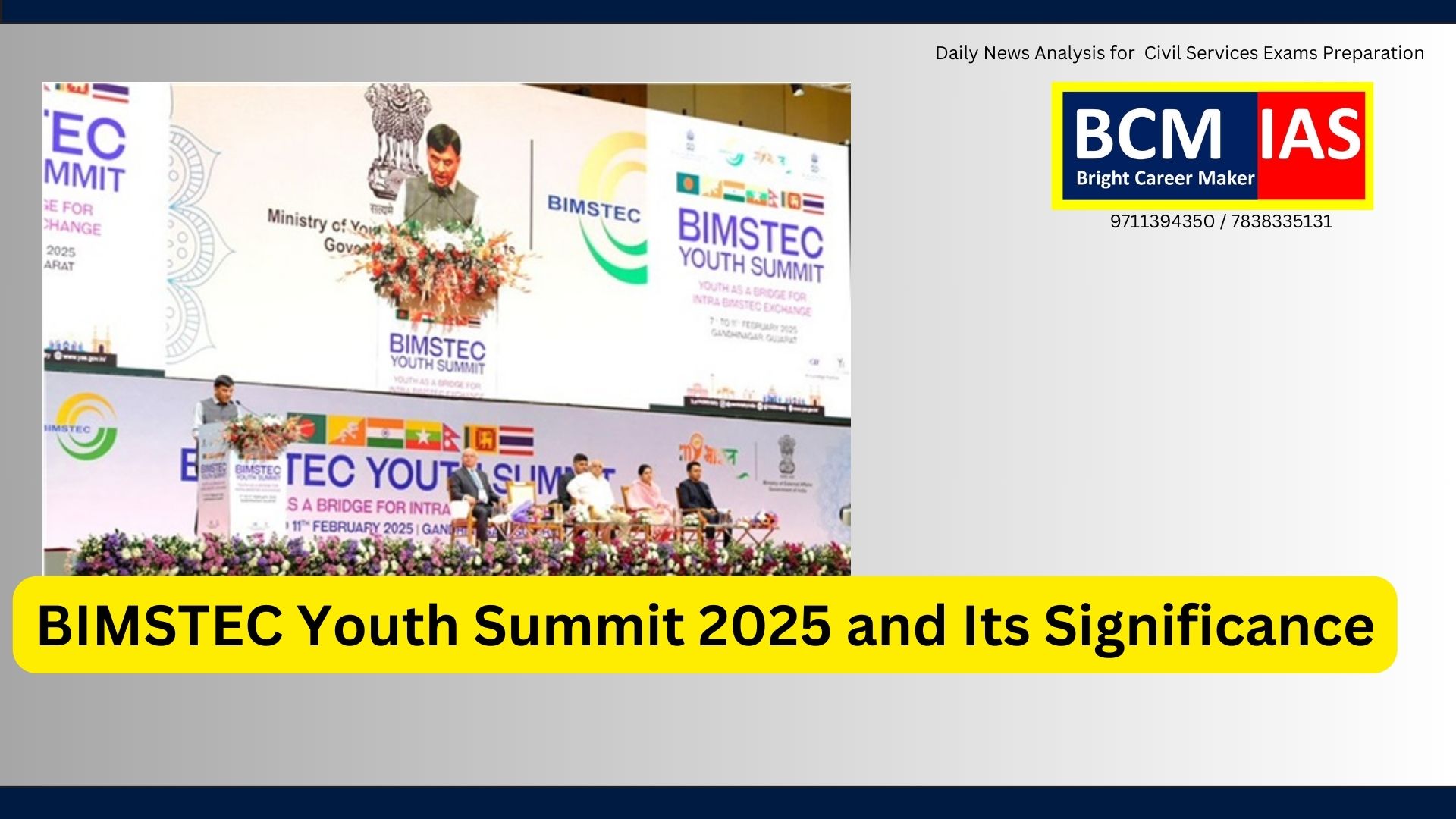
BIMSTEC Youth Summit 2025 and
Its Significance
1. Introduction
The first-ever BIMSTEC Youth Summit 2025, held in Gandhinagar,
Gujarat, underscores the growing importance of youth engagement in
regional cooperation. With over 60% of BIMSTEC’s 1.8 billion population
being youth, the summit focused on skill development, entrepreneurship,
and fostering regional partnerships.
The event aligns with India's long-term vision of becoming
a developed nation by 2047, leveraging its startup ecosystem, digital
transformation, and youth-centric policies.
2. Understanding BIMSTEC: An Overview
(A) What is BIMSTEC?
- Full
Form: Bay of
Bengal Initiative for Multi-Sectoral Technical and Economic Cooperation
(BIMSTEC)
- Established: 1997
- Member
Countries: India,
Bangladesh, Myanmar, Sri Lanka, Thailand, Nepal, Bhutan
- Headquarters: Dhaka, Bangladesh
- Objective: Strengthening economic,
security, and regional cooperation in the Bay of Bengal region.
(B) Why is BIMSTEC
Important?
- Bridges
South Asia and Southeast Asia through maritime and trade connectivity.
- Focuses
on climate change, poverty reduction, economic integration, and regional
security.
- Acts
as an alternative to SAARC, which has been affected by regional
tensions.
3. Key Highlights of BIMSTEC Youth Summit 2025
(A) Theme: "Youth
as a Bridge for Intra-BIMSTEC Exchange"
- Emphasized
the role of youth in strengthening cooperation across BIMSTEC
nations.
- Encouraged
education, research collaboration, and cultural exchange programs.
(B) Focus Areas
1.
Skill Development & Digital Training
o India showcased
its Skill India Mission, which has trained 15 million youth in AI,
robotics, and digital technologies.
o Promotes vocational
education and skill exchange programs within BIMSTEC.
2.
Entrepreneurship and Startup Growth
o India
proposed a BIMSTEC-wide startup network to foster innovation and business collaboration.
o India's
startup ecosystem is the world's third-largest, with 157,000 startups,
nearly 50% women-led.
3.
India’s Vision 2047: Developed Nation Roadmap
o India stressed
that youth empowerment is central to achieving its goal of becoming a
developed economy by 2047.
o Encourages
investment in education, R&D, and digital entrepreneurship.
4. Significance of the BIMSTEC Youth Summit
(A) Economic Growth
& Employment Generation
- Encourages
collaboration in tech-driven startups, e-commerce, and digital markets.
- Strengthens
cross-border job opportunities and labor mobility in BIMSTEC.
(B) Strengthening
Regional Connectivity
- Enhances
people-to-people exchanges through youth programs, education
partnerships, and scholarships.
- Encourages
digital infrastructure growth, including cross-border payment
systems and e-governance cooperation.
(C) Boosting Innovation
& Entrepreneurship
- The proposed
BIMSTEC Startup Network can create a regional ecosystem for
funding, mentorship, and business incubation.
- Facilitates
technology transfer and R&D collaborations in renewable
energy, AI, and space technology.
(D) Climate Change &
Sustainability
- Encourages
youth participation in sustainable initiatives like green
startups, carbon reduction, and climate resilience projects.
- BIMSTEC
countries face climate vulnerabilities such as rising sea levels
and natural disasters, making youth-driven solutions crucial.
5. India's Leadership in BIMSTEC & Future
Prospects
(A) India’s Role in
BIMSTEC Youth Empowerment
- National
Education Policy (NEP) 2020 promotes global research collaboration and
innovation.
- PM
Internship Scheme facilitates industry exposure and career development.
- India’s
digital infrastructure (UPI, Aadhaar, Digital India) can be extended to BIMSTEC
nations.
(B) Strengthening
BIMSTEC for Regional Stability
- Enhanced
trade & investment partnerships can reduce dependence on other economic blocs.
- Youth-led
diplomacy and cultural exchanges can bridge geopolitical divides.
(C) Next Steps for
BIMSTEC Youth Engagement
- Establish
a permanent BIMSTEC Youth Forum for policy dialogues and joint
programs.
- Expand
digital skilling initiatives to prepare youth for future-ready
jobs.
- Strengthen
student exchange programs & scholarships to foster academic
collaboration.
6. Conclusion
The BIMSTEC Youth Summit 2025 marks a strategic
shift in regional cooperation by placing youth at the center of economic
growth and innovation. India’s leadership in skill development,
startups, and technology-driven entrepreneurship can strengthen regional
economic ties.
Going forward, a structured approach toward youth-centric
policies will ensure that BIMSTEC evolves into a dynamic economic and
geopolitical force in Asia.
UPSC Mains Probable Question
"The BIMSTEC Youth
Summit 2025 highlights the role of youth in strengthening regional cooperation.
Analyze the significance of youth-led economic and technological initiatives in
fostering regional stability and development among BIMSTEC nations."
(250 words)
Answer
Introduction
The first-ever BIMSTEC Youth Summit 2025, held in Gandhinagar,
India, emphasized the role of youth in economic growth,
entrepreneurship, and regional cooperation. With over 60% of BIMSTEC’s
1.8 billion population being youth, their engagement is crucial in driving
innovation, economic development, and regional stability.
1. Importance of
Youth-Led Initiatives in BIMSTEC Development
(A) Economic Growth and Job Creation
- Youth-led
startups and innovation hubs can enhance employment
opportunities and industrial growth.
- The proposed
BIMSTEC Startup Network will enable cross-border entrepreneurship,
trade, and investment.
(B) Digital Transformation and Technological Innovation
- India’s
Skill India Mission and digital skilling programs have trained 15
million youth in AI, robotics, and data science, which can be extended
to other BIMSTEC nations.
- Cross-country
collaboration in digital payments, e-commerce, and AI-driven businesses
can strengthen regional digital connectivity.
(C) Strengthening Regional Stability through Youth Diplomacy
- Educational
and cultural exchange programs promote people-to-people ties and diplomatic trust.
- Engaging
youth in policy-making, leadership programs, and climate initiatives
can prevent radicalization and political instability.
(D) Climate Change Resilience and Sustainability
- BIMSTEC
nations face climate risks such as rising sea levels and extreme
weather.
- Youth-led
green startups and sustainability projects can promote clean
energy adoption, afforestation, and disaster management solutions.
2. India’s Role in
Leading Youth-Centric BIMSTEC Growth
(A) Policy and Institutional Support
- National
Education Policy (NEP) 2020 promotes research, entrepreneurship, and global
education ties.
- PM
Internship Scheme provides industry exposure, fostering youth leadership and skill
development.
(B) Enhancing Startups and Innovation Networks
- India’s
third-largest startup ecosystem (157,000 startups) can act as a mentor
for BIMSTEC nations.
- Women-led
enterprises,
constituting nearly 50% of India’s startups, can be promoted across
BIMSTEC countries.
(C) Expanding Digital and Infrastructure Connectivity
- India’s
Digital Public Infrastructure (DPI), UPI, Aadhaar, and fintech
solutions can be integrated into BIMSTEC economies.
- Strengthening
regional digital trade will enhance economic integration.
3. Challenges in
Youth-Led Regional Development
- Limited
funding and mentorship for startups across developing BIMSTEC nations.
- Political
instability in Myanmar and Bangladesh affects economic cooperation.
- Lack
of a formalized BIMSTEC youth policy framework for structured engagement.
4. Way Forward
(A) Institutionalizing a BIMSTEC Youth Forum
- Establish
a permanent BIMSTEC Youth Forum to drive policy discussions and
networking.
(B) Enhancing Funding and Skill Development
- Launch
regional investment funds for youth-led enterprises.
- Expand
digital skill training in AI, robotics, and climate-tech solutions.
(C) Strengthening Cultural and Educational Exchanges
- Increase
student exchange programs and joint R&D centers to foster innovation.
- Promote
BIMSTEC-wide scholarships for leadership and skill training.
Conclusion
Youth engagement is a critical driver of economic
integration, innovation, and regional stability among BIMSTEC nations.
Through entrepreneurship, digital skilling, and climate action, young
leaders can shape BIMSTEC’s transformation into a dynamic economic and
technological powerhouse. Strengthening institutional support, funding
mechanisms, and policy coordination will ensure sustainable youth-led
development in the region.
MCQs
Q1. With reference to
the BIMSTEC Youth Summit 2025, consider the following statements:
1.
It was held in Dhaka, Bangladesh, and focused on
climate resilience and economic integration.
2.
The summit aimed to promote youth entrepreneurship and
regional cooperation among BIMSTEC member states.
3.
India proposed the establishment of a BIMSTEC-wide
startup network to boost innovation.
Which of the statements given above is/are correct?
(a) 1 and 2 only
(b) 2 and 3 only
(c) 1 and 3 only
(d) 1, 2, and 3
Answer: (b) 2 and 3 only
Explanation: The BIMSTEC Youth Summit 2025 was held in Gandhinagar,
Gujarat (India), not Dhaka. It focused on youth entrepreneurship, skill
development, and regional cooperation.
Q2. Which of the
following countries are members of BIMSTEC?
1.
India
2.
Bangladesh
3.
Nepal
4.
Thailand
5.
Afghanistan
Select the correct answer using the codes given below:
(a) 1, 2, 3, and 5 only
(b) 1, 2, 3, and 4 only
(c) 2, 3, 4, and 5 only
(d) 1, 3, 4, and 5 only
Answer: (b) 1, 2, 3, and 4 only
Explanation: BIMSTEC members include India, Bangladesh, Nepal,
Thailand, Myanmar, Sri Lanka, and Bhutan. Afghanistan is not a BIMSTEC
member.
Q3. Consider the
following initiatives and their objectives:
1.
Skill India Mission – Focuses on providing vocational training and
employment opportunities.
2.
PM Internship Scheme – Aims to train students in AI, robotics, and digital
technologies.
3.
BIMSTEC Startup Network – Proposed by India to foster
entrepreneurship in the BIMSTEC region.
Which of the above initiatives were discussed at the BIMSTEC
Youth Summit 2025?
(a) 1 and 2 only
(b) 2 and 3 only
(c) 1 and 3 only
(d) 1, 2, and 3
Answer: (d) 1, 2, and 3
Explanation: All three initiatives were highlighted at the BIMSTEC
Youth Summit 2025, with India emphasizing skill development, digital
training, and startup ecosystem expansion.
Q4. What is the primary
focus of the BIMSTEC Youth Summit 2025?
(a)
Strengthening security cooperation among BIMSTEC nations.
(b) Promoting youth-led entrepreneurship, digital innovation, and skill
development.
(c) Enhancing trade agreements between BIMSTEC countries.
(d) Increasing foreign direct investment (FDI) inflows into the Bay of
Bengal region.
Answer: (b) Promoting youth-led entrepreneurship, digital innovation, and
skill development.
Explanation: The BIMSTEC Youth Summit 2025 was primarily focused
on enhancing youth participation in startups, skill development, and
economic collaboration.
Q5. Which of the
following best describes the role of BIMSTEC as a regional organization?
(a)
BIMSTEC is a South Asian trade bloc focusing only on economic cooperation.
(b) BIMSTEC is a regional organization that promotes cooperation in
areas such as trade, climate change, and security among member states.
(c) BIMSTEC primarily deals with maritime security and defense
collaboration among Bay of Bengal countries.
(d) BIMSTEC functions as a subgroup within ASEAN for regional economic
development.
Answer: (b) BIMSTEC is a regional organization that promotes cooperation in
areas such as trade, climate change, and security among member states.
Explanation: BIMSTEC is a multi-sectoral regional cooperation
platform focusing on trade, technology, security, environment, and
cultural ties among South and Southeast Asian countries.


Comments on “BIMSTEC Youth Summit 2025 and Its Significance”