


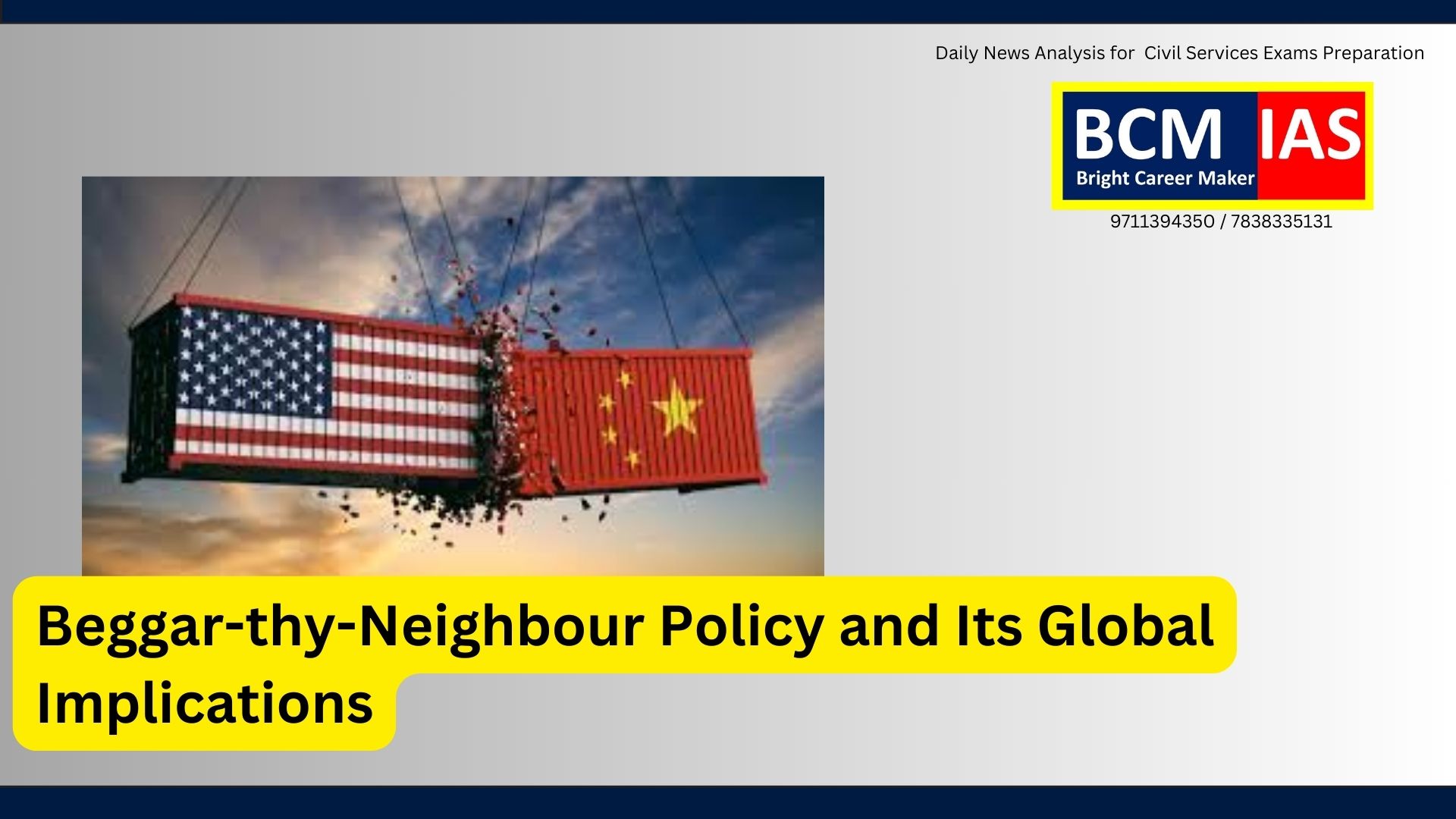
Beggar-thy-Neighbour Policy and Its Global Implications
1. Introduction
The Beggar-thy-Neighbour Policy refers to protectionist
economic measures that benefit one country at the expense of others.
The recent U.S. tariffs on China, Canada, and Mexico are examples of
such policies, aimed at protecting domestic industries but potentially
triggering trade conflicts.
This policy includes actions like:
- Trade barriers (tariffs, import
restrictions)
- Currency devaluation to boost
exports
- Subsidies to domestic industries
While such policies can offer short-term economic benefits,
they often lead to global trade disruptions, retaliatory actions, and
economic instability.
2. Understanding the
Beggar-thy-Neighbour Policy
(A) Definition and
Mechanism
- A
country improves its own economic position by making other
countries’ economies worse.
- Protectionist
tools include tariffs,
subsidies, and currency devaluation, making domestic goods cheaper
while increasing the cost of imports.
(B) Origins and Economic
Thought
- Adam
Smith (1776)
criticized the policy in The Wealth of Nations, arguing that:
- Protectionism
benefits a few industries at the expense of consumers and trade
partners.
- Free
trade leads to mutual economic growth.
(C) Historical Example:
The Great Depression (1929-39)
- The U.S.
Smoot-Hawley Tariff Act (1930) imposed high tariffs on imports.
- Retaliatory
tariffs from other nations led to a global trade collapse, worsening the
Depression.
3. Arguments For and
Against the Policy
|
Perspective |
Arguments |
|
Supporters’ View |
- Protects domestic industries and jobs from foreign
competition. |
|
Critics’ View |
- Retaliatory tariffs can reduce exports, harming
global trade. |
4. Case Study: U.S.
Tariffs on China, Canada, and Mexico (2025)
(A) Rationale Behind the
U.S. Tariffs
- Protecting
domestic industries from foreign competition.
- Addressing
trade imbalances, particularly with China.
- Encouraging
domestic manufacturing and job creation.
(B) Potential
Consequences
- Trade
retaliation from affected countries.
- Disruptions
in global supply chains, impacting U.S. industries dependent on imports.
- Higher
consumer prices due to limited foreign competition.
(C) Impact on India
- Diversion
of trade opportunities: India could benefit if countries seek alternative trade
partners.
- Global
economic slowdown: A prolonged trade war could reduce overall global demand,
affecting India's exports.
- Currency
fluctuations:
If major economies devalue their currencies, India may face pressure to
do the same.
5. Alternative
Approaches to Trade Policies
(A) Unilateral Free
Trade Approach
- Instead
of retaliating, countries can lower trade barriers to attract global
investment.
- Example: The U.K.’s free trade policies
in the 19th century led to economic expansion.
(B) Multilateral Trade
Agreements
- Encourages
negotiation-based solutions through WTO or regional agreements.
- Example: The Comprehensive and
Progressive Agreement for Trans-Pacific Partnership (CPTPP) promotes
fair trade practices.
(C) Strategic Trade
Diversification
- Countries
affected by tariffs should diversify exports and reduce reliance on
any single market.
6. Conclusion
The Beggar-thy-Neighbour Policy may offer short-term
economic benefits but risks long-term trade disruptions. While
protectionist measures can shield domestic industries, they often lead
to higher consumer prices, trade wars, and global economic instability.
Instead of aggressive protectionism, cooperative trade policies and
strategic diversification can foster sustainable economic growth.
UPSC Mains Probable Question
"The
Beggar-thy-Neighbour policy is often used as a short-term economic strategy,
but it carries long-term risks for global trade stability. Critically analyze
the impact of such protectionist policies on the global economy and suggest
alternative trade strategies for sustainable economic growth."
(250 words)
Answer
Introduction
The Beggar-thy-Neighbour policy is a protectionist
approach where a country improves its own economic position at the
expense of others. It involves tariffs, subsidies, and currency
devaluation to promote domestic industries. However, such policies often
trigger retaliatory actions, leading to global trade disruptions and
economic instability.
1. Impact of the
Beggar-thy-Neighbour Policy on the Global Economy
(A) Short-Term Benefits
- Protects
domestic industries and jobs by reducing foreign competition.
- Encourages
self-reliance and industrial growth, especially in critical sectors.
- Boosts
exports by making goods cheaper through currency devaluation.
(B) Long-Term Risks
1.
Trade Wars and
Retaliation
o Countries
affected by tariffs impose counter-tariffs, reducing global trade.
o Example: The
U.S.-China trade war (2018-2020) led to a decline in exports for
both countries.
2.
Higher Consumer
Prices
o Protectionist
policies increase costs for imported goods.
o Domestic
consumers bear the burden of inflation and reduced choices.
3.
Global Economic
Slowdown
o Restricted trade
reduces overall investment and economic growth.
o Example: The
Great Depression (1929-39) worsened due to the Smoot-Hawley Tariff Act
(1930).
4.
Disruptions in
Global Supply Chains
o Tariffs and
trade barriers affect industries dependent on raw materials and components
from foreign suppliers.
o Example: The
U.S. semiconductor industry suffered from supply chain disruptions after
trade restrictions on China.
2. Alternative Trade
Strategies for Sustainable Economic Growth
(A) Strengthening
Multilateral Trade Agreements
- Encouraging
negotiated trade policies through WTO, G20, and regional agreements.
- Example:
CPTPP (Comprehensive and Progressive Agreement for Trans-Pacific
Partnership) facilitates open trade without extreme protectionism.
(B) Trade
Diversification
- Countries
should diversify their trading partners to reduce dependency on a
few economies.
- Example:
India’s Act East Policy seeks to expand trade with ASEAN nations.
(C) Strategic Tariffs
and Subsidies for Critical Sectors
- Instead
of broad protectionism, targeted subsidies can promote key
industries like renewable energy and technology.
- Example:
India’s PLI (Production Linked Incentive) scheme supports domestic
manufacturing without imposing harsh trade barriers.
(D) Bilateral Trade
Agreements for Fair Competition
- Countries
can engage in bilateral trade agreements that ensure reciprocal
benefits and market access.
- Example:
India-UAE CEPA (Comprehensive Economic Partnership Agreement)
boosts bilateral trade while maintaining fair competition.
Conclusion
While protectionist policies can temporarily shield
domestic industries, they often lead to retaliation, higher consumer
costs, and global economic slowdown. A balanced approach—focusing on
multilateral agreements, strategic trade diversification, and targeted
incentives—is crucial for sustainable global trade growth. Instead
of beggar-thy-neighbour policies, nations should prioritize cooperative
trade mechanisms that foster long-term economic stability.
MCQs
Q1. With reference to
the Beggar-thy-Neighbour policy, consider the following statements:
1.
It is a protectionist strategy that benefits one
country’s economy at the expense of others.
2.
It includes measures such as currency devaluation,
import tariffs, and trade subsidies.
3.
It promotes global free trade by reducing trade
restrictions.
Which of the statements given above is/are correct?
(a) 1 and 2 only
(b) 2 and 3 only
(c) 1 and 3 only
(d) 1, 2, and 3
Answer: (a) 1 and 2 only
Explanation: The Beggar-thy-Neighbour policy restricts free trade
by imposing protectionist measures. It does not promote free trade.
Q2. Which of the
following is an example of a Beggar-thy-Neighbour policy?
(a)
Imposing high tariffs on imports to protect domestic industries.
(b) Reducing trade barriers to facilitate global commerce.
(c) Signing multilateral free trade agreements.
(d) Promoting mutual economic cooperation through bilateral trade deals.
Answer: (a) Imposing high tariffs on imports to protect domestic industries.
Explanation: Tariffs increase the cost of foreign goods, making
domestic products more competitive but harming trade partners.
Q3. The Great Depression
(1929-1939) worsened due to the adoption of Beggar-thy-Neighbour policies.
Which of the following best explains this phenomenon?
(a)
Countries increased government spending to boost demand.
(b) Nations imposed high tariffs and trade restrictions, leading
to reduced global trade.
(c) Countries adopted multilateral free trade agreements to
counter economic collapse.
(d) Governments focused on fiscal consolidation and reducing budget
deficits.
Answer: (b) Nations imposed high tariffs and trade restrictions, leading to
reduced global trade.
Explanation: The Smoot-Hawley Tariff Act (1930) in the U.S. led
to global retaliation, worsening the economic downturn.
Q4. Which of the
following is a likely consequence of a Beggar-thy-Neighbour policy?
1.
Increased trade wars and retaliatory tariffs.
2.
Reduced global trade and economic cooperation.
3.
Lower prices for domestic consumers due to
decreased competition.
Select the correct answer using the codes given below:
(a) 1 and 2 only
(b) 2 and 3 only
(c) 1 and 3 only
(d) 1, 2, and 3
Answer: (a) 1 and 2 only
Explanation: While protectionism benefits domestic producers, it raises
prices for consumers due to reduced competition, not lowers them.
Q5. Which of the
following trade policies serve as an alternative to Beggar-thy-Neighbour
strategies?
1.
Multilateral trade agreements that promote free trade.
2.
Trade diversification to reduce dependency on any one
country.
3.
Production-linked incentive (PLI) schemes for local manufacturing without
imposing high tariffs.
Select the correct answer using the codes given below:
(a) 1 and 2 only
(b) 2 and 3 only
(c) 1 and 3 only
(d) 1, 2, and 3
Answer: (d) 1, 2, and 3
Explanation: All three strategies encourage sustainable economic
growth without triggering trade wars or retaliatory measures.


Comments on “Beggar-thy-Neighbour Policy and Its Global Implications”