


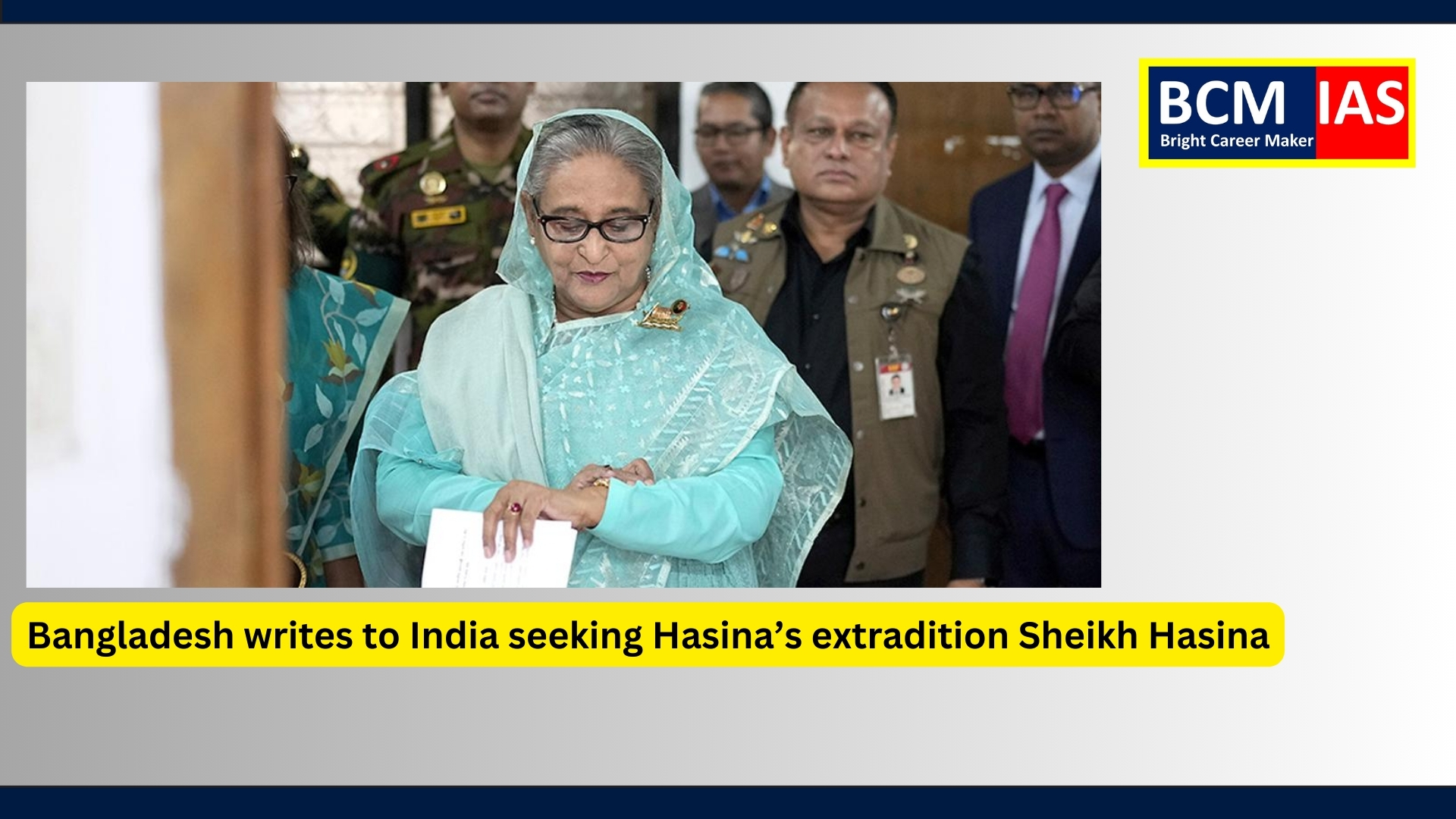
Bangladesh writes to India seeking Hasina’s extradition Sheikh
Hasina
This news article reports on
Bangladesh's official request to India for the extradition of Sheikh Hasina,
the deposed Prime Minister, amidst political and legal turmoil. Below is a
detailed analysis and explanation:
Key
Highlights of the News
1.
Extradition
Request:
o
Bangladesh's
interim government has formally sent a note verbale (diplomatic
communication) to India seeking Sheikh Hasina's extradition.
o
The request
is made under the framework of the existing extradition treaty between the two
nations.
2.
Legal and
Political Context:
o
Sheikh
Hasina has been in exile in India since August 5, 2024, following political
instability and allegations of police brutality during her final weeks in
office.
o
Multiple
cases have been filed against her, including charges of police excesses,
kidnapping, deaths during encounters, and accountability for events such as the
2009 Pilkhana killings and rallies of Hefazat-e-Islam.
3.
India’s
Response:
o
The
Ministry of External Affairs confirmed receiving the extradition request but
refrained from commenting further.
o
This
cautious approach suggests that India may consider the geopolitical and legal
implications before making a decision.
4.
Past
Extradition Precedents:
o
India has
previously extradited individuals to Bangladesh, such as Nur Hossain in the
Narayanganj seven murders case, establishing a precedent for cooperation in
legal matters.
o
However,
pending cases like that of Prashanta Kumar Haldar show that the process can be
protracted.
5.
Impact on
Bilateral Relations:
o
Sheikh
Hasina's extradition request, given her significant political stature and long
tenure as Bangladesh’s leader, is likely to test diplomatic ties between India
and Bangladesh.
o
The
decision will have implications for regional stability, given the domestic
political climate in Bangladesh.
Analysis
1.
Legal
Complexity:
o
Extradition
under the treaty involves a detailed assessment of legal processes in both
countries. India will need to evaluate the charges, ensure compliance with
treaty conditions, and assess if the extradition request aligns with
international norms of justice.
2.
Political
Sensitivity:
o
Sheikh
Hasina’s leadership is central to Bangladesh’s political history. Her
extradition could polarize political opinions and influence internal dynamics
in Bangladesh.
o
India must
consider the potential fallout of either decision—extradition or rejection—on
its relationship with Bangladesh's government and opposition.
3.
Regional
Dynamics:
o
As a
neighboring country with close cultural and historical ties, India’s actions
could set a precedent for handling future extradition requests from other South
Asian nations.
o
The request
also reflects growing political turbulence in Bangladesh, underscoring the
importance of stability in the region.
4.
International
Implications:
o
Any
perceived lack of fairness or political motivation in the extradition process
could attract international scrutiny. India’s decision will also signal its
stance on supporting democratic norms and the rule of law.
Conclusion
This extradition request
marks a critical juncture in India-Bangladesh relations. The case involves
complex legal, political, and diplomatic considerations. While India's cautious
response indicates a measured approach, its eventual decision will have significant
ramifications for regional stability, bilateral ties, and its image as a
democratic and legal ally in South Asia.
Mains Question
Q. Discuss
the implications of Bangladesh's request for the extradition of Sheikh Hasina
on India-Bangladesh relations and regional stability. What factors should India
consider while addressing the request? (250 words)
Answer
Bangladesh’s request for the
extradition of its former Prime Minister Sheikh Hasina presents a sensitive
diplomatic and political challenge for India. The implications of this decision
extend beyond bilateral relations, impacting regional stability and India's
geopolitical positioning.
Implications
on India-Bangladesh Relations:
1.
Diplomatic
Sensitivity: Sheikh Hasina is a prominent political figure who
significantly shaped Bangladesh’s governance. Any perceived bias in handling
this case could polarize public opinion in Bangladesh, straining bilateral
ties.
2.
Trust and
Cooperation: India's decision will reflect its stance on its
extradition treaty commitments, affecting Bangladesh’s trust in India as a
reliable partner.
3.
Potential
for Domestic Instability: Extraditing Sheikh Hasina could
exacerbate political unrest in Bangladesh, impacting cross-border relations,
including issues like refugee inflows and trade.
Regional
Stability:
1.
Geopolitical
Dynamics: A misstep could allow external powers like China to
exploit strained India-Bangladesh ties, reducing India’s influence in the
region.
2.
Impact on
SAARC Cooperation: Strained relations may weaken
South Asian cooperation on security, trade, and climate change.
Factors
India Should Consider:
1.
Legal
Obligations: India must evaluate the merits of the charges and
compliance with international legal norms to ensure fairness.
2.
Human
Rights Concerns: Potential risks to Sheikh Hasina's safety and rights
under the current regime should be assessed.
3.
Domestic
and International Reactions: India’s decision should balance
domestic political interests with maintaining its image as a responsible
regional leader.
Conclusion:
India’s response should prioritize fairness, transparency, and stability. A
collaborative diplomatic dialogue with Bangladesh, along with adherence to
legal norms, can help navigate this complex issue without jeopardizing
bilateral or regional stability.
MCQs
Question 1:
The extradition treaty
between India and Bangladesh enables:
1.
Extradition
of individuals accused or convicted of crimes as per the treaty.
2.
Extradition
requests to be processed without any legal review in the requested country.
3.
Protection
of individuals from politically motivated charges.
Select the
correct answer using the codes below:
A. 1 only
B. 1 and 3 only
C. 2 and 3 only
D. 1, 2, and 3
Answer:
B
Question 2:
Which of the following
factors is most likely to influence India’s decision on Sheikh Hasina’s
extradition request?
A. The volume of bilateral trade between India and Bangladesh.
B. India’s commitment to democratic principles and rule of law.
C. Bangladesh’s role in combating cross-border terrorism.
D. The historical context of India’s support for Bangladesh’s liberation.
Answer:
B
Question 3:
Consider the following
statements:
1.
Sheikh
Hasina is facing multiple cases, including charges related to police crackdowns
and encounters.
2.
India has
no precedent of extraditing individuals to Bangladesh under its extradition
treaty.
3.
The
Pilkhana killings of 2009 are among the cases cited against Sheikh Hasina.
Which of
the statements given above is/are correct?
A. 1 and 3 only
B. 2 only
C. 1, 2, and 3
D. 1 only
Answer:
A
Question 4:
Which of the following
statements best explains the significance of Sheikh Hasina’s extradition
request?
A. It marks the first formal use of the India-Bangladesh extradition treaty.
B. It reflects the ongoing political turmoil in Bangladesh post-Hasina's rule.
C. It demonstrates India’s role in mediating regional conflicts.
D. It highlights the growing collaboration on counter-terrorism efforts.
Answer:
B
Question 5:
In the context of
India-Bangladesh relations, which of the following is a likely consequence of
Sheikh Hasina’s extradition?
A. Strengthened bilateral cooperation on border management.
B. Increased political polarization in Bangladesh.
C. Improved trade ties between the two nations.
D. Enhanced regional stability through coordinated governance.
Answer:
B


Comments on “Bangladesh writes to India seeking Hasina’s extradition Sheikh Hasina”