


Daily Current Affairs Analysis
10 June 2024
-------------------------------------------------------------------------------------------------------------
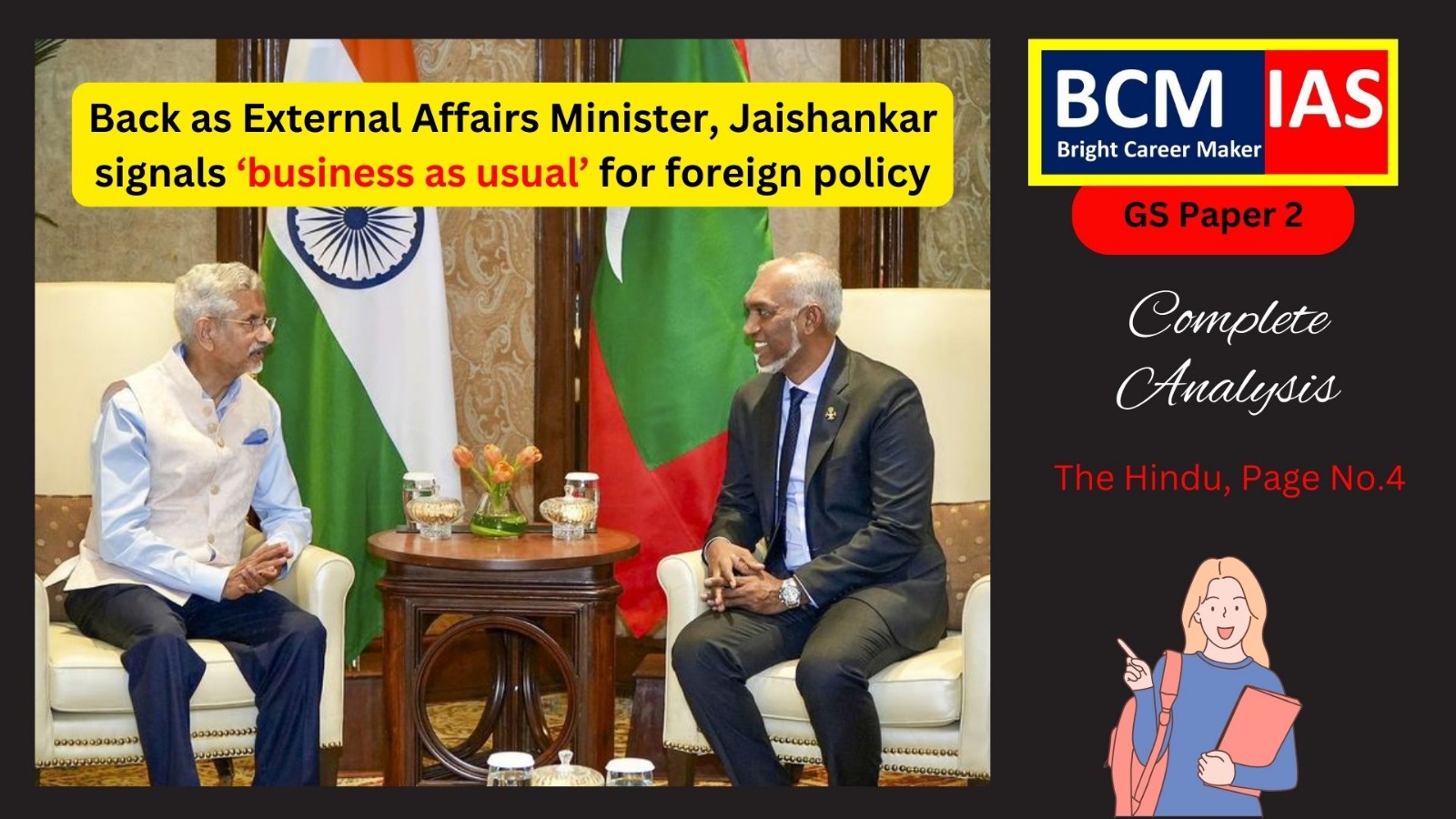
Back as External Affairs Minister, Jaishankar
signals ‘business as usual’ for foreign policy
Meaning of Headline-
·
This headline indicates that S. Jaishankar, having been reappointed
as the External Affairs Minister, is signaling continuity in India's foreign
policy.
·
Despite the change in government, Jaishankar's message suggests
there will be no significant deviations from the existing foreign policy
strategies and priorities.
·
This continuity encompasses India's relations with key global
players such as China, Pakistan, the U.S., and Russia, as well as ongoing
international issues like the conflict in Ukraine and reforms in the United
Nations Security Council.
Related Topic (as per UPSC
Syllabus)
Prelims:
- Current Events of National and International Importance: This news falls
under the current events section, focusing on India's foreign policy,
important international relations, and diplomatic strategies.
Mains:
- General Studies Paper II:
o
Bilateral, Regional and Global Groupings
and Agreements Involving India and/or Affecting India's Interests: The news covers India's stance and
policies regarding bilateral relations with neighboring countries (China,
Pakistan), regional dynamics (South Asia, Indian Ocean), and global groupings
(UNSC reforms).
o
Effect of Policies and Politics of
Developed and Developing Countries on India’s Interests, Indian Diaspora: The article discusses how global political changes, especially in the
U.S., China, and Russia, impact India's foreign policy and international
relations.
o
Important International Institutions,
Agencies and Fora, their Structure, Mandate: References to the United Nations Security
Council and other international platforms highlight their significance in
India's foreign policy.
Interview:
- Current Affairs: Understanding ongoing foreign policy strategies, diplomatic
challenges, and India's role on the global stage would be crucial for the
interview. Knowledge about key ministers and their policies also forms an
essential part of the interview preparation.
By understanding the headline and its
broader implications, UPSC aspirants can better grasp the continuity and
strategic direction of India's foreign policy under S. Jaishankar's tenure.
News
Analysis
Analysis: India's
Foreign Policy under External Affairs Minister S. Jaishankar
Introduction
The article from The Hindu, titled
"Back as External Affairs Minister, Jaishankar signals ‘business as usual’
for foreign policy," discusses the continuity and stability in India’s
foreign policy with the reappointment of S. Jaishankar as the External Affairs
Minister. It highlights the key areas of focus and the strategic priorities of
the Indian government in dealing with international relations.
Analysis
1.
Continuity in Foreign Policy:
- Stable
Leadership: Jaishankar's reappointment
signals continuity in India's foreign policy approach. This stability is
crucial as India navigates complex global issues and maintains its
strategic relationships.
- Experienced
Team: The new Ministers of State for
External Affairs, Pabitra Margherita and Kirtivardhan Singh, bring fresh
perspectives while ensuring a blend of continuity with experience.
2.
Focus on Neighborhood Relations:
- Immediate
Neighbors: Jaishankar's outreach to leaders
from the neighborhood, such as the Maldives, emphasizes India's commitment
to fostering strong regional ties. This includes addressing longstanding
issues and enhancing cooperation.
- Regional
Stability: By inviting leaders to Prime
Minister Narendra Modi’s swearing-in ceremony, India reinforces its role
as a stabilizing force in South Asia.
3.
Balancing Global Powers:
- US and Russia
Relations: India aims to maintain a
balanced approach between the US and Russia. This is evident in its
diplomatic efforts to navigate issues like the Ukraine conflict and the
Line of Actual Control (LAC) standoff with China.
- Strategic
Neutrality: The article notes that India
avoids criticism of China while seeking to address critical border issues,
showcasing a strategic balancing act.
4.
Upcoming Diplomatic Agendas:
- China
Relations: Addressing the LAC standoff
remains a priority, with India seeking urgent resolutions through talks
while refraining from public criticism of China.
- Global
Platforms: India is expected to engage
actively in global platforms such as the G20 summit and the BRICS summit,
leveraging these opportunities to showcase its diplomatic prowess and
economic initiatives.
5.
Trade and Economic Diplomacy:
- Restoring Trade
Ties: Efforts to restore trade
relations, especially with Pakistan, are highlighted as low-hanging fruit.
Initiatives to resume trade of essential goods signal a pragmatic approach
to regional diplomacy.
- Economic
Reforms: India's focus on economic
reforms and strategic partnerships aims to bolster its global standing and
attract foreign investments.
6.
Challenges and Criticisms:
- Political
Changes in the US: The article mentions potential
challenges due to political changes in the US, including the possibility
of a new administration. This could impact bilateral relations and
necessitate strategic adjustments.
- Navigating
Global Issues: With critical issues like the
Russia-Ukraine conflict and climate change on the agenda, India’s
diplomatic efforts will need to be robust and adaptive.
7.
Diplomatic Initiatives and Future Outlook:
- New Policy
Initiatives: Jaishankar’s term is expected to
see a continuation of significant initiatives, including promoting
International Yoga Day and expanding the diaspora’s global influence.
- Strategic
Engagement: India's participation in
international forums and summits will be crucial in shaping its foreign
policy and achieving its strategic goals.
Conclusion
The article underscores the
importance of continuity and stability in India's foreign policy under External
Affairs Minister S. Jaishankar. With a focus on regional stability, balancing
global powers, and addressing critical diplomatic challenges, India aims to
maintain its strategic autonomy and enhance its global influence. This analysis
is valuable for understanding India's diplomatic priorities and strategic
initiatives, essential for UPSC IAS exam preparation.
Mains Probable Question
Question: Analyze the significance of continuity in foreign policy for India's strategic interests, with reference to S. Jaishankar's reappointment as External Affairs Minister.
Answer
Introduction
Continuity
in foreign policy is crucial for
maintaining stable and predictable international relations. It ensures that a
country’s strategic interests are consistently pursued, fostering trust and
reliability among global partners. In the context of India, the reappointment
of S. Jaishankar as the External Affairs Minister signals a commitment
to maintaining established diplomatic strategies and priorities. This
continuity is vital for navigating complex global dynamics and securing India's
strategic interests in a rapidly changing international environment.
Demand
of the Question
To
analyze the significance of continuity in foreign policy for India's strategic
interests, particularly through the lens of S. Jaishankar's reappointment, it
is essential to explore three core aspects:
1.
Stability in Bilateral Relations:
How continuity supports stable and robust relations with key global players
such as China, Pakistan, the U.S., and Russia.
2.
Consistency in Global Engagements:
The role of a stable foreign policy in maintaining India's stance in global
forums and its approach to international conflicts.
3.
Strategic Advancements:
How sustained foreign policy efforts contribute to India's long-term strategic
goals, including economic growth, security cooperation, and diplomatic
influence.
1.
Stability in Bilateral Relations
Continuity
in foreign policy under S. Jaishankar
ensures stable and predictable bilateral relations with key countries. This
stability is particularly significant in the context of India's relationships
with China and Pakistan, where geopolitical tensions and security concerns
are high. For instance, India's approach to managing its complex relationship
with China, characterized by border disputes and economic competition, benefits
from a consistent and strategic foreign policy.
- China: The
ongoing border standoff and economic competition with China require a
nuanced and steady approach. Continuity in foreign policy enables India to
manage these challenges while simultaneously pursuing avenues for
cooperation, such as trade and investment.
- Pakistan: With
Pakistan, the continuity of India's foreign policy helps in maintaining a
firm stance on terrorism while exploring diplomatic channels for peace and
stability in the region. S. Jaishankar's reappointment suggests a
continued focus on these strategic priorities without abrupt changes that
could destabilize the region.
2.
Consistency in Global Engagements
India's
global engagements and its approach to international conflicts are
significantly influenced by a stable foreign policy. The reappointment of S.
Jaishankar indicates that India will continue to pursue a balanced and
strategic approach to global issues, including the conflict in Ukraine and
reforms in international institutions like the United Nations Security Council
(UNSC).
- Global Conflicts: In the
context of the Ukraine conflict, India's balanced stance, which involves
engaging with both the U.S. and Russia, is a testament to its strategic
diplomacy. This approach helps India maintain its global standing and
avoid being drawn into polarized blocs.
- UNSC Reforms:
Continuity in foreign policy is crucial for India's ongoing efforts to
reform the UNSC. India's quest for a permanent seat in the UNSC requires
consistent diplomatic efforts and strategic alliances, which are better
pursued under a stable and continuous foreign policy framework.
3.
Strategic Advancements
Sustained
foreign policy efforts are essential
for achieving India's long-term strategic goals, such as economic growth,
security cooperation, and increased diplomatic influence. The reappointment of
S. Jaishankar signals a commitment to these objectives, ensuring that India’s
foreign policy remains focused and effective.
- Economic Growth: A
stable foreign policy is pivotal for attracting foreign investment and
expanding trade relations. By maintaining consistency in its diplomatic
and economic engagements, India can foster a favorable environment for
economic partnerships and growth.
- Security Cooperation:
Continuity in foreign policy enhances India's ability to build and sustain
security alliances. This is particularly important for counter-terrorism
efforts and defense collaborations with key partners like the U.S.,
Israel, and France.
- Diplomatic Influence:
India's diplomatic influence on the global stage is bolstered by a
consistent and strategic foreign policy. By continuously advocating for
its interests and values, India can enhance its leadership role in
international forums and multilateral organizations.
Way
Forward
To
further strengthen India's strategic interests through continuity in foreign
policy, several steps can be taken:
1.
Enhancing Diplomatic Infrastructure: Investing in the diplomatic infrastructure, including embassies and
consulates, will help India project its influence more effectively. Training
and deploying skilled diplomats who can navigate complex international issues
is also crucial.
2.
Strengthening Regional Ties:
Prioritizing regional stability by deepening ties with neighboring countries
through initiatives like SAARC and BIMSTEC will enhance India's strategic
security and economic interests.
3.
Leveraging Economic Diplomacy:
Promoting economic diplomacy by forging new trade agreements and expanding
existing ones will support India's economic growth and global integration.
Engaging with emerging economies and diversifying trade partnerships will
mitigate risks associated with global economic uncertainties.
4.
Promoting Soft Power: Strengthening
India's soft power through cultural diplomacy, educational exchanges, and the
promotion of India's cultural heritage can enhance its global image and
influence. Initiatives like the International Yoga Day and the Indian
diaspora's engagement are effective tools in this regard.
5.
Advocating for Global Governance Reforms: Continuously pushing for reforms in global
governance institutions, including the UNSC, World Trade Organization (WTO),
and International Monetary Fund (IMF), will help India secure a more
significant role in shaping global policies.
6.
Fostering Strategic Partnerships:
Building and maintaining strategic partnerships with key global players,
including the U.S., EU, Japan, and ASEAN countries, will enhance India's
geopolitical and economic standing. Collaborative efforts in technology,
defense, and climate change will further consolidate these partnerships.
7.
Focus on Technological and Innovation Diplomacy: Promoting collaborations in technology and
innovation, particularly in areas like artificial intelligence, cybersecurity,
and renewable energy, will position India as a leader in these critical fields.
Conclusion
The
reappointment of S. Jaishankar as the External Affairs Minister signifies a
commitment to continuity in India's foreign policy, which is essential for
maintaining stability, consistency, and strategic advancements. By focusing on
enhancing diplomatic infrastructure, strengthening regional ties, leveraging
economic diplomacy, promoting soft power, advocating for global governance
reforms, fostering strategic partnerships, and focusing on technological and
innovation diplomacy, India can effectively navigate the complex global
landscape and secure its strategic interests. The continuity in foreign policy
not only ensures predictable and stable international relations but also
enhances India's ability to achieve its long-term goals of economic growth, security
cooperation, and increased diplomatic influence.
MCQs for Prelims Practice
1. Who has been reappointed as the External Affairs Minister of India,
signaling continuity in foreign policy?
o
a) Pabitra Margherita
o
b) Kirtivardhan Singh
o
c) S. Jaishankar
o
d) Narendra Modi
o
Answer: c) S.
Jaishankar
o
Explanation: S.
Jaishankar has been reappointed as the External Affairs Minister, indicating
continuity in India's foreign policy.
2. Which countries are highlighted as key focuses in India's foreign policy
under S. Jaishankar's tenure?
o
a) China, Pakistan, U.S., and
Russia
o
b) Japan, Australia, Germany,
and Brazil
o
c) France, UK, Italy, and
Spain
o
d) South Africa, Brazil,
Canada, and Mexico
o
Answer: a) China,
Pakistan, U.S., and Russia
o
Explanation: The article
mentions these countries as primary focuses in India's foreign policy.
3. What is one of the major global conflicts mentioned in the article that
India is balancing its approach towards?
o
a) Syria conflict
o
b) Israel-Palestine conflict
o
c) Ukraine conflict
o
d) Korean Peninsula conflict
o
Answer: c) Ukraine
conflict
o
Explanation: The article
discusses India's balanced approach to the conflict in Ukraine.
4. Which international body's reforms are a top agenda in India's foreign
policy according to the article?
o
a) World Bank
o
b) International Monetary Fund
o
c) United Nations Security
Council
o
d) World Health Organization
o
Answer: c) United
Nations Security Council
o
Explanation: The article
highlights UN Security Council reforms as a key focus for India.
5. Which two Ministers of State for External Affairs are mentioned as part
of Jaishankar's new team?
o
a) Amit Shah and Rajnath Singh
o
b) Pabitra Margherita and
Kirtivardhan Singh
o
c) Smriti Irani and Nirmala
Sitharaman
o
d) Arvind Kejriwal and Manish
Sisodia
o
Answer: b) Pabitra
Margherita and Kirtivardhan Singh
o
Explanation: The article
mentions Pabitra Margherita and Kirtivardhan Singh as the new Ministers of
State for External Affairs.


Comments on “Back as External Affairs Minister, Jaishankar signals ‘business as usual’ for foreign policy”