


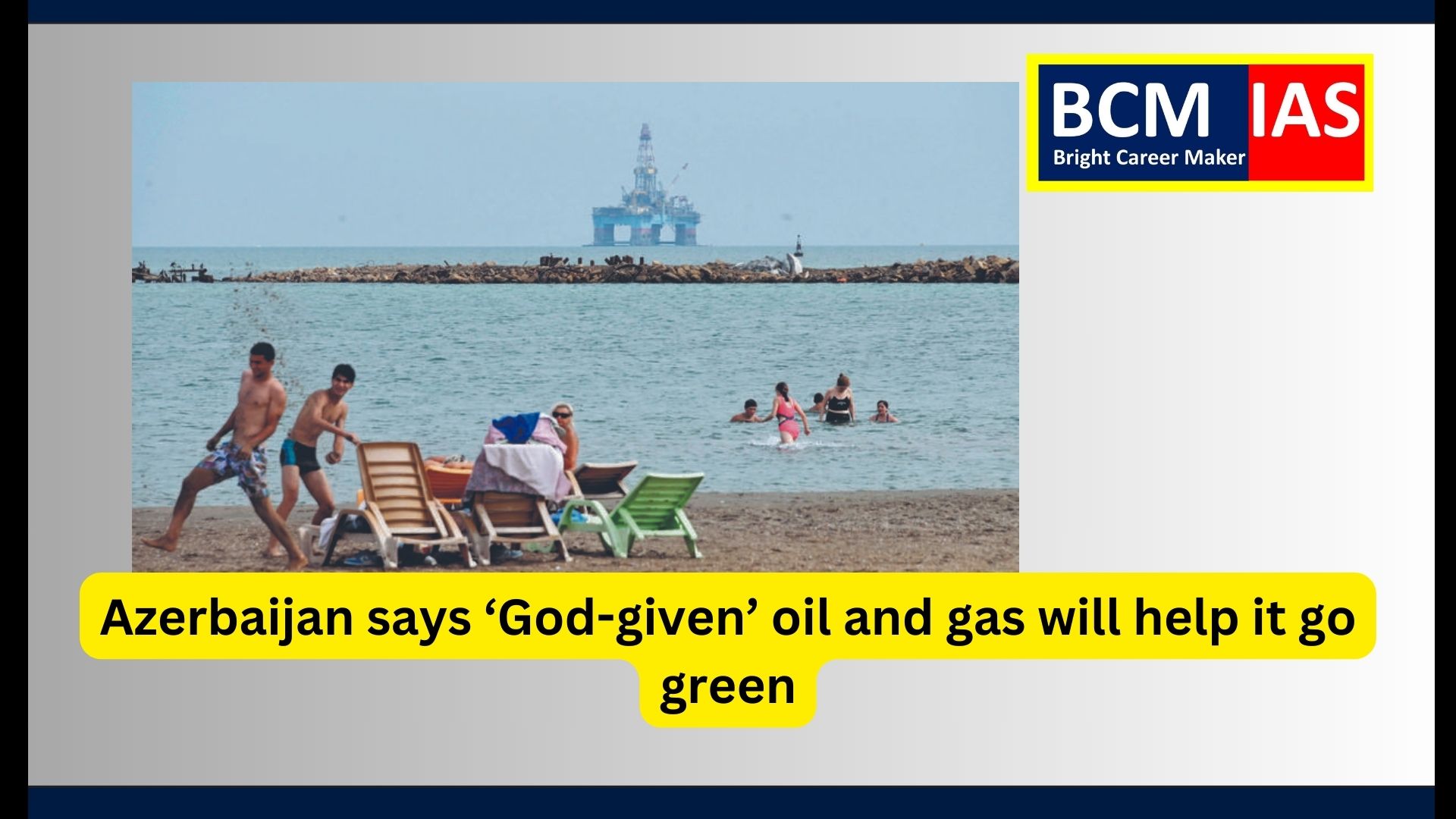
Azerbaijan says ‘God-given’ oil
and gas will help it go green
News Analysis
Introduction
Azerbaijan, a resource-rich
nation situated along the Caspian Sea, has long been known for its vast oil and
natural gas reserves. Historically, the nation's economy and political power
have been heavily influenced by its energy wealth. As the world shifts towards
decarbonization and green energy, Azerbaijan is facing a critical transition
phase. The country aims to capitalize on its remaining fossil fuel reserves
while simultaneously striving for greener, renewable energy sources to maintain
its economic stability and contribute to global environmental efforts. This
situation becomes even more significant as Azerbaijan prepares to host the
COP29 climate conference, where it will likely face both scrutiny and
expectations regarding its energy policies.
Background:
The Role of Oil and Gas in Azerbaijan's Economy
Azerbaijan's economic
development has been deeply tied to its oil and gas industry.
- Historical Perspective: The first commercial oil well
was drilled in Azerbaijan in the mid-19th century, making it a global
pioneer in industrial oil production. Both onshore and offshore drilling
began in Azerbaijan, and Baku, the capital city, emerged as a booming
center of the global oil industry.
- Modern Production: Since gaining independence from
the Soviet Union in 1991, Azerbaijan has significantly ramped up its oil
and gas production. It has extracted over 1 billion tonnes of oil and is
expected to increase its natural gas output from 37 billion cubic meters
(bcm) to 49 bcm within the next decade. Oil and gas revenues constitute
around 35% of Azerbaijan’s GDP and nearly half of its state budget,
underscoring the country’s reliance on hydrocarbons.
- Strategic Influence: The revenues from oil and gas
have allowed Azerbaijan to modernize rapidly and increase its military
power, particularly in conflicts such as the Nagorno-Karabakh dispute with
Armenia. The country has also become a crucial energy supplier to Europe,
especially in the wake of the European Union's efforts to reduce its
dependence on Russian gas.
Challenges:
Finite Fossil Fuel Resources
Despite Azerbaijan’s
significant role as an energy exporter, its oil and gas reserves are finite.
- Exhaustion of Reserves: According to estimates,
Azerbaijan’s oil reserves could be depleted within 20 years, while natural
gas reserves may last for about 50 years. This looming resource depletion
raises concerns over the long-term sustainability of Azerbaijan's economy,
which remains highly dependent on hydrocarbons.
- Economic Diversification Efforts: Recognizing the risks of its
reliance on fossil fuels, the Azerbaijani government has begun efforts to
diversify its economy, focusing on sectors such as agriculture,
technology, and alternative energy sources. These steps are crucial as
Europe pursues decarbonization targets, which will likely lead to reduced
demand for fossil fuels in the coming decades.
Green
Transition: Ambitions and Realities
Azerbaijan is under pressure
to align its energy policies with global climate goals, especially as it
prepares to host the COP29 climate summit.
- Renewable Energy Goals: Azerbaijan has set a target to
increase its renewable energy capacity to 30% by 2030 and reduce its
greenhouse gas emissions by 40% by 2050. These goals are in line with
global efforts to combat climate change.
- Current Greenhouse Gas Emissions: Despite these ambitious
targets, Azerbaijan’s projected carbon dioxide emissions could reach 781
million tonnes per year, which would surpass the current annual emissions
of the United Kingdom. This discrepancy between emission levels and green
energy goals has led to criticism from environmental organizations,
particularly as Azerbaijan continues to prioritize increasing oil and gas
production in the short term.
- Economic Pressures vs. Green
Commitments: Azerbaijan’s
green transition is complicated by the need to maximize its revenue from
oil and gas exports before European decarbonization efforts significantly
reduce the demand for fossil fuels. The challenge lies in balancing
immediate economic benefits with long-term environmental sustainability.
Geopolitical
Context and Strategic Moves
Azerbaijan's energy strategy
is also shaped by its geopolitical positioning and international partnerships.
- European Energy Supply: Following Russia's invasion of
Ukraine, the European Union has sought to reduce its dependence on Russian
energy supplies. This has benefited Azerbaijan, which has become a more
critical supplier of natural gas to European markets. In 2022, the
European Commission signed an agreement with Azerbaijan to double gas
imports, highlighting the strategic importance of the country in European
energy security.
- Diplomatic Leverage: Azerbaijan’s energy wealth
gives it significant diplomatic leverage, especially with the West, which
is keen on securing reliable alternative energy sources. However, as the
world accelerates towards renewable energy, Azerbaijan will need to shift
its foreign policy and economic strategies to remain relevant in a
post-fossil fuel world.
Conclusion
Azerbaijan’s future rests on
its ability to navigate a dual challenge: maximizing its economic gains from
remaining hydrocarbon resources while making a credible transition to renewable
energy. The country's oil and gas sector has historically been its backbone,
fueling rapid economic growth and military power, but the finite nature of
these resources and the global push for decarbonization means Azerbaijan must
diversify its economy. The transition will require substantial investment in
green technologies, commitment to emission reduction targets, and strategic
partnerships that support sustainable development. Hosting COP29 offers
Azerbaijan a platform to showcase its green ambitions, but it must also contend
with the inherent contradictions in expanding fossil fuel production while
advocating for climate action.
In this context,
Azerbaijan’s future success will depend on how well it can balance these
competing priorities and ensure a smooth transition from an oil-dependent
economy to one driven by sustainable energy and diversified growth.


Comments on “Azerbaijan says ‘God-given’ oil and gas will help it go green”