

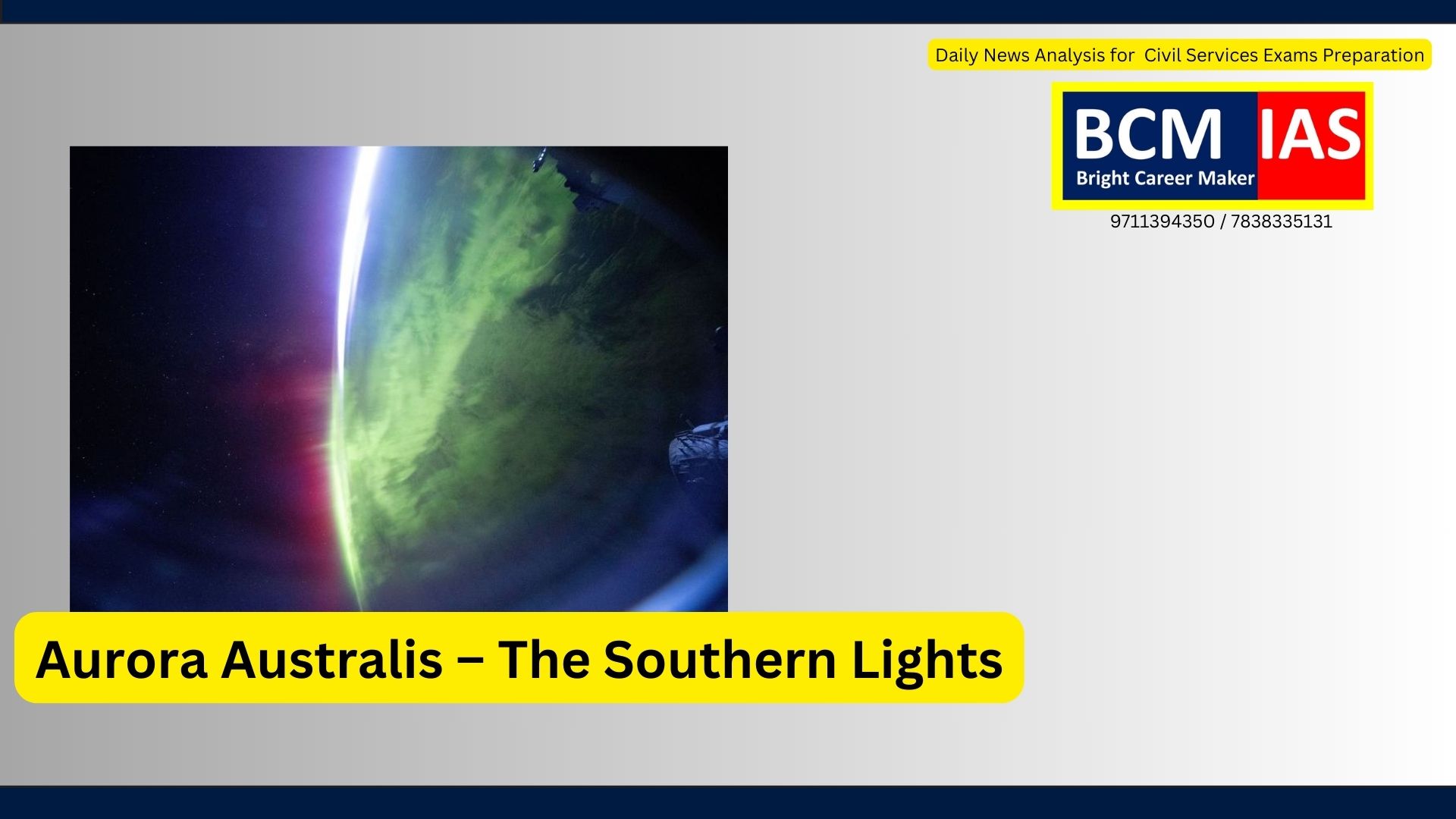
Aurora Australis – The Southern Lights
Aurora Australis,
also known as the Southern Lights, is
a natural light display in the Southern Hemisphere’s sky,
caused by the interaction of solar wind with Earth's magnetic field. It
is the southern counterpart of the Aurora
Borealis (Northern Lights) and is visible near the Antarctic
region.
1. Causes of Aurora
Australis
- The
Sun emits charged
particles (solar wind).
- These
particles collide with Earth’s
magnetosphere, getting funneled towards the polar regions.
- Excitation
of atmospheric gases (mainly oxygen and
nitrogen) leads to colorful
lights in the sky.
2. Colors of Aurora
Australis
- Green:
Due to oxygen
molecules at lower
altitudes (~100 km).
- Red:
Due to oxygen at
higher altitudes (~300 km).
- Blue
and Violet: Due to nitrogen molecules.
3. Where is it
Visible?
Aurora Australis is best seen in high-latitude
Southern Hemisphere locations, such as:
- Antarctica
- Tasmania
(Australia)
- New
Zealand
- Southern
Chile and Argentina
- South
Africa’s southernmost regions
4. When Does it
Occur?
- More
frequent during solar
maximum periods (when sunspot activity is high).
- Best
viewed during winter
nights (March-September) when skies are dark.
5. Scientific and
Cultural Significance
- Helps
scientists study
space weather and Earth’s
magnetic field.
- Featured
in Indigenous and
ancient cultures as spiritual or mystical phenomena.
Conclusion
Aurora Australis is a breathtaking
natural phenomenon that showcases Earth’s interaction with
the Sun’s energy, making it one of the most
stunning celestial displays on the planet.
MCQs for
Practice
Q1. What causes the
phenomenon of Aurora Australis (Southern Lights)?
a) Reflection of sunlight from the ocean
surface
b) Interaction of solar wind with Earth's magnetic field
c) Volcanic eruptions emitting colorful gases
d) Lightning discharges in the upper atmosphere
(Answer: b) Interaction of solar wind
with Earth's magnetic field
Explanation:
Aurora Australis occurs when charged particles from the Sun (solar
wind) collide with Earth's magnetosphere, exciting
atmospheric gases and producing colorful light displays near the South
Pole.
Q2. In which of the
following locations is Aurora Australis most likely to be visible?
a) Alaska
b) Tasmania
c) Sahara Desert
d) Japan
(Answer: b) Tasmania
Explanation:
Aurora Australis is visible in the Southern Hemisphere,
particularly near Antarctica, Tasmania (Australia), New
Zealand, and southern parts of Chile and Argentina. Alaska
and Japan experience Aurora
Borealis (Northern Lights) instead.
Q3. Which of the
following gases is primarily responsible for the green color observed in Aurora
Australis?
a) Hydrogen
b) Helium
c) Oxygen
d) Carbon dioxide
(Answer: c) Oxygen
Explanation:
The green color in auroras is due to oxygen
molecules in the atmosphere at lower
altitudes (~100 km). Higher-altitude oxygen can
produce a red glow,
while nitrogen contributes to blue
and violet hues.


Comments on “Aurora Australis – The Southern Lights”