


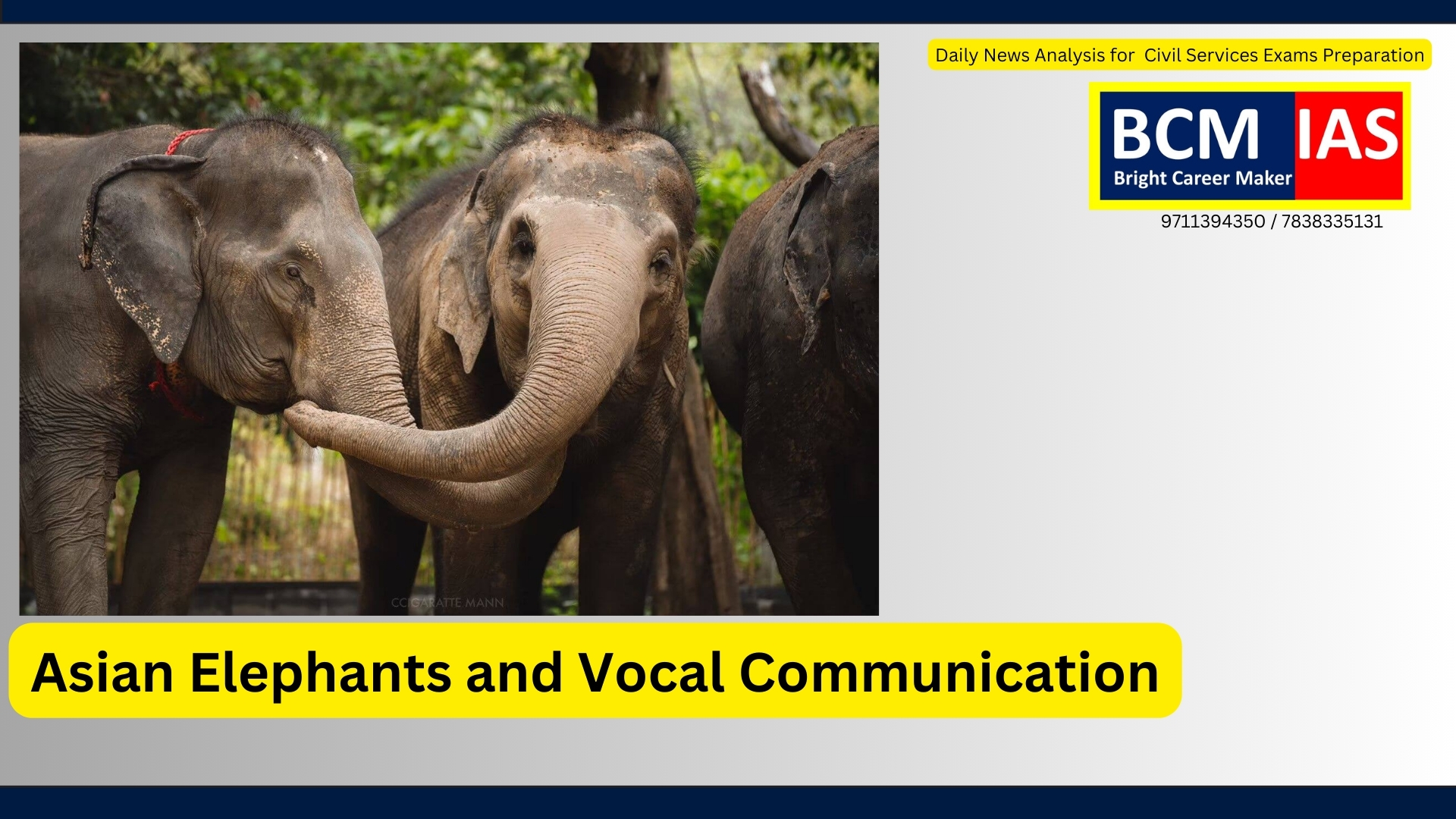
Asian Elephants and Vocal Communication
The study on Asian
elephants' vocal communication,
published in Mammalian Biology,
offers valuable insights into the complex ways these animals use sound to
navigate their social lives. Unlike previous research, which mostly focused on African
elephants, this study reveals unique aspects of Asian
elephants' communication patterns,
challenging earlier assumptions about their use of trumpeting
and providing a deeper understanding of their acoustic behavior.
1. Significance of Vocal
Communication in Elephants
A. Importance in Social
Survival
- Elephants
are highly social
animals that rely on vocal communication to interact, warn
each other of danger, and maintain contact within their herds.
- They
use a range of sounds
– from low-frequency
rumbles to high-frequency
trumpets and chirps – to convey different messages across
varying distances.
B. Lifespan and Social
Structure
- Elephants
can live up to 70
years, during which their herds split and merge
multiple times.
- A
complex communication system helps them navigate these dynamic social structures.
2. Key Findings of the Study
A. Four Main Types of Calls
The researchers identified
four primary types of calls used by Asian elephants:
1.
Trumpets
– High-frequency calls associated with social interactions, play, and
disturbances.
2.
Roars
– Low-frequency calls used to signal emotional states or attract attention.
3.
Rumbles
– Deep, resonant sounds used for long-distance communication.
4.
Chirps
– Short, high-pitched calls, often used by younger elephants.
B. Combination Calls
- The
study documented the first instance of combination calls in a southern Indian
population of Asian elephants.
- These
calls, such as the roar-rumble,
appear to serve multiple functions, including maintaining contact and
signaling disturbances.
3. Trumpeting: Changing
Perceptions
A. Earlier Beliefs
- Previously,
it was believed that Asian
elephants used trumpeting mainly to signal disturbances caused by humans or
predators.
B. New Findings
- The
study revealed that trumpeting occurs in varied contexts, including social interactions, play, and
intra-group conflicts.
- This
finding suggests that trumpeting plays a broader communicative role than
previously thought.
4. Age and Sex Differences in
Vocalization
A. Age-Based Differences
- Younger
elephants produced higher-pitched
calls to attract attention and establish their presence.
- Older
elephants used lower-pitched
calls, likely due to changes in body size and vocalization mechanisms over
time.
B. Sex-Based Differences
- The
study found no significant difference in the duration of trumpets across
age groups for both male
and female elephants.
- However,
the roars and
roar-rumbles became longer as the elephants aged,
indicating a possible correlation with their growing social roles.
5. Universal Purpose of Roars
- The
researchers found that Asian
elephant calves' roars closely mirrored those of their African counterparts.
- These
roars serve a universal
purpose, signaling emotional
states and attracting the attention of adults.
- This
suggests that certain vocalizations, like roars, are highly conserved across elephant
species, highlighting their importance in evolutionary communication.
6. Implications and Future
Research
A. Building a Sound Library
- The
team plans to create an Asian
Elephant Sound Library for public education and scientific research.
- This
library aims to provide a comprehensive
record of elephant vocalizations in both wild and captive environments.
B. Deeper Exploration of
Acoustic Behaviors
- This
study sets the groundwork for future research on acoustic behaviors
in free-ranging elephant populations.
- Researchers
aim to understand how different
environmental factors influence elephant communication
patterns.
Conclusion
The study highlights the complexity
of Asian elephants' vocal communication,
challenging previous beliefs about their use of trumpeting
and emphasizing the importance of combination calls.
By documenting the age and sex-based differences
in vocalizations, the research underscores the adaptive
significance of these sounds in navigating
their social lives.
As researchers continue to explore this field, the creation of an Asian
Elephant Sound Library will be a valuable resource
for conservation efforts, scientific study,
and public education. This study marks a critical
step toward a deeper appreciation of the complex
world of elephant acoustic communication.
MCQs
1. Which of the following
statements about the vocal communication of Asian elephants is correct?
(a) Asian elephants use only
low-frequency sounds for communication.
(b) They produce a variety of calls, including trumpets, roars, rumbles, and
chirps.
(c) Their calls are identical to those of African elephants.
(d) Asian elephants rely only on visual signals for communication.
Answer: (b)
They produce a variety of calls, including trumpets, roars, rumbles, and
chirps.
Explanation:
The study found that Asian elephants use a range of
vocalizations, including high-frequency
and low-frequency calls, to communicate different
messages.
2. The study on Asian
elephants' vocal communication, published in Mammalian Biology (2024), found
that trumpeting is used in which of the following contexts?
(a) Only in response to human
disturbances
(b) Only when fighting with predators
(c) In multiple situations, including social interactions, play, and
disturbances
(d) Only when young elephants try to attract attention
Answer: (c)
In multiple situations, including social interactions, play, and disturbances
Explanation:
Previously, it was believed that trumpeting was primarily a distress
call, but the study revealed that it is used in various
contexts, including social play and intra-group interactions.
3. The study found that
younger elephants produce high-pitched calls, whereas older elephants use
lower-pitched calls. What is the likely reason for this difference?
(a) Older elephants lose their
ability to produce high-frequency sounds.
(b) Changes in body size and vocalization mechanisms over time.
(c) Younger elephants do not use vocalizations for communication.
(d) Older elephants deliberately avoid using vocal communication.
Answer: (b)
Changes in body size and vocalization mechanisms over time.
Explanation:
The study suggests that age-related changes in body structure and
vocal mechanisms influence the pitch of
elephant vocalizations, with older elephants
producing lower-frequency sounds.
4. Which of the following is a
universal vocalization found in both Asian and African elephant calves?
(a) Chirps
(b) Roars
(c) Hisses
(d) Whistles
Answer: (b)
Roars
Explanation:
The study found that calves of both Asian and African
elephants use roars to attract the attention of adults and signal emotional
states, indicating a universal
function of this call.
5. What is the primary
objective of the 'Asian Elephant Sound Library' initiative mentioned in the
study?
(a) To train elephants for
human interactions
(b) To create a database of elephant sounds for scientific research and
education
(c) To track elephant migration patterns through satellite technology
(d) To prevent human-elephant conflicts by broadcasting elephant calls
Answer: (b)
To create a database of elephant sounds for scientific research and education
Explanation:
The study aims to curate an Asian Elephant Sound Library
to help scientists better understand elephant vocal
communication, aiding in conservation
efforts and public education.


Comments on “Asian Elephants and Vocal Communication”