


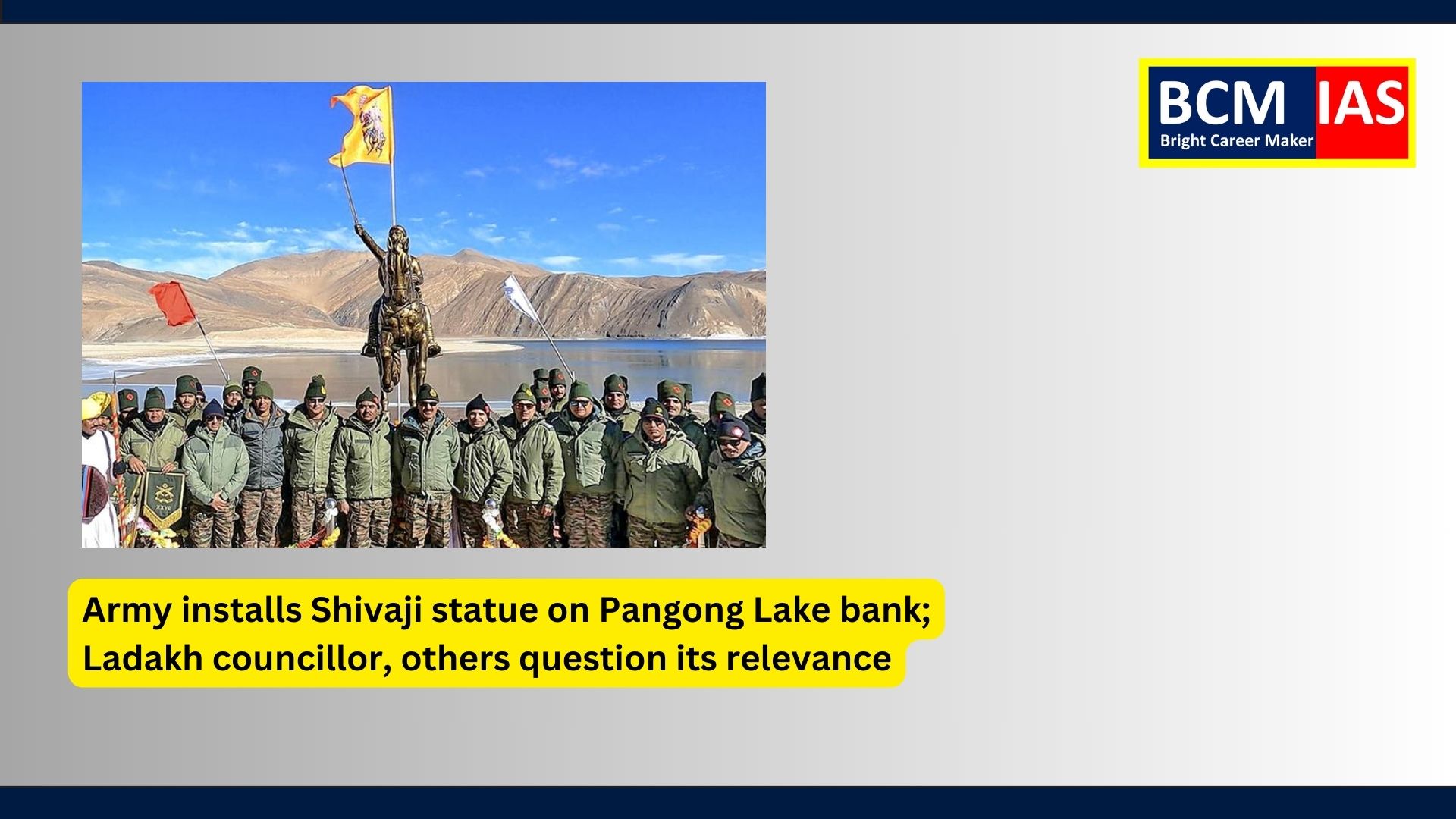
Army installs Shivaji statue on Pangong Lake bank;
Ladakh councillor, others question its relevance
Key Issue
The installation of a statue of Chhatrapati Shivaji
Maharaj by an Indian Army Maratha unit on the banks of Pangong Lake in Ladakh
has sparked debate over its cultural and historical relevance to the region.
The controversy has drawn reactions from local leaders, veterans, and the
general public, raising broader questions about the appropriateness of such
symbols in specific geographic and cultural contexts.
Arguments Supporting the
Installation
1.
Military Tradition:
o The statue
was installed by a Maratha Light Infantry unit, funded voluntarily by serving
and retired personnel.
o Infantry
units often place icons associated with their regimental legacy to motivate
soldiers and honor their history.
2.
Symbolism of Valour:
o Shivaji
Maharaj is celebrated as a symbol of courage, strategic brilliance, and
justice, which aligns with the ethos of military service.
o The Army
stated that the statue was a "towering symbol" of inspiration for
generations.
Criticism of the
Installation
1.
Cultural and Historical Irrelevance:
o Local
leaders and activists argue that Shivaji Maharaj lacks direct cultural or
historical significance in the Ladakh region.
o Figures such
as Zorawar Singh, a military
leader who campaigned in the region and whose legacy is deeply tied to Ladakh,
are viewed as more appropriate icons.
2.
Environmental Concerns:
o Pangong
Lake is an ecologically sensitive area. Critics, including local councillor
Konchok Stanzin, suggest that resources should be prioritized for
community-benefiting or conservation projects rather than symbolic
installations.
3.
Local Sentiments:
o The
statue’s installation reportedly occurred without consulting local communities,
raising concerns about a lack of inclusivity in decision-making.
o Activists
like Sajjad Kargili have suggested honoring local historical figures like Khree Sultan Cho, Ali Sher Khan Anchen, or Seenge Namgyal instead.
4.
Veteran Critiques:
o Several
military veterans have questioned the broader practice of erecting such
statues, especially in regions unrelated to the figure being honored.
o They argue
that the installation was unnecessarily publicized, detracting from the
military's core objectives and raising avoidable controversies.
Broader Implications
1.
Cultural Sensitivity:
o The
incident highlights the need for cultural awareness and inclusivity when
introducing symbols in regions with unique histories and identities.
o Misplaced
symbols can create rifts between institutions like the Army and local
communities, potentially undermining trust.
2.
Environmental Preservation:
o Pangong
Lake, a popular tourist and ecologically sensitive area, requires careful
preservation. Any installations should align with environmental priorities and
cultural appropriateness.
3.
Symbolic vs. Practical Efforts:
o Critics
argue that symbolic acts like statue installations should not take precedence
over practical projects that directly benefit local communities or the
environment.
Suggestions for Resolution
1.
Consultation with Local Stakeholders:
o Engage with
local communities, historians, and environmental experts to ensure
installations align with regional identity and ecological priorities.
2.
Honoring Relevant Figures:
o Consider
erecting statues or memorials of historical figures who have direct connections
to Ladakh, such as Zorawar Singh or other local icons, to better reflect the
region’s heritage.
3.
Focus on Development and Conservation:
o Prioritize
projects that benefit the community, such as infrastructure development,
conservation efforts, or initiatives to promote local culture and history.
Conclusion
While the installation of Shivaji Maharaj’s statue at
Pangong Lake reflects the regimental pride of the Maratha Light Infantry, it
has sparked valid concerns about cultural relevance and environmental
sensitivity. Moving forward, such initiatives should prioritize inclusivity,
local history, and ecological preservation to foster harmony and respect for
the unique identity of the region.
MCQs
1.
Why was the statue of Chhatrapati Shivaji Maharaj installed at Pangong Lake?
a) To attract
tourists to the region
b) To honor the legacy of the Maratha Light Infantry unit stationed there
c) To promote cultural integration in Ladakh
d) To commemorate Ladakhi historical figures
Answer: b) To honor the legacy of the Maratha Light Infantry
unit stationed there
2.
What was the primary criticism of the Shivaji statue raised by local leaders
and activists?
a) The statue was too
large for the location.
b) It was not approved by the Indian Army headquarters.
c) Shivaji Maharaj lacks cultural or historical relevance to Ladakh.
d) It caused environmental damage to Pangong Lake.
Answer: c) Shivaji Maharaj lacks cultural or historical
relevance to Ladakh.
3.
Which historical figure was suggested as a more relevant choice for a statue in
the region?
a) Maharana Pratap
b) Zorawar Singh
c) Khree Sultan Cho
d) Both b) and c)
Answer: d) Both b) and c)
4.
What environmental concern was raised about the installation of the statue?
a) It interfered with
migratory bird habitats at Pangong Lake.
b) The installation process damaged the local ecosystem.
c) Statues in environmentally sensitive areas like Pangong Lake could disrupt
conservation efforts.
d) The materials used for the statue were non-biodegradable.
Answer: c) Statues in environmentally sensitive areas like
Pangong Lake could disrupt conservation efforts.
5.
What critique was raised by military veterans regarding the installation?
a) The statue was not
aligned with Indian Army traditions.
b) Publicizing such unit-level installations on social media was unnecessary.
c) It did not represent the Army’s core values.
d) It caused logistical challenges for the Army.
Answer: b) Publicizing such unit-level installations on social
media was unnecessary.


Comments on “Army installs Shivaji statue on Pangong Lake”