


Daily Current Affairs Analysis
22-24 May 2024
-------------------------------------------------------------------------------------------------------------
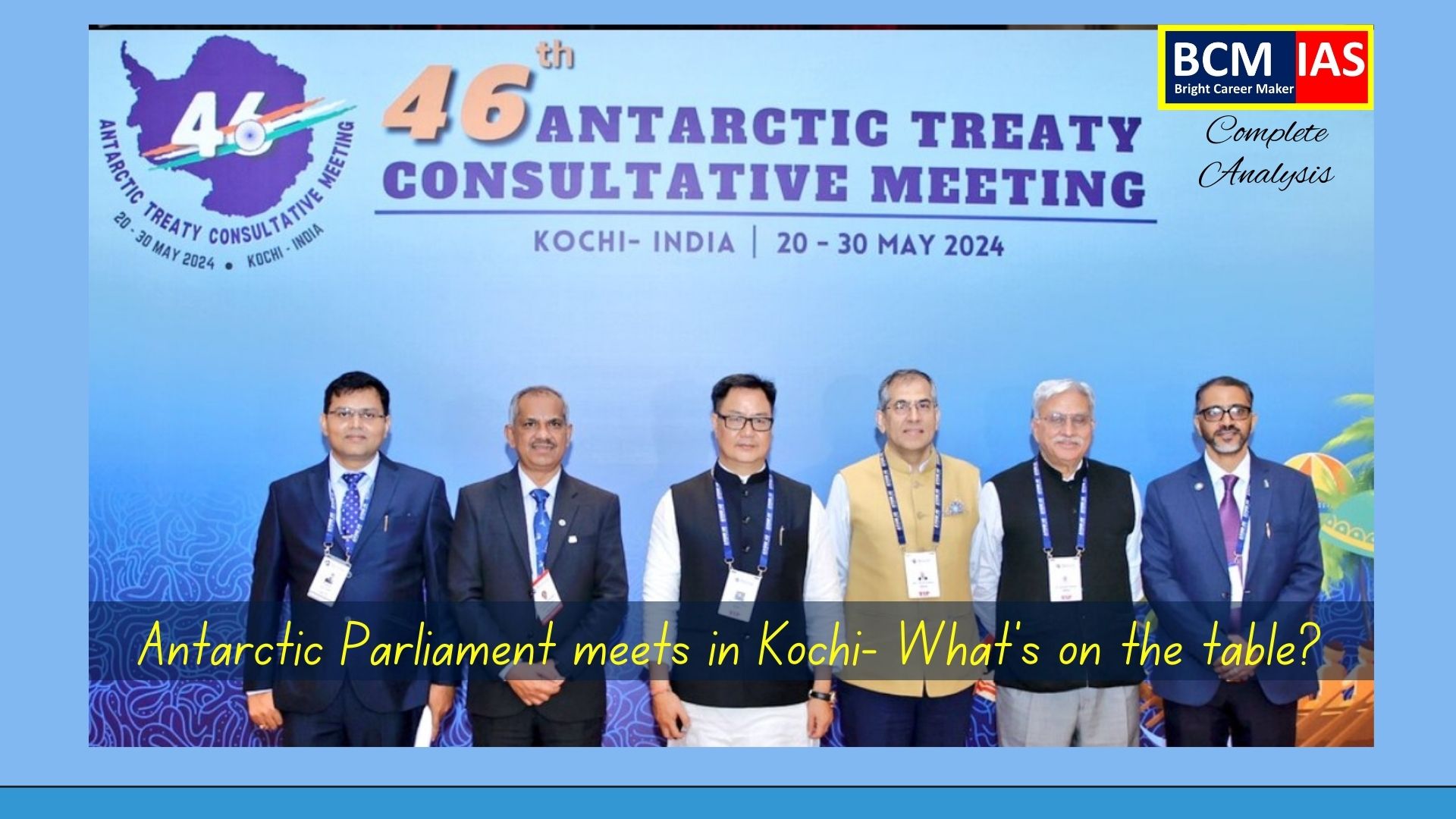
Antarctic Parliament meets in Kochi: What’s on the
table?
Meaning of the heading
The news heading refers to the 46th Antarctic Treaty
Consultative Meeting (ATCM 46), commonly known as the Antarctic Parliament,
held in Kochi, India. The meeting is a significant international event where 56
member countries of the Antarctic Treaty convene to discuss and decide on
various issues related to Antarctica. Key topics include governance, scientific
research, environmental protection, and new initiatives such as India's
proposal to construct a new research station, Maitri II. The discussions aim to
ensure the peaceful use of Antarctica, promote international scientific
cooperation, and protect the continent's fragile ecosystem.
Related Topic (as per UPSC
Syllabus)
Prelims
1. Geography of India and
the World
o
Physical geography of the world, including landforms
and oceans.
o
Geographical features and their location-changes in
critical geographical features (including water bodies and ice-caps).
2. Environment and Ecology
o
General issues on environmental ecology, biodiversity,
and climate change.
Mains
1. General Studies Paper I
o
Geography
§
Distribution of key natural resources across the world
including South Asia and the Indian subcontinent.
§
Important Geophysical phenomena such as earthquakes,
Tsunami, Volcanic activity, cyclones, etc., geographical features, and their
location.
2. General Studies Paper
III
o
Environment and Ecology
§
Conservation, environmental pollution, and
degradation, environmental impact assessment.
o
Science and Technology
§
Developments and their applications and effects in
everyday life.
§
Awareness in the fields of IT, Space, Computers,
robotics, nano-technology, bio-technology, and issues relating to intellectual
property rights.
3. General Studies Paper
II
o
International Relations
§
Important international institutions, agencies, and
fora, their structure, mandate.
Interview
1. Current Affairs
o
Knowledge and understanding of current events of
national and international importance.
2. Personality Test
o
Ability to articulate views on contemporary issues,
including environmental conservation, international treaties, and scientific
cooperation.
News
Analysis
Introduction
India is hosting the 46th Antarctic Treaty
Consultative Meeting (ATCM 46) in Kochi from May 20-30, 2024. This significant
event, organized by the National Centre for Polar and Ocean Research through
the Ministry of Earth Sciences (MoES), brings together representatives from the
56 member countries of the Antarctic Treaty. The meeting aims to address
various aspects of Antarctic governance, science, and environmental protection.
The Antarctic Treaty
The Antarctic Treaty, signed on December 1,
1959, by twelve countries, including major powers like the United States and
the USSR, is a cornerstone of Antarctic governance. The treaty, which came into
force in 1961, has several key provisions:
- Peaceful
Use:
Antarctica is to be used exclusively for peaceful purposes, with a strict
prohibition on militarization.
- Scientific
Cooperation:
Signatories are encouraged to conduct scientific research and share
findings openly.
- Environmental
Protection:
Nuclear testing and the disposal of radioactive waste are forbidden.
India joined the treaty in 1983 as a
consultative party, granting it the right to participate in decision-making
processes regarding the continent's future.
India's Presence in Antarctica
India has a long history of scientific
research in Antarctica, starting with the establishment of its first research
station, Dakshin Gangotri, in 1983. This was followed by the creation of Maitri
in 1989 and Bharati in 2012. These stations support various scientific
endeavors, including oceanographic, geological, and space research. India plans
to construct a new station, Maitri II, to replace the ageing Maitri, with
operations expected to begin by 2029.
Agenda of ATCM 46
Peaceful Governance
India aims to promote peaceful governance
in Antarctica, emphasizing that geopolitical tensions should not disrupt the
protection of the continent and its resources. This stance is in line with the
treaty's original purpose of maintaining Antarctica as a non-militarized,
scientifically focused zone.
Regulation of Tourism
For the first time, India is introducing a
dedicated working group to regulate tourism in Antarctica. This group, which
includes countries like the Netherlands and Norway, seeks to create guidelines
to manage tourism activities and mitigate their impact on the fragile Antarctic
ecosystem. This initiative stems from concerns about the potential threats
posed by uncontrolled tourist activities.
Maitri II Proposal
India will officially present its plan to
construct Maitri II at the meeting. As per the Antarctic Treaty's requirements,
any new construction requires the approval of the ATCM. This new station is
part of India's ongoing commitment to scientific research and environmental
stewardship in Antarctica.
Sustainable Management and Climate Change
Discussions at ATCM 46 will also cover the
sustainable management of Antarctica's resources, biodiversity prospecting, and
the impacts of climate change. These topics are crucial for the long-term
preservation of the continent's unique environment. The exchange of information
and data, along with collaboration on research and capacity building, are
essential components of these discussions.
Conclusion
The 46th Antarctic Treaty Consultative
Meeting in Kochi represents a critical opportunity for the international
community to reinforce their commitment to the peaceful and sustainable
management of Antarctica. India's proposals, including the construction of
Maitri II and the regulation of tourism, highlight its proactive role in
safeguarding the continent. The outcomes of this meeting will shape the future
of Antarctic governance and environmental protection, ensuring that this unique
region remains a global commons dedicated to peace and science.
Probable Mains Question
Q. "Discuss the significance of the Antarctic
Treaty Consultative Meetings in promoting international cooperation and
environmental conservation."
Model
Answer (hints):
Introduction
The Antarctic Treaty Consultative Meetings (ATCM)
are pivotal in fostering international cooperation and ensuring the
environmental conservation of Antarctica. These meetings, held annually, gather
representatives from the 56 member countries of the Antarctic Treaty to
deliberate on issues concerning the governance, scientific research, and
protection of Antarctica's fragile ecosystem. The 46th ATCM, hosted by India in
Kochi, underscores the global commitment to maintaining Antarctica as a zone
dedicated to peace and science.
Demand of the Question
The ATCM plays a crucial role in:
1. Promoting International
Cooperation: The treaty
brings together diverse nations to collaborate on scientific research and
environmental protection, transcending geopolitical tensions.
2. Environmental
Conservation: Stringent
regulations and collective efforts aim to preserve Antarctica's pristine
environment, prohibiting militarization and ensuring sustainable resource
management.
3. Scientific Research and
Data Sharing: The
meetings facilitate the exchange of scientific data, enhancing global
understanding of climatic and environmental changes.
4. Regulating Human
Activities: Initiatives to
regulate tourism and new constructions, such as India's proposal for Maitri II,
are crucial to mitigating human impact on the continent.
Way Forward
Strengthening Environmental Regulations: Enhancing and strictly enforcing
regulations to mitigate the impacts of human activities, including tourism, is
imperative. The newly proposed working group to regulate tourism is a step in
the right direction.
Enhanced Scientific Collaboration: Increasing collaborative research efforts
can lead to better understanding and solutions for global environmental
challenges. Sharing data and resources among nations can amplify the impact of
scientific endeavors.
Sustainable Development Practices: Any new construction or initiative, such
as Maitri II, should prioritize sustainability. Utilizing green technologies
and minimizing ecological footprints are essential for preserving Antarctica's
environment.
Global Governance and Policy Making: Continued dialogue and consensus-building
among member countries are vital. Strengthening the governance framework of the
Antarctic Treaty System can ensure long-term protection and sustainable use of
Antarctica.
Climate Change Mitigation: Addressing climate change impacts through
targeted research and global cooperation is crucial. Understanding how
Antarctic ice melt affects global ocean flows and developing strategies to
mitigate these effects should be a priority.
Educational and Awareness Programs: Raising global awareness about the
importance of Antarctica and the implications of its conservation can garner
broader support for the treaty's objectives. Educational programs can highlight
the continent's role in global climate regulation and biodiversity.
In conclusion, the ATCM serves as a
cornerstone for the international governance of Antarctica, ensuring that this
unique region remains a sanctuary for peace, scientific research, and
environmental conservation. By strengthening regulations, fostering collaboration,
and promoting sustainable practices, the global community can protect
Antarctica for future generations. The commitment to these goals reflects a
broader dedication to preserving our planet's environmental health and
stability.
MCQs for Prelims Practice
Question 1
The Antarctic Treaty, which came into
force in 1961, primarily aims to:
A) Promote the establishment of
permanent human settlements in Antarctica.
B) Facilitate the exploitation of
mineral resources in Antarctica.
C) Ensure that Antarctica is used
only for peaceful purposes and scientific research.
D) Allow military activities for
national defense in Antarctica.
Answer: C
Explanation: The Antarctic Treaty
designates Antarctica as a zone for peaceful purposes and scientific research,
explicitly prohibiting military activities, mineral resource exploitation, and
nuclear testing.
Question 2
Which of the following countries was
NOT an original signatory of the Antarctic Treaty?
A) India
B) Argentina
C) Australia
D) United Kingdom
Answer: A
Explanation: India joined the
Antarctic Treaty in 1983, while Argentina, Australia, and the United Kingdom
were among the original twelve signatories who signed the treaty in 1959.
Question 3
What is the primary purpose of the
Antarctic Treaty Consultative Meetings (ATCM)?
A) To discuss the commercial
exploitation of Antarctic resources.
B) To facilitate a global dialogue on
the governance, science, and environmental protection of Antarctica.
C) To negotiate military alliances in
the Southern Hemisphere.
D) To promote tourism in Antarctica.
Answer: B
Explanation: The ATCMs are held to
discuss various aspects of Antarctic governance, scientific research,
environmental protection, and other issues related to the peaceful use and
conservation of the continent.
Question 4
India's proposal at the 46th
Antarctic Treaty Consultative Meeting (ATCM 46) includes:
A) Constructing a new research
station named Maitri II.
B) Initiating commercial fishing
operations in Antarctic waters.
C) Expanding military presence in
Antarctica.
D) Allowing unregulated tourism
activities.
Answer: A
Explanation: At ATCM 46, India
proposed the construction of a new research station, Maitri II, to replace the
ageing Maitri station, highlighting its continued commitment to scientific
research in Antarctica.
Question 5
The Antarctic Act of 2022, enacted by
India, reaffirms its commitment to:
A) Exploiting mineral resources in
Antarctica.
B) Enhancing military infrastructure
in Antarctica.
C) Adhering to the principles and
provisions of the Antarctic Treaty.
D) Increasing unregulated tourism
activities in Antarctica.
Answer: C
Explanation: The Antarctic Act of
2022 reaffirms India's commitment to the Antarctic Treaty, which emphasizes the
peaceful use of Antarctica, scientific cooperation, and environmental
protection.


Comments on “Antarctic Parliament meets in Kochi: What’s on the table”