


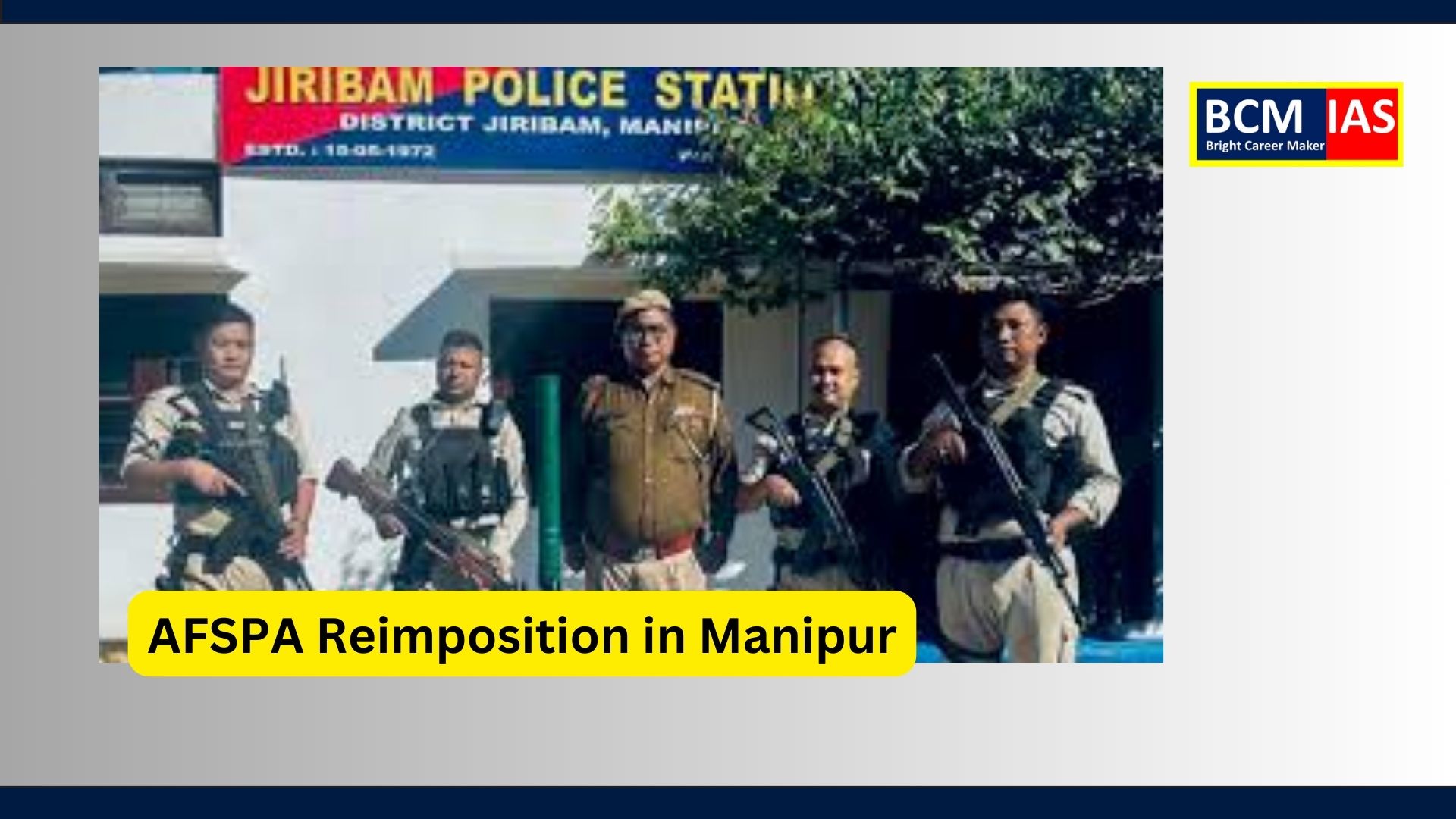
AFSPA Reimposition in Manipur
Introduction
The Union Home Ministry has
reimposed the Armed Forces (Special Powers) Act (AFSPA) in six police station
limits across five districts in Manipur due to ongoing ethnic violence and
security challenges. The decision marks a reversal from 2022 when the Manipur
government withdrew AFSPA from certain areas, citing improved security.
What is AFSPA?
1.
Definition:
The Armed Forces (Special Powers) Act (AFSPA) empowers armed forces to maintain
public order in "disturbed areas" where civil administration
struggles to function effectively due to insurgency or violence.
2.
Key
Provisions:
o The armed forces can conduct operations,
arrest individuals, or search premises without prior warrants.
o The Act protects security personnel from
prosecution for actions taken under its provisions without central government approval.
3.
Invocation
Criteria:
o Areas are declared "disturbed" under
Section
3 of AFSPA by the State or Central government.
o The Act is applied when local law enforcement
and civil administration fail to maintain peace and order.
AFSPA in Manipur: A Historical Context
1.
Initial
Imposition:
AFSPA was introduced in Manipur in 1958 to counter insurgency and unrest. It
has been periodically extended across various districts.
2.
Partial
Withdrawal in 2022:
o In April 2022, the Manipur government withdrew
AFSPA from certain areas, including valley districts, citing an improved
security situation.
o This move was part of broader efforts to
instill public confidence and reduce the military footprint in civilian areas.
Current Reimposition (November 2024)
1.
Areas
Declared ‘Disturbed’:
o Imphal West:
Sekmai, Lamsang police station limits.
o Imphal East:
Lamlai.
o Jiribam: Jiribam
station limits.
o Bishnupur: Moirang.
o Kangpokpi:
Leimakhong.
2.
Reasons for
Reimposition:
o Increase in Violence:
Ethnic violence between the Meitei (valley-dwelling) and Kuki-Zo-Hmar
(hill-dwelling) communities has led to over 240 deaths since May 2023.
o Armed Insurgency:
A surge in the number of armed insurgents in valley areas and border zones
between the two communities.
o Operational Challenges:
Armed forces faced delays in responding to incidents in areas where AFSPA had
been lifted, as they required civil administration assistance.
3.
Objectives:
o Facilitate coordinated security operations.
o Address rising cases of extortion and
abductions.
o Curb violence in "buffer zones"
between ethnic communities.
Impact of Reimposition
1.
Security
Perspective:
o AFSPA allows for swift military action,
enabling security forces to respond effectively to insurgent activities.
o Central and State governments aim to restore
order in conflict zones.
2.
Human Rights
Concerns:
o AFSPA has been criticized for alleged misuse
of power, including extrajudicial killings and human rights violations.
o Reimposition may reignite fears among local
populations, especially in areas where the Act was previously withdrawn.
3.
Public
Reaction:
o The decision reflects the government's
acknowledgment of a deteriorating security situation, but it may face
opposition from human rights groups and local stakeholders.
Way Forward
1.
Balancing
Security and Civil Liberties:
The government must ensure that the application of AFSPA does not infringe upon
human rights while addressing security challenges effectively.
2.
Dialogue and
Reconciliation:
Long-term peace in Manipur requires addressing the root causes of ethnic
tensions through dialogue and trust-building measures.
3.
Strengthening
Local Governance:
o Equipping the civil administration and police
forces to handle law and order independently.
o Gradual withdrawal of AFSPA as the security situation
stabilizes.
Conclusion
The reimposition of AFSPA in
violence-hit areas of Manipur highlights the complexity of managing security
and ethnic tensions in the region. While the Act provides essential tools for
maintaining order, it must be implemented with caution and oversight to prevent
misuse and ensure a pathway toward peace and stability.
Mains
Question
Question:
"Discuss
the implications of the reimposition of the Armed Forces (Special Powers) Act
(AFSPA) in parts of Manipur amidst ongoing ethnic violence. Critically evaluate
the role of AFSPA in maintaining public order while addressing associated
concerns." (250 words)
Answer
Introduction
The
reimposition of AFSPA in six police station limits across five districts in
Manipur reflects the challenges posed by ongoing ethnic violence between the
Meitei and Kuki-Zo-Hmar communities. AFSPA grants sweeping powers to the armed
forces to maintain public order in "disturbed areas" but has been
criticized for human rights concerns.
Implications
of AFSPA Reimposition
1. Positive Implications:
o Enhanced Security Operations: AFSPA facilitates swift and decisive actions
by armed forces, bypassing bureaucratic delays.
o Control over Insurgency: It enables coordinated efforts to curb the
activities of insurgents, particularly in buffer zones between ethnic groups.
o Restoration of Public Order: Provides a sense of security to affected
communities by countering extortion, abductions, and violence.
2. Challenges and Concerns:
o Human Rights Violations: AFSPA has been criticized for misuse,
including arbitrary arrests, custodial violence, and extrajudicial killings.
o Public Distrust: The act may erode trust between the state
and its citizens, especially in previously peaceful areas.
o Conflict Escalation: Over-reliance on military measures without
addressing underlying ethnic tensions may worsen the situation.
Balancing
Security and Civil Liberties
1. Need for Oversight:
Transparent mechanisms and accountability measures must be in place to prevent
misuse of AFSPA provisions.
2. Addressing Root Causes:
Ethnic reconciliation through dialogue, socio-economic development, and
capacity building of local law enforcement are essential.
3. Gradual Withdrawal:
As the security situation stabilizes, AFSPA must be phased out to restore
civilian governance and trust.
Conclusion
While
AFSPA is a crucial tool for maintaining public order in conflict zones, it
should be used judiciously with safeguards to uphold human rights. Long-term
peace in Manipur requires a holistic approach that integrates security,
governance, and social harmony.
MCQs
on AFSPA
Question
1:
The
Armed Forces (Special Powers) Act (AFSPA) is invoked in an area when:
1. The region is declared a "disturbed
area" under Section 3 of AFSPA.
2. The judiciary determines the region requires
armed intervention.
3. The armed forces demand greater powers for
counterinsurgency operations.
4. There is a breakdown of civil administration
due to security threats.
Select
the correct answer using the codes below:
- (a) 1 and 2
only
- (b) 1 and 4
only
- (c) 2 and 3
only
- (d) 1, 3,
and 4
Answer: (b) 1 and 4 only
Question
2:
Which
of the following powers is granted to armed forces under AFSPA?
1. Arresting individuals without a warrant.
2. Searching premises without prior judicial
approval.
3. Using force, even to the extent of causing
death, against those acting against law and order.
4. Establishing courts-martial in disturbed
areas.
Select
the correct answer using the codes below:
- (a) 1, 2, and
3 only
- (b) 1 and 4
only
- (c) 2, 3,
and 4 only
- (d) 1, 2, 3,
and 4
Answer: (a) 1, 2, and 3 only
Question
3:
Which
of the following states/union territories has never been under the
purview of AFSPA?
- (a) Jammu
& Kashmir
- (b) Punjab
- (c) Kerala
- (d) Tripura
Answer: (c) Kerala
Question
4:
The
power to declare an area as "disturbed" under AFSPA lies with:
- (a) Only the
Central Government
- (b) Only the
State Government
- (c) Both
Central and State Governments concurrently
- (d) Supreme
Court of India
Answer: (c) Both Central and State Governments
concurrently
Question
5:
The
provision of immunity for armed forces under AFSPA implies that:
- (a) Armed
forces personnel are immune from all legal proceedings for their actions.
- (b)
Prosecution against armed forces requires prior approval from the Central
Government.
- (c) Civil
courts cannot entertain cases against armed forces personnel.
- (d) Armed
forces personnel are immune from disciplinary actions within the military.
Answer: (b) Prosecution against armed forces requires
prior approval from the Central Government


Comments on “AFSPA Reimposition in Manipur”