


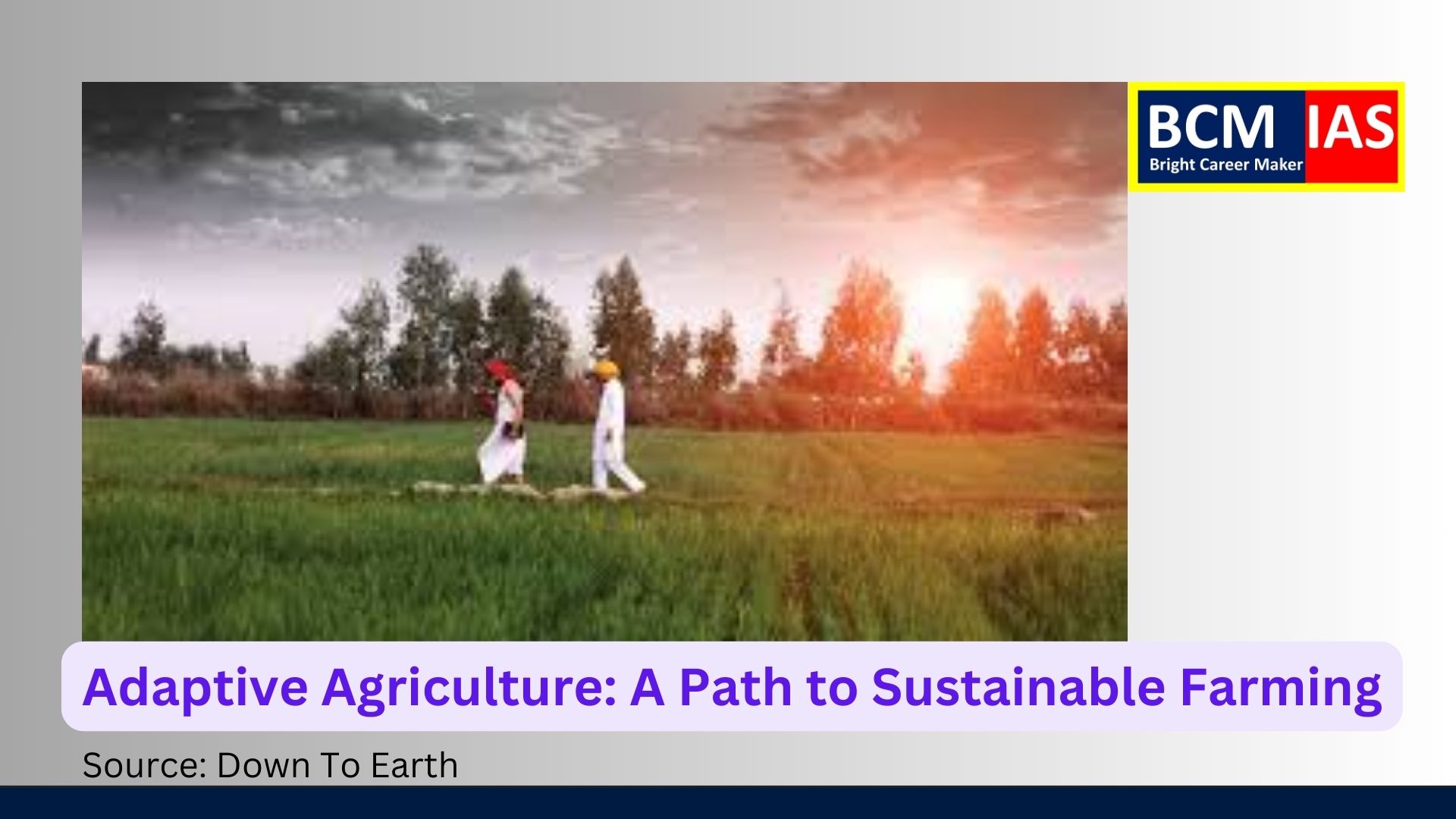
Adaptive Agriculture: A Path to
Sustainable Farming
Why in News?
A recent report by the Centre for Science and Environment has
highlighted the advantages of organic and natural farming over
chemical-dependent methods, emphasizing the need for adaptive agriculture
in response to climate change.
What is Adaptive Agriculture?
Adaptive Agriculture refers to the necessity of adjusting agricultural practices
to address climate change and develop food systems that can sustainably and
healthily feed the global population.
- Focus: It aims to increase resilience
and sustainability in agricultural systems by addressing environmental
challenges.
- Methodologies: Adaptive agriculture employs a
variety of strategies for growing food responsibly, including
climate-resilient crops, conservation tillage, agroecology, and organic
farming.
Examples of Adaptive Agriculture Practices
1.
Climate-Resilient Crops: Developing crop varieties resistant
to extreme weather conditions.
2.
Conservation Tillage: Minimizing soil disturbance to maintain soil health
and reduce erosion.
3.
Agroecology: Designing farming systems that mimic natural ecosystems.
4.
Organic Farming: Using natural inputs to avoid synthetic chemicals and GMOs.
5.
Natural Farming: Minimal human intervention, allowing nature to dictate
farming processes.
Benefits of Adaptive Agriculture
1.
Increased Water Holding Capacity: Porous soil improves water
retention.
2.
Better Growth of Plants: Deep-rooted plants absorb more
nutrients due to healthier soil.
3.
Builds Resilience: Soil health and microbial stability strengthen
plants against climate variability.
4.
Enhances Productivity: Improved practices and technologies
lead to higher agricultural yields.
5.
Economic Viability: Adaptive methods help farmers manage risks, leading
to stable incomes.
6.
Sustainability: Reduces environmental impact and conserves natural
resources, ensuring long-term agricultural viability.
Why India Needs Adaptive Agriculture?
India is particularly vulnerable to climate change due to its
large population, extensive coastline, and agricultural dependence.
- Extreme
Weather Events:
India is identified as one of the top countries affected by extreme
weather events (2000-2019), posing risks to 42.3% of the workforce in
agriculture, which contributes 18.2% to the GDP.
- Agricultural
Vulnerability:
55% of the net sown area relies on rainwater, making it highly vulnerable
to unpredictable climate changes. Rainfed regions produce 44% of India’s
food and support 60% of its livestock.
- Rural
Vulnerability:
About 70% of rural households depend on agriculture, with 86% being small
and marginal farmers.
Challenges in Implementing Adaptive Agriculture
1.
Adoption Challenges:
o As of March
2023, only 4.2% of India's net sown area practices organic farming, and only 3%
of farmers have shifted to these methods.
2.
Lack of Quality Inputs:
o Farmers struggle
to access organic inputs due to knowledge gaps, lack of availability, and the
labor-intensive nature of organic farming.
3.
Unfair Returns:
o Farmers face
difficulties in securing fair prices for organic produce.
4.
Marketing Issues:
o Small and
marginal farmers struggle with lengthy supply chains and poor value addition,
limiting their market access.
5.
MSP System:
o The current
Minimum Support Price (MSP) system primarily supports wheat and rice, promoting
monoculture, straining water resources, and reducing crop diversity.
Government Initiatives to Promote Adaptive
Agriculture
1.
National Initiatives:
o National
Initiative on Climate Resilient Agriculture (NICRA) (2011): Focuses on improving risk
management technologies.
o National
Mission for Sustainable Agriculture (NMSA) (2014-15): Promotes climate-resilient farming
practices.
o Paramparagat
Krishi Vikas Yojana:
Encourages organic farming.
o National
Mission on Natural Farming (NMNF): Promotes natural farming to enhance soil health and reduce
chemical use.
o Bio-input
Resource Centres:
Planned under NMNF to address knowledge gaps and availability of organic
inputs.
o Promoting
FPOs: The government
aims to establish 10,000 Farmer Producer Organisations (FPOs) by 2027-28.
2.
State Government Initiatives:
o Andhra
Pradesh: Community
Managed Natural Farming (APCNF) is the largest program globally in terms of
farmer enrollment for natural farming.
o Haryana: Mera Pani Meri Virasat
incentivizes crop diversification.
o Odisha: Millet Mission promotes
millet cultivation with procurement guarantees.
o Karnataka: Raitha Siri supports organic
farming for millets, pulses, and oilseeds.
o Maharashtra: Project on Climate Resilient
Agriculture (POCRA) focuses on water security and agri-enterprise
promotion.
What Lies Ahead?
1.
Introduce MSP for All Crops: Ensuring MSP coverage across
diverse crops to promote crop diversity.
2.
Investment in R&D: Focus on developing
climate-resilient crops, innovative irrigation techniques, and soil management
practices.
3.
Collaborative Innovation: Encourage partnerships between the
government, private sector, and research institutions to scale adaptive
agriculture solutions.
4.
Leverage Digital Technologies: Use precision agriculture, remote
sensing, and data analytics to improve decision-making and resource management.
5.
Address Adoption Barriers: Provide education and support to
small farmers for the transition to adaptive and sustainable farming practices.
Conclusion
Adaptive agriculture is essential for addressing India’s
agricultural vulnerabilities to climate change. With significant government
initiatives in place and continued efforts to overcome challenges in adoption,
adaptive agriculture can ensure sustainable food production, enhance farmers'
resilience, and secure the livelihoods of millions of small and marginal
farmers in India.
Mains Practice Question
Examine the role of adaptive agriculture in addressing the
challenges posed by climate change in India. Discuss the initiatives taken by
the government and suggest measures to enhance its implementation.
Answer:
Introduction: Adaptive agriculture has emerged as a crucial response to the
increasing challenges posed by climate change. With India's agricultural sector
highly dependent on monsoons and natural resources, climate variability
significantly threatens the livelihoods of millions of small and marginal
farmers. Adaptive agriculture focuses on resilience, sustainability, and
reducing environmental degradation, making it vital for India’s food security.
Role of Adaptive Agriculture in Addressing
Climate Change Challenges:
1.
Building Resilience:
Adaptive agriculture emphasizes climate-resilient crops, which are better
suited to withstand extreme weather conditions such as droughts, floods, and
heatwaves. This helps mitigate the impact of erratic weather patterns on crop
yields.
2.
Soil Health and Water Retention:
Conservation tillage and organic farming practices maintain soil health and
increase its water retention capacity, thus protecting crops during dry spells
and improving productivity.
3.
Sustainable Practices:
Adaptive agriculture uses agroecological practices, which mimic natural
ecosystems and promote biodiversity. This helps reduce dependence on chemical
inputs, conserving resources and improving long-term sustainability.
4.
Economic Stability for Farmers:
By promoting organic and natural farming, adaptive agriculture can offer better
income opportunities to farmers. It also helps them manage risks and
uncertainties related to climate change, leading to more stable incomes.
Government Initiatives Promoting Adaptive
Agriculture:
1.
National Initiative on Climate Resilient Agriculture
(NICRA):
Launched in 2011 by ICAR, NICRA aims to enhance the climate resilience of
Indian agriculture by developing appropriate technologies and practices for
risk management in farming.
2.
National Mission for Sustainable Agriculture (NMSA):
Initiated in 2014-15, NMSA focuses on making Indian agriculture more
productive, sustainable, and climate-resilient through the promotion of
appropriate farming practices.
3.
Paramparagat Krishi Vikas Yojana (PKVY):
A component of NMSA, PKVY aims to promote organic farming practices across
India, reducing dependence on chemical inputs and improving soil health.
4.
Mission Organic Value Chain Development for North East
Region:
This program supports organic farming in the northeastern states, creating
comprehensive value chains from production to consumption.
5.
State-Specific Programs:
States like Andhra Pradesh (Community Managed Natural Farming), Haryana (Mera
Pani Meri Virasat), and Odisha (Millet Mission) are leading the way in
promoting climate-resilient and sustainable farming practices.
Challenges in Implementing Adaptive
Agriculture:
1.
Adoption Barriers:
Despite the advantages, only 4.2% of India’s net sown area is under organic
farming, and a mere 3% of farmers have transitioned to these methods. This
reflects a low adoption rate due to a lack of knowledge and resources.
2.
Lack of Quality Inputs:
Farmers face difficulties in accessing bio-inputs and organic materials, which
require time, labor, and knowledge to produce.
3.
Marketing Challenges:
Small and marginal farmers struggle to market their organic produce due to long
supply chains and limited value addition.
4.
Current MSP System:
The existing Minimum Support Price (MSP) framework primarily supports wheat and
rice, promoting monoculture and straining water resources, which weakens the
resilience of Indian agriculture.
Measures to Enhance Implementation of Adaptive
Agriculture:
1.
Introduce MSP for Diverse Crops:
Expanding MSP to cover a wider range of crops can encourage crop
diversification, reduce monoculture, and enhance agricultural resilience to
climate change.
2.
Investment in Research and Development:
Focused R&D on climate-resilient crops, innovative irrigation techniques,
and improved soil management practices tailored to different agro-ecological
zones can help farmers adopt more sustainable practices.
3.
Promote Farmer Education and Awareness:
Government efforts to provide education and training to farmers on sustainable
practices, along with incentives, can significantly enhance the adoption of
adaptive agriculture.
4.
Strengthening Farmer Producer Organisations (FPOs):
FPOs can help small and marginal farmers access better markets, technology, and
inputs, thus overcoming marketing and supply chain issues.
5.
Leverage Digital Technologies:
Using precision agriculture, remote sensing, and data analytics can help
farmers make informed decisions, optimize resource usage, and better manage
climate-related risks.
Conclusion: Adaptive agriculture holds great potential to mitigate the
adverse impacts of climate change on Indian agriculture by improving
resilience, sustainability, and income stability. Government initiatives,
combined with policy reforms such as MSP diversification, investment in
R&D, and farmer education, will be essential in scaling up adaptive
agricultural practices. As India faces increasing climate risks, adaptive
agriculture will play a critical role in ensuring food security and sustainable
livelihoods for millions of farmers.
MCQs for Practice
1. Which of the following best defines adaptive agriculture?
a) It refers to using genetically modified crops to improve
yields in all environmental conditions.
b) It focuses on adapting agricultural practices to climate change, promoting
resilience and sustainability in food systems.
c) It involves increasing chemical inputs to maximize short-term crop
production.
d) It refers to replacing traditional farming with full mechanization and
automation of agricultural processes.
2. Which of the following is NOT an example of adaptive
agriculture practices?
a) Conservation tillage
b) Climate-resilient crops
c) Heavy use of synthetic fertilizers
d) Agroecology
3. Consider the following statements regarding the benefits
of adaptive agriculture:
1.
It improves the water-holding capacity of the soil.
2.
It enhances agricultural productivity by promoting
sustainable practices.
3.
It increases dependence on chemical fertilizers and
pesticides to boost crop yield.
Which of the statements given above is/are correct?
a) 1 and 2 only
b) 1 and 3 only
c) 2 and 3 only
d) 1, 2, and 3
4. Why is India particularly vulnerable to climate change,
necessitating the adoption of adaptive agriculture?
1.
A significant proportion of the population depends on
agriculture for their livelihoods.
2.
More than half of the net sown area in India relies on
rainwater for irrigation.
3.
India has very low agricultural employment, reducing
the impact of climate change on food production.
Select the correct answer using the code given below:
a) 1 only
b) 1 and 2 only
c) 2 and 3 only
d) 1, 2, and 3
5. Which of the following is a challenge in implementing
adaptive agriculture in India?
a) Availability of adequate infrastructure to promote organic
farming.
b) Lack of awareness and access to quality organic inputs among farmers.
c) Over-reliance on technology-driven solutions in rural areas.
d) Extensive government support for monoculture farming practices.
Answers:
1.
b) It focuses on adapting agricultural practices to
climate change, promoting resilience and sustainability in food systems.
2.
c) Heavy use of synthetic fertilizers
3.
a) 1 and 2 only
4.
b) 1 and 2 only
5.
b) Lack of awareness and access to quality organic
inputs among farmers.


Comments on “Adaptive Agriculture: A Path to Sustainable Farming”