


Daily Current Affairs Analysis
01 May 2024
-------------------------------------------------------------------------------------------------------------
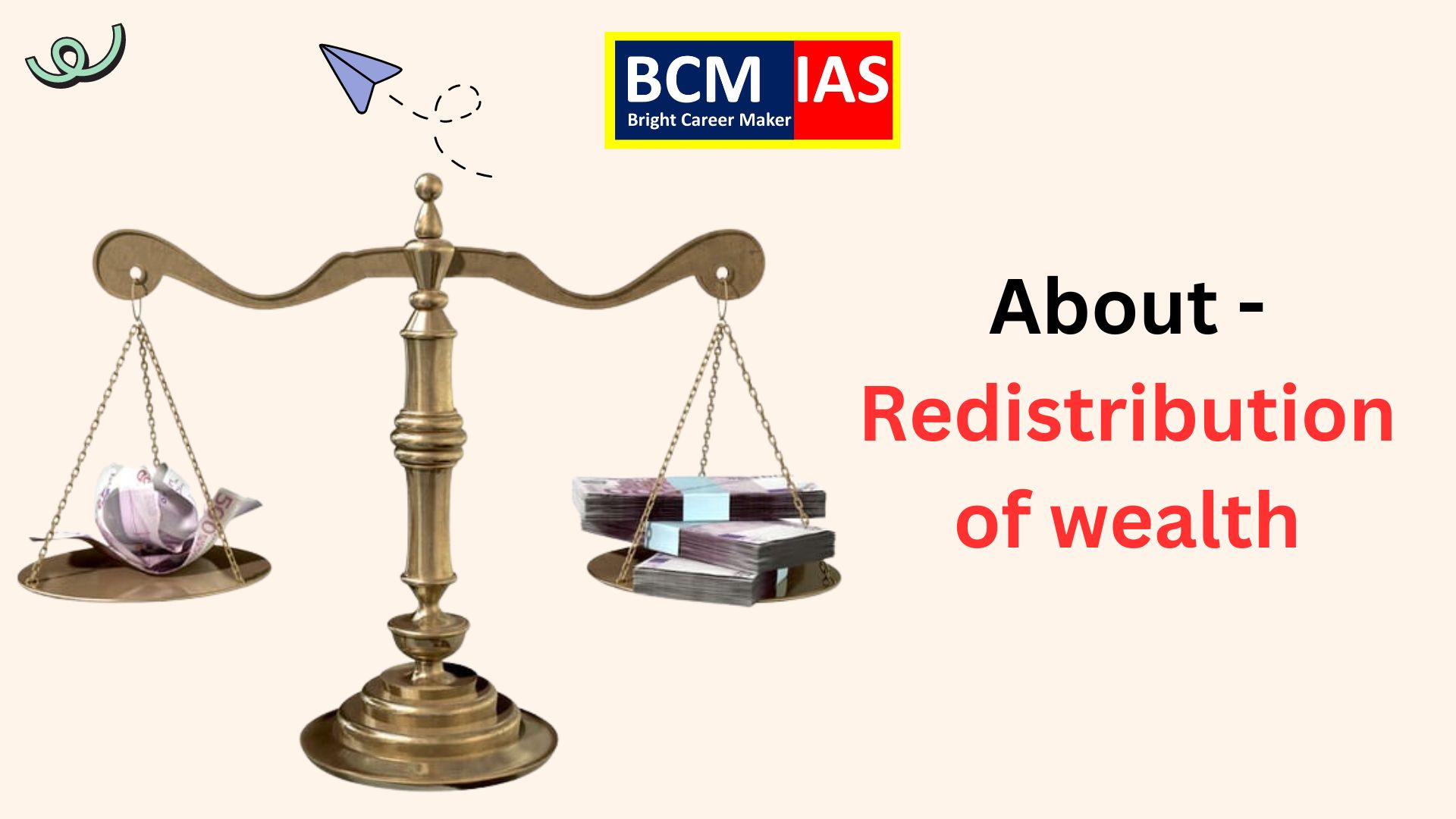
About the redistribution of
wealth
Related Topic (as per UPSC
Syllabus)
1. Indian Polity and
Governance (Mains GS Paper II):
·
Constitutional Provisions: Discusses articles of the Constitution
that pertain to economic justice and the redistribution of resources.
·
Role of Judiciary and Policies: Examination of how various Supreme Court
judgments and government policies have aimed to implement or interpret these
constitutional mandates.
2. Economics (Prelims,
Mains GS Paper III):
·
Agricultural Economics: Includes land reforms and policies aimed
at redistributing land to the tiller.
·
Public Distribution System (PDS): How economic resources are distributed
and managed to ensure fair play and economic equity.
3. Ethics, Integrity, and
Aptitude (Mains GS Paper IV):
·
Ethics of Redistribution: Exploring the ethical dimensions of
redistributing wealth, including the implications on rights and the collective
good of society.
News
Analysis
Introduction:
The article discusses the ongoing debate
and constitutional background related to the redistribution of wealth in India.
This has been a significant issue in the recent election campaigns, highlighting
its importance in the political and socio-economic landscape of the country.
Constitutional Provisions:
The Constitution of India aims to secure
justice, liberty, and economic equity for all citizens. The Fundamental Rights
and Directive Principles of State Policy (DPSP) guide this vision, advocating
for the redistribution of wealth to ensure economic justice and equality.
Notably, the right to property was initially a fundamental right but was later
shifted to a legal right, allowing the government more flexibility in
implementing land reforms and redistributing wealth.
Historical Context:
The redistribution of wealth, especially
land, has been a central theme since India's independence. Land reforms
initiated in the early years aimed to eliminate feudal ownership patterns and
distribute land to the tiller. This was seen as crucial for achieving economic
equity and reducing rural poverty.
Judicial Rulings and Amendments:
Over the decades, the Supreme Court has
played a key role in interpreting these constitutional provisions. Significant
rulings include:
- 1978: The 44th
amendment removed the right to property from fundamental rights,
emphasizing the state's role in redistributing resources.
- Post-1978: The judiciary
has continued to interpret and uphold the constitutionality of wealth
redistribution, particularly in terms of land reforms.
Current Debates and Policies:
The debate today revolves around how best
to balance economic growth with equity. The government has implemented various policies
to boost economic productivity and ensure fair distribution of resources. These
include agricultural loans, insurance, and tax policies that favor small and
medium enterprises and the agricultural sector.
Exceptions to Fundamental Rights:
The article outlines specific instances
where the government may infringe on certain fundamental rights, particularly
for achieving greater public good, which includes wealth redistribution.
Conclusion:
The redistribution of wealth in India is a
complex issue intertwined with the country's constitutional directives,
historical needs, and contemporary policies. While significant progress has
been made, ongoing debates and policies continue to shape this dynamic issue.
The judiciary's role remains crucial in interpreting the balance between
individual rights and societal needs.
Probable Mains Question
"Discuss the constitutional basis for wealth
redistribution in India and its impact on socio-economic equality."
Model
Answer for UPSC Civil Services Mains Exam:
Introduction: The redistribution of wealth is a
fundamental socio-economic strategy aimed at achieving economic equality among
the citizens of India. It is deeply rooted in the constitutional framework,
primarily driven by the Directive Principles of State Policy (DPSP) and
supported by various amendments and judgments from the Supreme Court.
Demand of the Question: The question requires an analysis of how
the constitutional directives are implemented to ensure wealth redistribution
and its effectiveness in promoting socio-economic equality. This involves
discussing the constitutional articles related to the right to property and
the role of the state in redistributing wealth, as well as the impact of
such policies on reducing disparities between different sections of the
society.
Way Forward: To further enhance the effectiveness of
wealth redistribution policies, the government should focus on:
1. Improving
Implementation: Ensuring
that the policies are effectively implemented at the grassroots level to truly
benefit the intended beneficiaries.
2. Monitoring and
Evaluation: Establishing robust
mechanisms to monitor and evaluate the impact of these policies to ensure they
meet their objectives without unintended consequences.
3. Public Participation
and Transparency:
Encouraging greater public participation in the planning and execution stages
of redistribution policies to enhance transparency and accountability.
In conclusion, while the constitutional
framework provides a solid basis for the redistribution of wealth, continuous
efforts are needed to adapt and refine these policies to meet the changing
needs of India's dynamic socio-economic landscape.
MCQs for Prelims Practice
Question 1:
Which constitutional amendment made the "right to property" a
legal right instead of a fundamental right?
A) 42nd Amendment
B) 44th Amendment
C) 61st Amendment
D) 73rd Amendment
Answer: B) 44th Amendment
Explanation:
The 44th Amendment of the Constitution of India, enacted in 1978,
changed the status of the right to property from a fundamental right to a legal
right, thus giving the government more authority to implement land reforms and
other redistributive measures without being challenged on the grounds of
violating the fundamental right to property.
Question 2:
The Directive Principles of State Policy (DPSP) are aimed at ensuring
which of the following?
A) Economic democracy
B) Judicial overreach
C) Federal equilibrium
D) Parliamentary supremacy
Answer: A) Economic democracy
Explanation:
The DPSP, outlined in Part IV of the Constitution, aims to provide
guidelines to the state to secure a social order for the promotion of welfare
of the people and, importantly, to ensure economic democracy through the
redistribution of wealth and resources.
Question 3:
Which of the following is not a goal of land reform policies in India?
A) Redistribution of land to the landless
B) Consolidation of fragmented land holdings
C) Ensuring corporate investments in agriculture
D) Abolition of feudal land ownership patterns
Answer: C) Ensuring corporate investments in agriculture
Explanation:
Land reform policies in India have historically focused on
redistribution of land to the landless, consolidation of fragmented land, and
abolition of feudal systems, rather than promoting corporate investments in
agriculture, which is not a direct goal of such reforms.
Question 4:
What is the primary purpose of transforming the right to property from a
fundamental right to a legal right under the Indian Constitution?
A) To enable unrestricted sale of tribal land
B) To promote foreign direct investment
C) To facilitate land reforms and resource redistribution
D) To increase state revenue from property taxes
Answer: C) To facilitate land reforms and resource redistribution
Explanation:
The demotion of the right to property from a fundamental right to a
legal right was primarily intended to facilitate the government’s ability to
carry out land reforms and redistribute resources more effectively, aligning
with the goals of economic equity and reducing socio-economic disparities.
Question 5:
The Supreme Court’s role in wealth redistribution has been primarily to:
A) Interpret the constitutionality of wealth redistribution policies
B) Enforce minimum wage laws across states
C) Regulate the stock market and financial redistributions
D) Directly administer land reforms
Answer: A) Interpret the constitutionality of wealth redistribution
policies
Explanation:
The Supreme Court of India has played a crucial role in interpreting the
constitutional mandates related to wealth redistribution, ensuring that such
policies align with constitutional provisions and do not infringe on individual
rights unjustly, thus balancing public interest with private rights.


Comments on “About the redistribution of wealth”