


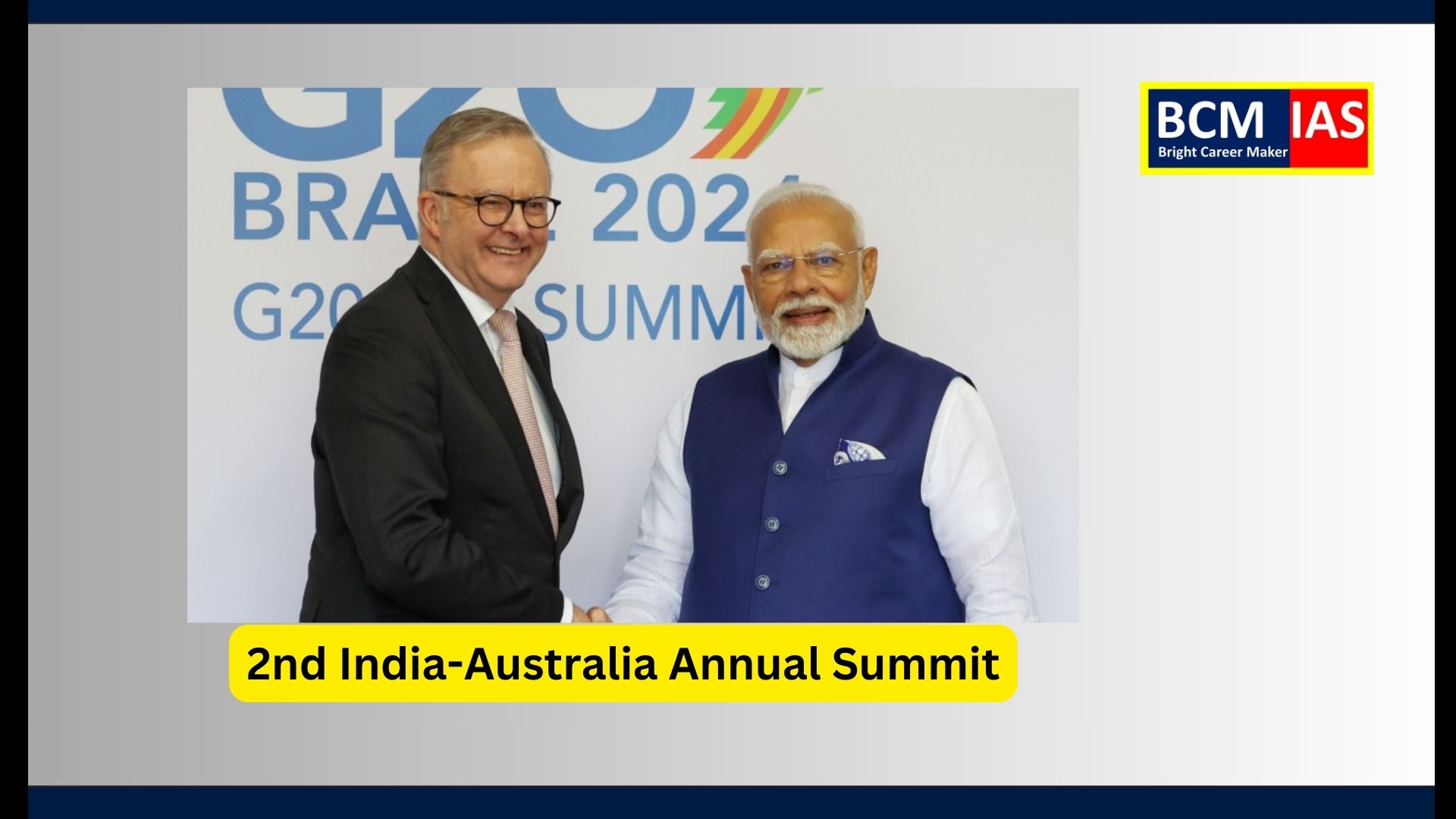
2nd
India-Australia Annual Summit
The 2nd India-Australia Annual
Summit, held on the sidelines of the G20 Summit 2024 in Rio de Janeiro,
marks a significant step in strengthening the India-Australia Comprehensive
Strategic Partnership (CSP). This summit addressed key areas of
collaboration, including renewable energy, trade, mobility, defence, and
regional cooperation, while highlighting mutual efforts to tackle global and
regional challenges.
Key Highlights of the
Summit:
1.
Renewable Energy Partnership:
- Launch of the India-Australia Renewable Energy
Partnership (REP) to promote collaboration in solar energy, green
hydrogen, and energy storage technologies.
- This reflects both nations' commitment to
addressing climate change and transitioning toward sustainable
energy sources.
2.
Trade and Investments:
- Comprehensive Economic Cooperation Agreement
(CECA) negotiations are being advanced to complement the India-Australia
Economic Cooperation and Trade Agreement (Ind-Aus ECTA) of 2022, which
boosted bilateral trade by 40% in two years.
- Initiatives like Australia-India Business
Exchange (AIBX) have been extended for four years, fostering
commercial partnerships and investments.
- Emphasis on aligning India's Make in India
with Australia’s Future Made in Australia to promote job creation
and economic growth.
3.
Enhanced Mobility:
- Launch of Australia's Working Holiday Maker
Visa Programme for India and the Mobility Arrangement for Talented
Early-professionals Scheme (MATES) to attract India's STEM
graduates.
- These programs aim to address skill shortages and
deepen people-to-people ties.
4.
Defence and Security Collaboration:
- Agreement to renew the Joint Declaration on
Defence and Security Cooperation (JDSC) in 2025, signifying increased
military and strategic convergence.
- Defence ties have been strengthened through:
- Joint military exercises like AUSINDEX
and Pitch Black.
- Logistics agreements, such as the Mutual
Logistics Support Agreement (MLSA).
- Enhanced operational interoperability through
aerial refueling agreements.
5.
Regional and Multilateral Cooperation:
- Both countries reiterated their commitment to a free,
open, and inclusive Indo-Pacific, in line with UNCLOS
principles.
- Collaboration under the Quad framework has
been reinforced, focusing on:
- Pandemic response.
- Cybersecurity.
- Infrastructure resilience.
- Upcoming events like the 2024 Indian Ocean
Conference in Perth and India’s IORA Chairmanship in 2025
underscore joint efforts in maritime sustainability.
- Support for Pacific Island nations through
the Forum for India-Pacific Islands Cooperation (FIPIC).
India-Australia
Comprehensive Strategic Partnership (CSP):
Established in 2020, this
partnership is based on shared democratic values, regional security interests,
and economic growth goals. Key features include:
1. Economic
Cooperation: CECA discussions, infrastructure collaboration, and
innovation.
2. Defence: Military
cooperation via joint exercises and logistical agreements.
3. Maritime
Security: Focus on illegal fishing and sustainable oceanic resource
management.
4. Technology
and Research: Enhanced cooperation in cybersecurity and medical research.
Significant
Milestones in Bilateral Relations:
1.
Bilateral Trade:
o India is
Australia's 5th largest trading partner, with trade valued at USD
49.1 billion in 2023.
o Exports
include:
§ India to
Australia: Gems, textiles, and refined petroleum.
§ Australia
to India: Coal, natural gas, and education-related services.
2.
Civil Nuclear
Cooperation:
o The 2014
agreement enabled uranium exports to India, fueling its peaceful nuclear
energy needs.
3.
Defence
Cooperation:
o Joint
exercises (AUSINDEX, Pitch Black) and programs like the General Rawat
Exchange Programme.
o New aerial
refueling agreements to enhance Indo-Pacific operational reach.
4.
Multilateral
Engagement:
o Collaboration
through Quad, IORA, and ISA.
o Australia
supports India’s candidature for a permanent UNSC seat and APEC
membership.
Conclusion:
The 2nd Annual Summit has
fortified the growing India-Australia relationship, emphasizing economic,
strategic, and people-to-people partnerships. While challenges such as delays
in CECA remain, both nations continue to deepen ties, particularly in areas of renewable
energy, regional security, and economic cooperation. This
enduring collaboration aligns with their shared vision for a stable and
prosperous Indo-Pacific region.
Mains Question:
Evaluate the evolution of
India-Australia trade relations in the context of shifting global dynamics.
Answer:
Introduction
India and Australia have
transformed their bilateral trade relationship from one centered on commodities
to a robust partnership encompassing diverse sectors such as energy, education,
defence, and technology. This evolution reflects both nations' strategic
alignment amid shifting global dynamics, including the rise of China and the
focus on Indo-Pacific cooperation.
Evolution of Trade
Relations
1.
Early Stage:
Resource-Based Trade
o Historically,
trade was driven by Australia’s exports of raw materials (coal, copper
ores, and natural gas) and India’s exports of textiles, gems, and jewelry.
o Agreements
like the Civil Nuclear Cooperation Agreement (2014) allowed uranium
exports to India, diversifying trade.
2.
Emergence of
Strategic Trade Ties
o With the Comprehensive
Strategic Partnership (CSP) in 2020, economic relations expanded to include
sectors like green energy, education, and critical minerals.
o The India-Australia
Economic Cooperation and Trade Agreement (Ind-Aus ECTA) in 2022 facilitated
a 40% increase in bilateral trade within two years.
3.
Current Trends
o Initiatives
like the India-Australia Renewable Energy Partnership (2024) underscore
a pivot toward sustainability.
o The Australia-India
Business Exchange (AIBX) and ongoing CECA negotiations aim to further
liberalize trade.
o Trade
diversification includes high-value sectors like STEM talent mobility,
technology exchange, and defense equipment.
Significance of Trade
Evolution
1.
Economic Gains
o Australia
is India’s 5th largest trading partner, with bilateral trade valued at USD
49.1 billion in 2023.
o Ind-Aus
ECTA offers tariff-free access to 100% of Australian goods and 70% of
Indian goods, fostering growth in textiles, agriculture, and technology.
2.
Geopolitical
Importance
o Amid China's
assertiveness, both nations seek to reduce economic dependence on China and
strengthen supply chains.
o Focus on a free
and open Indo-Pacific promotes regional stability and trade resilience.
3.
Technological and
Educational Collaboration
o Programs
like MATES and Working Holiday Maker visas facilitate talent
exchange.
o Education
exports from Australia to India contribute significantly to bilateral trade.
4.
Energy Security
o Australia’s
expertise in green hydrogen and renewable energy complements India’s
energy transition goals.
Challenges in the
Partnership
1.
Delay in CECA
Negotiations
o The Comprehensive
Economic Cooperation Agreement remains under negotiation, delaying full
trade liberalization.
2.
Geopolitical
Risks
o The growing
influence of China and regional security concerns could impact trade flows.
3.
Trade Imbalance
o Australia’s
exports of raw materials dominate trade, leading to a potential imbalance.
4.
Sectoral
Divergence
o While
Australia focuses on raw materials, India seeks greater investment in manufacturing
and technology transfer under Make in India.
Way Forward
1.
Fast-Track CECA
Negotiations
o Finalizing
CECA will unlock the potential of untapped sectors like digital trade,
services, and start-up ecosystems.
2.
Enhance
Collaboration in Green Energy
o Joint
investment in green hydrogen and solar energy can drive sustainability
goals.
3.
Strengthen Supply
Chains
o Initiatives
like the Quad Supply Chain Resilience Initiative (SCRI) can further
reduce dependency on China.
4.
Expand Talent
Mobility Programs
o Boosting
programs like MATES will promote greater economic and technological
collaboration.
Conclusion
The evolution of India-Australia
trade relations highlights a shift from traditional commodity trade to a more
strategic and diversified partnership. Anchored by shared democratic values and
economic interests, the relationship is poised to deepen further, supported by
initiatives like CECA, Ind-Aus ECTA, and renewable energy partnerships. Amid
changing global dynamics, these ties are vital for ensuring regional
stability and mutual prosperity.
MCQs
Q1.Consider
the following statements regarding the India-Australia Economic Cooperation
and Trade Agreement (Ind-Aus ECTA):
1. It provides
India with tariff-free access to 100% of Australia's tariff lines.
2. It was
signed in 2020 as part of the India-Australia Comprehensive Strategic
Partnership.
3. It grants
preferential access to India’s agricultural products in Australian markets.
Which of the statements is/are
correct?
(a) 1 and 3 only
(b) 2 only
(c) 1 and 2 only
(d) 1, 2, and 3
Answer: (a)
Q2.Which of
the following exercises are part of India-Australia defence cooperation?
1. AUSINDEX
2. Malabar
3. Pitch Black
4. Yudh Abhyas
Select the correct answer using the
codes below:
(a) 1, 2, and 3 only
(b) 2 and 4 only
(c) 1 and 3 only
(d) 1, 2, 3, and 4
Answer: (a)
Q3.India and
Australia are members of which of the following multilateral groupings?
1. Indian
Ocean Rim Association (IORA)
2. Quad
3. G20
4. Asia-Pacific
Economic Cooperation (APEC)
Select the correct answer using the
codes below:
(a) 1, 2, and 3 only
(b) 2 and 4 only
(c) 1 and 3 only
(d) 1, 2, 3, and 4
Answer: (a)
Q4.The India-Australia
Renewable Energy Partnership (REP) launched in 2024 focuses on:
1. Green
hydrogen development
2. Energy
storage solutions
3. Nuclear
energy for peaceful purposes
4. Solar
energy cooperation
Select the correct answer using the
codes below:
(a) 1, 2, and 3 only
(b) 1, 2, and 4 only
(c) 2 and 4 only
(d) 1, 2, 3, and 4
Answer: (b)
Q5.In the
context of India-Australia relations, the Working Holiday Maker Visa
Programme, launched in 2024, aims to:
(a) Facilitate the export of skilled labor from India to Australia.
(b) Promote youth mobility between India and Australia for work and tourism.
(c) Provide STEM graduates from Australia an opportunity to work in India.
(d) Encourage business partnerships through short-term business visas.
Answer: (b)


Comments on “2nd India-Australia Annual Summit”