


Daily Current Affairs Analysis
14 June 2024
-------------------------------------------------------------------------------------------------------------
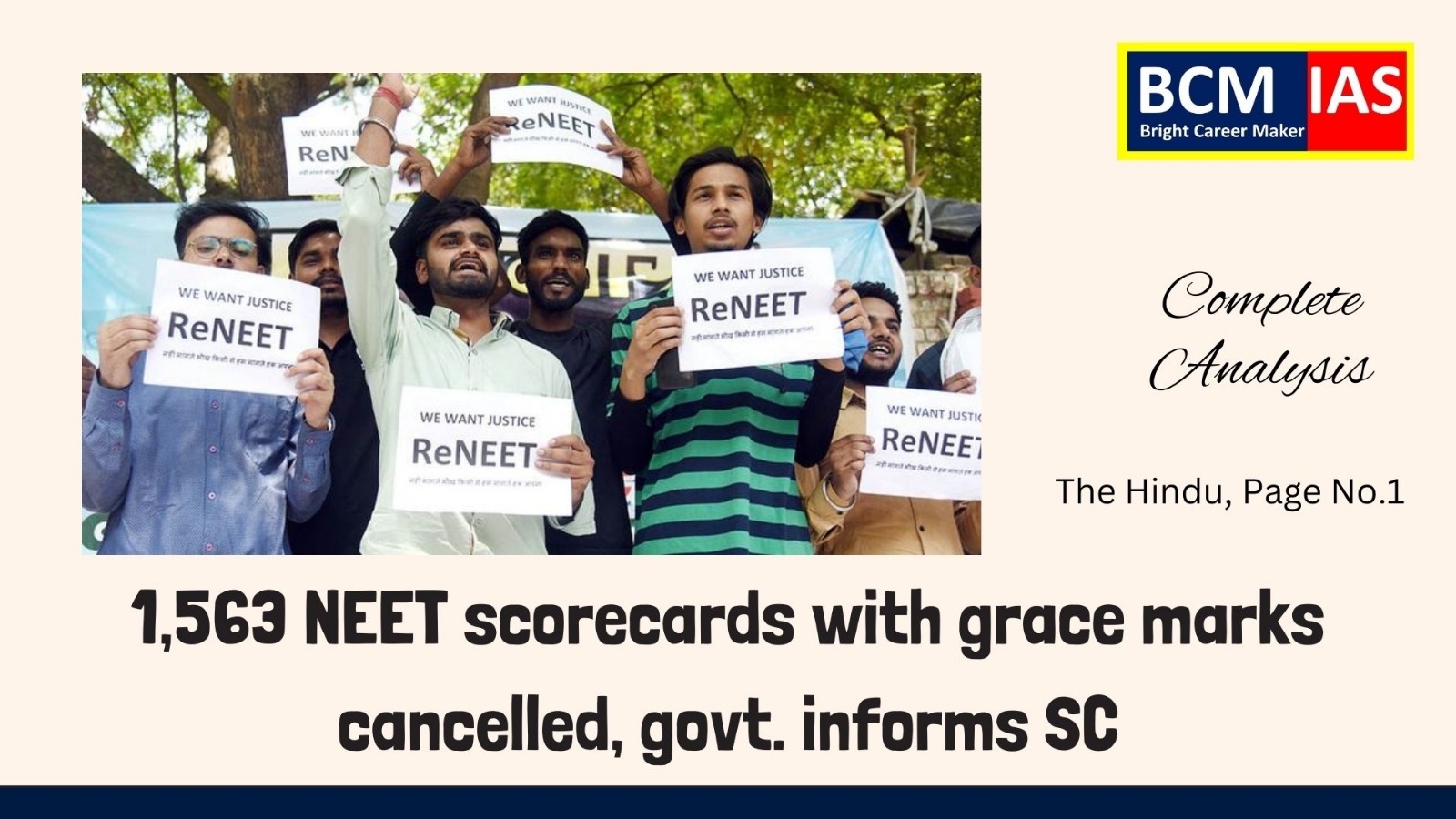
1,563 NEET scorecards with grace marks cancelled,
govt. informs SC
Meaning of Headline-
·
This headline means that the scorecards of 1,563 candidates who
were granted grace marks in the NEET (National Eligibility cum Entrance Test)
exam have been invalidated.
·
The government has informed the Supreme Court of this decision.
·
These candidates will be allowed to retake the exam on June 23.
·
If they choose not to take the re-examination, their original
scores, excluding the grace marks, will be considered as final.
·
The final results will be announced on June 30.
Related Topic (as per UPSC
Syllabus)
Prelims:
- General Studies
Paper I:
o
Current Events of National and
International Importance:
§
Issues related to the education system and competitive
exams in India.
Mains:
- General Studies
Paper II:
o
Governance, Constitution, Polity, Social
Justice, and International relations:
§
Government policies and interventions for development
in various sectors and issues arising out of their design and implementation.
§
Issues relating to development and management of
Social Sector/Services relating to Health, Education, Human Resources.
§
Role of Judiciary in protecting the rights of the
citizens and ensuring justice.
- General Studies
Paper III:
o
Issues relating to Development and
Management of Social Sector/Services relating to Health, Education, Human
Resources.
§
Policy reforms and their impact on the education
system.
Interview:
- Current Affairs
and General Awareness:
o
In-depth understanding of recent developments and
their implications.
o
Ability to analyze the role of government, judiciary,
and educational institutions in addressing systemic issues.
o
Opinions on reforms needed in the education system to
ensure fairness and transparency.
News
Analysis
Introduction:
The news article addresses a significant
development concerning the cancellation of NEET scorecards that included grace
marks. The Supreme Court has recorded the Union government's submission
regarding this issue, which impacts 1,563 candidates.
Body:
Key Points:
1. Cancellation
of Scorecards:
o
The Supreme Court noted that the NEET scorecards of
1,563 candidates who were granted compensatory or grace marks will be canceled.
o
These candidates will have the option to sit for a
retest scheduled for June 23. If they choose not to retake the exam, their
original scores without the grace marks will be considered final.
2. Reason
for Grace Marks:
o
The National Testing Agency (NTA) had initially
granted grace marks to these candidates based on the recommendation of a
committee formed to address the issue.
o
This decision was made after it was found that the
candidates did not have the full period of 3.2 hours to complete their exams
due to administrative errors at their respective centers.
3. Court
Proceedings:
o
The court heard petitions challenging the award of
grace marks on the grounds of a "non-discrimination formula."
o
The NTA, represented by senior advocate Naresh
Kaushik, informed the court of the retest and the decision to declare the
results by June 30.
4. NTA's
Response and Further Actions:
o
The NTA assured the court that measures would be taken
to avoid disrupting the counseling session scheduled for July 6.
o
The court disposed of the pleas concerning grace marks
but required the NTA to respond to allegations of question paper leaks and
other concerns by July 8.
5. Impact on
Candidates:
o
Candidates who opt for the reexamination will have
their new scores considered as their final result, superseding the previous
ones from May 5.
o
The article also mentions a petition by the CEO of
Physics Wallah, Alakh Pandey, challenging the NTA's decision to award grace
marks as "arbitrary."
Conclusion:
The cancellation of NEET scorecards with
grace marks and the subsequent decision to conduct a retest highlights the
importance of fairness and transparency in examination processes. The Supreme
Court's involvement ensures that the rights of the candidates are protected,
and the NTA's steps to address the issue indicate a commitment to rectifying
administrative errors. This development will likely impact the candidates'
future plans and the overall integrity of the NEET examination process.
Mains Probable Question
"Critically analyze the
implications of cancelling NEET scorecards with grace marks on the education
system and judicial intervention in India."
Model Suggested Answer:
1. Introduction
The National
Eligibility cum Entrance Test (NEET) is a highly competitive examination in
India, serving as a gateway for students aspiring to pursue undergraduate
medical courses. Recently, the Supreme Court intervened in a significant issue
concerning the cancellation of NEET scorecards for 1,563 candidates who were
awarded grace marks due to compensatory reasons. This intervention has sparked
a debate on the implications for the education system and the role of judicial
oversight in maintaining fairness and integrity in competitive exams.
2. Demand of the Question
Implications on the
Education System:
The
cancellation of NEET scorecards with grace marks primarily impacts the integrity
and credibility of the examination process. It underscores the necessity
for transparent and robust mechanisms in exam administration. The
decision to cancel these scorecards reveals systemic flaws, including
inadequate exam conduction protocols, issues in grace marks allocation,
and potential question paper leaks. Such incidents erode public trust in the
examination system and highlight the need for comprehensive reforms to prevent
future discrepancies.
- Student Confidence and Morale: The abrupt cancellation of scorecards significantly affects
students' confidence. Many aspirants who received grace marks due to
genuine reasons, such as loss of time or technical glitches, face undue
stress and uncertainty about their future. This can lead to psychological
distress and a sense of injustice among students who feel penalized
for no fault of their own.
- Legal and Administrative
Challenges: The decision to cancel
the scorecards also brings forth various legal and administrative
challenges. The authorities must manage the logistics of organizing a
re-examination while ensuring that the new examination is free from any
irregularities. Additionally, there is a need for a clear framework to
address grievances and ensure that students' rights are protected during
such transitions.
- Judicial Intervention and its Role: The
judiciary's involvement in this issue highlights the importance of judicial
oversight in maintaining fairness in competitive examinations. The
Supreme Court's decision underscores the judiciary's role in safeguarding
the rights of students and ensuring that the principles of natural
justice are upheld. However, it also raises questions about the
frequency and extent of judicial intervention in administrative matters.
While necessary in cases of gross irregularities, excessive judicial
interference might lead to a dilution of the autonomy of educational
bodies.
3. Way Forward
Enhancing
Examination Integrity: To prevent such issues in the future,
there must be a comprehensive overhaul of the examination process. This
includes implementing strict protocols for exam conduction, improving the
security of question papers, and ensuring that grace marks are awarded only in
exceptional and well-documented circumstances. Regular audits and reviews of
examination processes can help identify and rectify potential flaws before they
escalate.
- Strengthening Grievance Redressal
Mechanisms: Establishing robust and
transparent grievance redressal mechanisms is crucial. Students should
have access to a clear, efficient, and unbiased system to raise their
concerns and seek resolution. This includes setting up independent
committees to review grievances related to exam conduction and result
declaration.
- Legal and Policy Reforms: Legislative and policy reforms are necessary to delineate the scope
and extent of judicial intervention in educational matters. Clear
guidelines should be established to define when judicial oversight is
warranted, ensuring a balance between protecting students' rights and
maintaining the autonomy of educational institutions. Additionally,
policies should be formulated to address the psychological and academic
impact on students affected by such cancellations, providing them with
adequate support and resources.
- Technological Integration:
Leveraging technology can play a pivotal role in enhancing the
transparency and efficiency of the examination process. The use of biometric
verification, real-time monitoring, and secure digital
platforms for conducting exams can minimize the risk of
irregularities. Additionally, AI-based systems can be employed to detect
anomalies in exam patterns and results, ensuring a fair evaluation
process.
- Awareness and Training: Creating awareness among students and educators about the
importance of maintaining examination integrity is essential. Regular
training programs for exam invigilators and administrators can help them
understand and implement best practices in exam conduction. Moreover,
students should be informed about their rights and the available avenues
for redressal in case of any issues.
Conclusion:
The
cancellation of NEET scorecards with grace marks has significant implications
for the education system and highlights the critical role of judicial
intervention in ensuring fairness. While the decision underscores the need for
robust examination processes and transparent mechanisms, it also calls for a
balanced approach to judicial oversight. By implementing comprehensive reforms,
leveraging technology, and strengthening grievance redressal systems, we can
ensure the integrity of competitive exams and safeguard the interests of
students, ultimately fostering a more just and reliable education system.
In
conclusion, the way forward involves a multi-faceted approach that includes enhancing
examination integrity, strengthening grievance redressal mechanisms,
implementing legal and policy reforms, leveraging technological
advancements, and raising awareness. By addressing these areas, we
can create a more resilient and trustworthy examination system that upholds the
principles of fairness and justice, ensuring that students' efforts and
aspirations are valued and protected.
MCQs for Prelims Practice
1. The Supreme Court of
India recently intervened in the NEET examination process due to:
A. The introduction of a new syllabus
B. The cancellation of scorecards with grace marks
C. The extension of exam dates
D. The increase in examination fees
Answer: B. The
cancellation of scorecards with grace marks
2. NEET stands for:
A. National Eligibility and
Employment Test
B. National Entrance Examination for Teachers
C. National Eligibility cum Entrance Test
D. National Engineering Entrance Test
Answer: C. National
Eligibility cum Entrance Test
3. The re-examination
for the affected NEET candidates is scheduled to be held on:
A. June 10
B. June 15
C. June 23
D. June 30
Answer: C. June 23
4. The Supreme Court's
intervention in the NEET issue highlights the role of:
A. Executive oversight
B. Legislative reform
C. Judicial intervention
D. Media scrutiny
Answer: C. Judicial
intervention
5. The final results of
the NEET re-examination will be declared on:
A. June 23
B. June 30
C. July 6
D. July 10
Answer: B. June 30
Other Important Links
Other Important Links
|
|
Follow us
on-
|
|
ADMISSIONS
OPEN For
Details, Contact us- 9711394350 / 9717724350 |
|


Comments on “1,563 NEET scorecards with grace marks cancelled, govt. informs SC”