


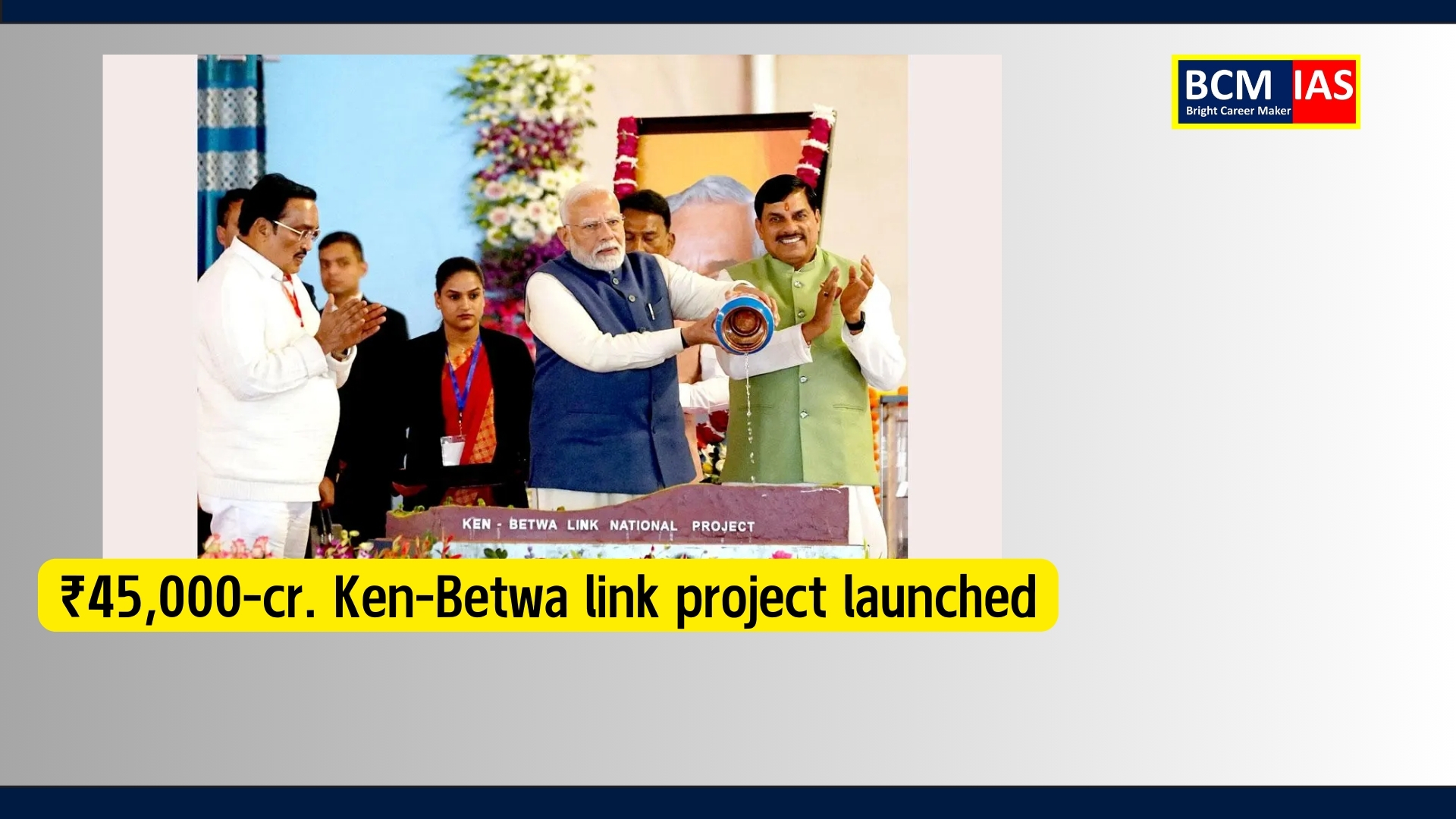
₹45,000-cr. Ken-Betwa link project launched
The foundation stone for the ₹45,000-crore
Ken-Betwa river-linking project was laid by Prime Minister Narendra Modi in
Khajuraho, Madhya Pradesh, on December 29, 2024. This ambitious project aims to
address water scarcity and promote socio-economic growth in the Bundelkhand
region, which spans parts of Madhya Pradesh and Uttar Pradesh. Below is a
detailed analysis and explanation of the key aspects of the event and project:
1. Objectives of the Ken-Betwa River
Linking Project
- Water Scarcity Resolution: The project is designed to
mitigate the acute water shortage in the Bundelkhand region, ensuring
water availability for drinking and irrigation purposes.
- Irrigation Potential: It aims to irrigate 11 lakh
hectares of land, boosting agricultural productivity.
- Energy Generation: The project is expected to
generate 100 MW of hydropower and 27 MW of solar energy,
contributing to renewable energy goals.
- Economic Growth: By addressing water issues,
the project is projected to bring prosperity to a historically
drought-prone region.
2. Political and Historical Context
- Dr. B.R. Ambedkar's Vision: PM Modi credited Dr. Ambedkar
with the conceptual framework of India’s river valley projects and water
management policies. The speech emphasized Ambedkar’s role in establishing
the Central Water Commission and accused previous Congress
governments of sidelining his contributions.
- Atal Bihari Vajpayee's Legacy: The project was
highlighted as a continuation of former Prime Minister Vajpayee’s
river-linking initiative. PM Modi underscored that Vajpayee envisioned
river-linking as a permanent solution to inter-state water disputes.
- Congress Critique: Modi criticized past
Congress-led governments for announcing projects without implementing them
effectively.
3. Key Projects Announced Alongside
- Daudhan Dam Irrigation Project: This dam is a part
of the Ken-Betwa initiative and is crucial for irrigation in the region.
- Floating Solar Project in Omkareshwar: The inauguration of
Madhya Pradesh’s first solar power plant aligns with India’s clean energy
mission.
- Atal Gram Seva Sadans: The foundation stone was laid
for 1,153 village service centers to enhance rural infrastructure.
- Commemorative Stamp and Coin for Atal Bihari Vajpayee: These were released
to honor Vajpayee’s centenary.
4. Environmental Concerns
- Impact on Panna Tiger Reserve:
- The Ken-Betwa project passes through the Panna Tiger
Reserve, raising concerns about its impact on wildlife.
- PM Modi assured that environmental considerations,
particularly the well-being of animals, will be prioritized in the
construction of the canal.
- This aspect remains contentious, with environmentalists
expressing concerns over habitat disruption and ecological balance.
5. Regional and National Significance
- Bundelkhand Development: By addressing water scarcity,
the project is expected to unlock the agricultural and industrial
potential of Bundelkhand, thus fostering regional development.
- Inter-State Coordination: The project sets an example
for resolving inter-state water disputes, particularly between Madhya
Pradesh and Uttar Pradesh.
- Energy and Sustainability: The integration of hydropower
and solar energy highlights a balanced approach toward economic and
environmental goals.
6. Challenges and Criticisms
- Environmental Concerns: Despite assurances, questions
about the project’s long-term ecological impact, particularly on the Panna
Tiger Reserve, remain unresolved.
- High Costs: The project’s ₹45,000 crore budget has
sparked concerns about its financial viability and burden on state
resources.
- Implementation Risks: Previous river-linking efforts
have faced delays due to legal, administrative, and logistical challenges.
Conclusion
The Ken-Betwa river-linking project marks a
significant step in India’s efforts to address water scarcity and promote
sustainable development in drought-prone regions. By combining historical,
political, and environmental narratives, the project underscores the
government’s focus on inclusive growth and infrastructure development. However,
the success of the project hinges on its timely implementation, effective
inter-state collaboration, and mitigation of environmental concerns,
particularly those related to the Panna Tiger Reserve.
Mains Question and Model Answer
Q: The Ken-Betwa river-linking
project aims to address water scarcity and promote socio-economic development
in the Bundelkhand region. Critically analyze the significance of the project
and the challenges associated with its implementation.
Model Answer
Introduction
The Ken-Betwa river-linking project, with an estimated cost of ₹45,000
crore, aims to address water scarcity in the drought-prone Bundelkhand region,
which spans Uttar Pradesh and Madhya Pradesh. The project also seeks to resolve
inter-state water disputes and promote irrigation, drinking water availability,
and renewable energy generation. However, it faces significant environmental
and financial challenges.
Significance of the Project
1. Water
Security:
o
Provides drinking water to 10
districts in Uttar Pradesh and Madhya Pradesh.
o
Helps mitigate drought-like
conditions in the Bundelkhand region.
2. Irrigation
Potential:
o
Expected to irrigate 11 lakh
hectares of farmland, improving agricultural productivity and reducing
dependency on erratic rainfall.
3. Energy
Generation:
o
Plans to produce 100 MW hydropower
and 27 MW solar energy, contributing to renewable energy goals.
4. Inter-State
Cooperation:
o
Sets a precedent for resolving
inter-state water disputes through collaboration.
5. Rural
Development:
o
Initiatives like the construction of Atal
Gram Seva Sadans are likely to improve rural infrastructure and governance.
6. Historical
Context:
o
Reinforces Dr. B.R. Ambedkar’s
vision for integrated water management and Atal Bihari Vajpayee’s
river-linking initiative, adding to its political and historical
significance.
Challenges Associated with the
Project
1. Environmental
Concerns:
o
The project passes through the Panna
Tiger Reserve, threatening wildlife habitats and ecological balance.
o
Displacement of flora and fauna due
to canal construction.
2. Financial
Viability:
o
The high cost of ₹45,000 crore raises
concerns about the financial burden on the government.
o
Long gestation period may delay
benefits.
3. Implementation
Delays:
o
Previous river-linking projects have
faced bureaucratic hurdles and delays.
o
Land acquisition and inter-state
coordination are potential bottlenecks.
4. Social
Impact:
o
Possible displacement of local
communities and inadequate rehabilitation measures could lead to social unrest.
5. Climate
Change Implications:
o
Changes in river flow patterns due to
climate change may impact the long-term utility of the project.
Way Forward
1. Sustainable
Development:
o
Ensure environmental safeguards to
protect the Panna Tiger Reserve and other ecosystems.
2. Financial
Prudence:
o
Explore public-private partnerships
(PPP) to share the financial burden and improve efficiency.
3. Stakeholder
Engagement:
o
Proactively involve local communities
to ensure better rehabilitation and cooperation.
4. Inter-State
Collaboration:
o
Strengthen coordination mechanisms
between Uttar Pradesh and Madhya Pradesh to avoid disputes.
5. Monitoring
and Evaluation:
o
Establish a robust framework for
continuous monitoring to address ecological and social impacts.
Conclusion
The Ken-Betwa river-linking project represents a
landmark effort to address water scarcity, improve irrigation, and promote
renewable energy in Bundelkhand. However, its success depends on balancing
developmental objectives with ecological preservation and ensuring timely
implementation. If executed effectively, it could serve as a model for future
inter-state water projects in India.
MCQs
Q1. The Ken-Betwa river-linking project
primarily aims to:
A. Promote urbanization in Bundelkhand region
B. Resolve water disputes between Madhya Pradesh and Rajasthan
C. Address water scarcity and boost irrigation in Bundelkhand region
D. Generate thermal energy for rural electrification
Answer: C
Explanation: The project aims to mitigate water scarcity and enhance
irrigation in Bundelkhand, which spans parts of Uttar Pradesh and Madhya
Pradesh.
Q2. Which of the following is a key
environmental concern associated with the Ken-Betwa river-linking project?
A. Loss of agricultural land
B. Threat to the ecosystem of the Panna Tiger Reserve
C. Decrease in groundwater recharge
D. Pollution of rivers due to industrial effluents
Answer: B
Explanation: The project’s canal passes through the Panna Tiger Reserve,
raising concerns about its impact on wildlife habitats.
Q3. The Ken-Betwa project is the first
interlinking of rivers in India to:
A. Include provisions for solar energy generation
B. Receive approval under the National River Linking Project
C. Be completed within the scheduled timeline
D. Utilize international funding for its implementation
Answer: B
Explanation: The Ken-Betwa project is the first river-linking project
under India’s National River Linking Project framework.
Q4. Which of the following benefits are
expected from the Ken-Betwa river-linking project?
1. Increased
irrigation potential
2. Hydropower
generation
3. Mitigation
of urban water crises
4. Conservation
of wildlife habitats
Select the correct answer using the code below:
A. 1 and 2 only
B. 1, 2, and 3 only
C. 2, 3, and 4 only
D. 1, 2, 3, and 4
Answer: A
Explanation: The project aims to increase irrigation potential and
generate hydropower but does not directly mitigate urban water crises or
conserve wildlife habitats.
Q5. Which two rivers are being
interlinked under the Ken-Betwa project?
A. Betwa and Chambal
B. Ken and Betwa
C. Narmada and Betwa
D. Chambal and Parbati
Answer: B
Explanation: The project interlinks the Ken and Betwa rivers to address
water scarcity and enhance irrigation in Bundelkhand.


Comments on “₹45,000-cr. Ken-Betwa link project launched”