


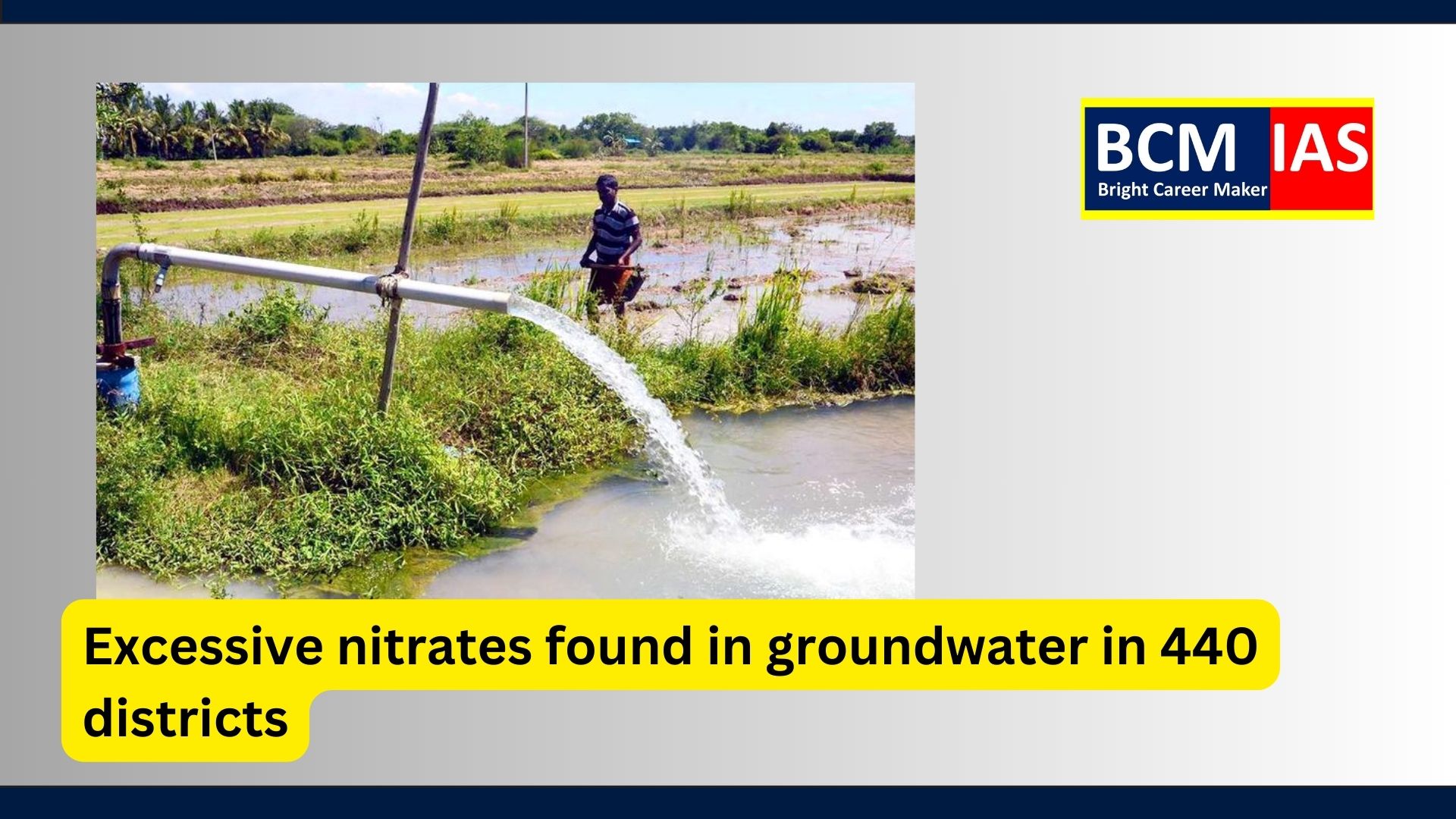
‘Excessive
nitrates found in groundwater in 440 districts’
This news highlights
the concerning issue of nitrate
contamination in India’s
groundwater, as reported by the Central
Groundwater Board (CGWB).
It also examines other groundwater quality issues, such as fluoride
and uranium contamination, while discussing overall groundwater extraction trends.
Key
Findings
1. Nitrate
Contamination in Groundwater
·
Extent
of the Problem:
- Excessive nitrates (>45 mg/l) were
found in groundwater in 440
districts in 2023, up from 359 districts in
2017.
- About 56% of India's districts now face
this problem.
·
Proportion
of Affected Samples:
- Of the 15,239 groundwater samples
collected in 2023, 19.8%
had nitrate levels exceeding safe limits.
- This proportion has remained relatively
stable, with 21.6%
affected in 2017.
·
Regional
Trends:
- Rajasthan, Karnataka, and Tamil Nadu
reported the highest levels of contamination, with 49%, 48%, and 37% of samples,
respectively, exceeding safe limits.
- Central and southern India, including Maharashtra
(35.74%), Telangana
(27.48%), Andhra
Pradesh (23.5%), and Madhya Pradesh (22.58%), are
showing increasing
trends, raising alarm.
·
Causes:
- The primary cause is the excessive use of subsidized
synthetic nitrogenous fertilizers, widely used in
farming.
- Nitrates from fertilizers leach into
the soil and contaminate groundwater.
- Monsoonal rains exacerbate the problem,
with nitrate contamination rising from 30.77% pre-monsoon to 32.66% post-monsoon.
·
Health
and Environmental Impact:
- High nitrate levels are hazardous,
particularly for young
children, leading to health conditions such as blue baby syndrome.
- It also contributes to environmental toxicity,
affecting ecosystems reliant on groundwater.
2. Other Groundwater
Contaminants
·
Fluoride
Contamination:
- Excessive fluoride levels are a
significant concern in Rajasthan,
Haryana,
Karnataka,
Andhra Pradesh,
and Telangana.
- Chronic fluoride exposure can cause dental and skeletal fluorosis,
severely impacting human health.
·
Uranium
Contamination:
- Rajasthan and Punjab reported the highest number
of groundwater samples exceeding 100
ppb of uranium.
- Several regions in Rajasthan, Gujarat, Haryana, Punjab, Tamil Nadu, Andhra Pradesh,
and Karnataka
also face unsafe uranium levels (>30 ppb).
- Over-extraction of groundwater
contributes to uranium contamination as it mobilizes uranium from rocks
into water.
3. Groundwater
Extraction Trends
·
Current
Extraction Levels:
- The overall stage of groundwater
extraction in India is 60.4%,
unchanged since 2009
when measurements began.
·
Safe
Blocks:
- About 73% of groundwater blocks are
considered "safe," showing sufficient replenishment.
- This is an improvement from 67.4% in 2022,
although fewer blocks were analyzed in the 2024 assessment.
·
Unsustainable
Practices:
- Regions with over-exploitation
(drawing more groundwater than replenished) face worsening contamination
levels, as seen with uranium.
Implications
1. Health Risks:
- High nitrate levels pose serious health
risks, particularly to children, and fluoride and uranium contamination
have long-term impacts on human health.
2. Agricultural
Practices:
- The reliance on synthetic nitrogenous fertilizers,
driven by subsidies, is a major contributor to groundwater contamination.
A shift toward sustainable
farming practices is critical.
3. Water Security:
- With over-extraction and contamination,
the availability of safe drinking water is under threat in several
regions.
4. Regional
Disparities:
- States like Rajasthan, Tamil Nadu, and
Karnataka face acute challenges, while regions in central and southern
India are showing worrying trends of increasing contamination.
5. Policy and
Governance:
- The rise in contamination underscores
the need for better groundwater
management policies, stricter regulation of fertilizer
use, and investment in clean
water infrastructure.
Recommendations
1. Promote Sustainable Agriculture:
o Encourage organic
fertilizers and reduce subsidies for synthetic nitrogenous
fertilizers.
o Train farmers in precision
farming to optimize fertilizer use.
2. Improve Groundwater Monitoring:
o Increase the frequency and scope of groundwater quality
assessments to identify and mitigate contamination trends earlier.
3. Invest in Water Treatment:
o Develop community-level solutions for treating nitrate,
fluoride, and uranium contamination in affected regions.
4. Raise Public Awareness:
o Educate communities about the dangers of contaminated
groundwater and promote water conservation.
5. Strengthen Policies:
o Implement stricter regulations to control groundwater
extraction in over-exploited regions.
o Enforce policies for safe disposal of agricultural
runoff.
Conclusion
Groundwater
contamination, particularly with nitrates, fluoride, and uranium, is a growing
concern in India, exacerbated by unsustainable agricultural practices and
over-extraction. While overall groundwater extraction has remained stable,
regional challenges and health risks demand urgent intervention. A holistic
approach combining sustainable
agricultural practices, better groundwater management, and community
awareness is essential to safeguard
India’s water security and public health.
Mains
Question:
"Excessive nitrate contamination in
groundwater is a growing concern for India, exacerbating health risks and
environmental challenges." Discuss the causes, implications, and potential
solutions to address this issue. (250 words)
Answer:
Introduction
Groundwater contamination with nitrates is a pressing issue in India, affecting
56%
of the country’s districts. The Central Ground Water
Board (CGWB) report for 2023 highlights that 440 districts report nitrate
levels exceeding the safe limit of 45 mg/l,
posing health and environmental risks.
Causes of Nitrate Contamination
1.
Excessive Fertilizer Use:
Overuse of subsidized synthetic nitrogenous fertilizers in agriculture leads to
nitrate leaching into the groundwater.
2.
Monsoonal Rains:
Rainfall increases nitrate mobility, further contaminating groundwater
post-monsoon.
3.
Over-Extraction of
Groundwater: Over-exploitation in regions like Rajasthan
and Punjab mobilizes nitrates and other contaminants from soil and rock.
4.
Improper Waste Disposal:
Poorly managed sewage and industrial effluents exacerbate contamination.
Implications
1.
Health Hazards:
High nitrate levels cause blue
baby syndrome in infants and other health risks like cancer.
2.
Environmental Degradation:
Excessive nitrates affect ecosystems dependent on groundwater.
3.
Regional Disparities:
States like Rajasthan, Tamil Nadu, and Karnataka are worst affected, with
increasing trends in central and southern India.
Solutions
1.
Sustainable Farming
Practices:
o Promote
organic fertilizers
and reduce dependence on synthetic fertilizers.
o Train
farmers in precision
farming to minimize nitrate runoff.
2.
Groundwater Monitoring:
o Increase
the scope of water quality assessments.
o Enforce
strict regulations to control groundwater extraction.
3.
Community Awareness:
o Educate
rural populations on the dangers of nitrate-contaminated water.
4.
Water Treatment:
o Invest
in nitrate removal
technologies, such as reverse osmosis, in affected areas.
Conclusion
Addressing nitrate contamination requires a multi-pronged approach combining policy
reforms, sustainable practices,
and public participation. Ensuring safe groundwater
is crucial for protecting public health, sustaining agriculture, and
safeguarding ecosystems in India.
MCQs
1. What is the safe limit of nitrate concentration in groundwater
as defined by the Central Ground Water Board (CGWB)?
a) 25 mg/l
b) 45 mg/l
c) 60 mg/l
d) 100 mg/l
Answer: b) 45 mg/l
2. Which of the following states reported the highest percentage of
nitrate-contaminated groundwater samples in 2023?
a) Tamil Nadu
b) Karnataka
c) Rajasthan
d) Madhya Pradesh
Answer: c) Rajasthan
3. Which of the following is a primary cause of excessive nitrates
in India’s groundwater?
a) Overuse of synthetic nitrogenous fertilizers
b) Urbanization and deforestation
c) High arsenic content in the soil
d) Excessive groundwater recharge during monsoons
Answer: a) Overuse of synthetic nitrogenous fertilizers
4. Which regions in India are witnessing a rising trend in nitrate
contamination in groundwater?
a) Northern and Eastern regions
b) Western and Southern regions
c) Central and Southern regions
d) Eastern and Central regions
Answer: c) Central and Southern regions
5. Which of the following contaminants, apart from nitrates, is a
major concern in India’s groundwater as per the CGWB report?
1. Fluoride
2. Uranium
3. Arsenic
4. Selenium
Select
the correct answer using the code below:
a) 1 and 2 only
b) 1, 2, and 3 only
c) 2 and 4 only
d) All of the above
Answer: a) 1 and 2 only


Comments on “‘Excessive nitrates found in groundwater in 440 districts’”