


Daily
Current Affairs Analysis
16 october
2024
-------------------------------------------------------------------------------------------------------------
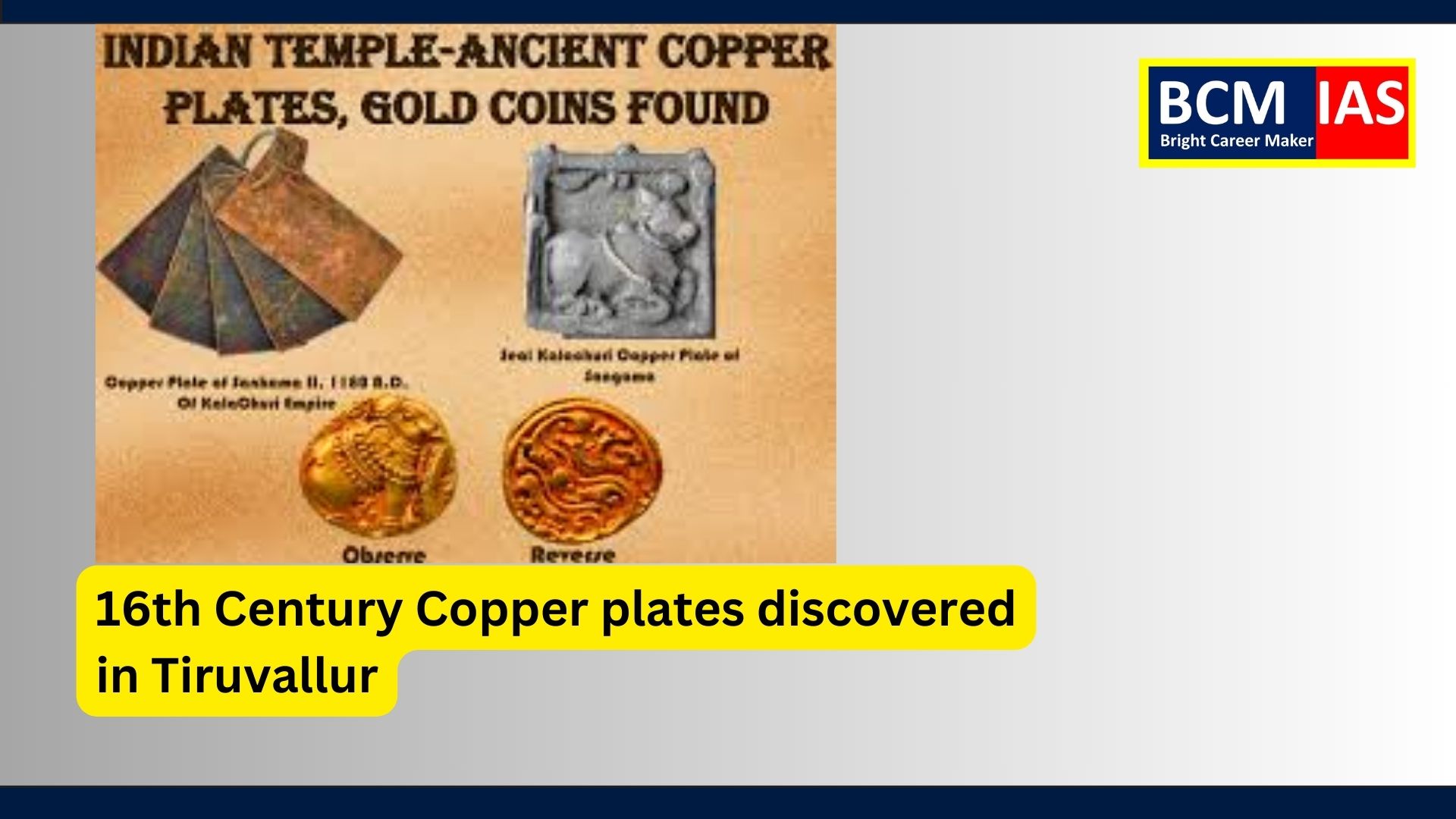
"16th Century Copper plates discovered in
Tiruvallur"
News Explanation
The news article reports the discovery of
16th-century copper plates at the Sri Singeeswarar temple in Mappedu village,
located in the Tiruvallur district of Tamil Nadu, India. Here's a detailed
analysis:
1. Discovery Details:
o
The copper plates date back to the 16th century CE and
were found at a historical temple.
o
The plates consist of two leaves, which were joined
together using a ring that bore the seal of the Vijayanagara Kingdom. This seal
is a significant historical marker, indicating the plates' association with
this South Indian empire.
2. Involvement of
Archaeological Authorities:
o
Upon discovery, officials alerted the Epigraphy
Division of the Archaeological Survey of India (ASI) via the State Archaeology
Department.
o
K. Munirathnam Reddy, Director (Epigraphy) at ASI,
Mysore, provided insights about the inscription, emphasizing its historical
value.
3. Inscription Details:
o
The inscription on the copper plates was written in
Sanskrit and Nandinagari script, which is a script used primarily in the Deccan
region.
o
It was engraved in the year 1513, during the reign of
King Krishnadevaraya, one of the most prominent rulers of the Vijayanagara
Empire.
o
These inscriptions are valuable historical records,
often used to preserve and document events, grants, and transactions, serving
as a crucial source for reconstructing the history of that period.
4. Historical Significance:
o
The use of copper plates with seals and inscriptions
was a common practice in ancient and medieval India to issue royal orders, land
grants, and record important events.
o
The association with the Vijayanagara Kingdom and King
Krishnadevaraya, who is known for his prosperous reign and contributions to
art, culture, and administration, makes this discovery especially significant.
The discovery of these copper plates
provides valuable insight into the administrative and cultural practices of the
Vijayanagara Empire and helps in understanding the historical context of the
region during the 16th century.
Mains Probable Question
"Discuss
the significance of copper plate inscriptions in reconstructing the history of
ancient and medieval India. How do recent discoveries, like the 16th-century
copper plates found in Tiruvallur, contribute to our understanding of the
Vijayanagara Empire?"
Model Answer
Introduction: Copper plate
inscriptions have been a critical source of historical information in ancient
and medieval India. They were used by rulers to document grants, decrees, and
important events, ensuring the preservation of these records over centuries.
The recent discovery of 16th-century copper plates in Tiruvallur, Tamil Nadu,
sheds light on the administration and cultural practices of the Vijayanagara
Empire.
Significance
of Copper Plate Inscriptions:
1. Legal and Administrative Records:
o
Copper plates were primarily
used for recording royal grants, particularly land donations to temples and
individuals. These inscriptions serve as evidence of the legal and
administrative processes of that time, highlighting the authority of the
rulers.
2. Linguistic and Scriptural Insights:
o
The plates were often
inscribed in languages and scripts prevalent in different regions, such as
Sanskrit, Tamil, Kannada, and Nandinagari. This provides insights into the
linguistic diversity and scriptural practices across India.
3. Cultural and Religious Documentation:
o
Many inscriptions document
religious endowments, temple constructions, and the patronage of arts and
culture. This helps historians understand the socio-religious dynamics and
cultural patronage during various periods.
4. Economic and Social Information:
o
The plates often record
details of taxation, land ownership, and the economic structure of society.
They also mention the social hierarchy, duties, and rights, giving a glimpse
into the social organization of the era.
Contribution
of Recent Discoveries:
1. Understanding the Vijayanagara Empire:
o
The copper plates found in
Tiruvallur were inscribed in 1513, during the reign of King Krishnadevaraya,
one of the most celebrated rulers of the Vijayanagara Empire. The plates bear
the seal of the empire, authenticating their historical value.
o
This discovery helps in
understanding the administrative reach and governance practices under
Krishnadevaraya, who was known for his efficient rule and cultural patronage.
2. Linguistic and Cultural Heritage:
o
The plates are written in
Sanskrit and Nandinagari script, reflecting the linguistic tradition of the
region. They also show the influence of the Vijayanagara rulers in promoting
Sanskrit, which was a medium for religious and administrative communication.
3. Historical Validation:
o
Discoveries like these
validate historical texts and provide corroborative evidence to literary
sources, making historical narratives more precise. For example, the
inscriptions confirm the political and cultural influence of the Vijayanagara
Empire in the Tamil Nadu region.
Conclusion: Copper plate
inscriptions are invaluable for reconstructing India’s historical narrative,
offering detailed insights into the political, social, economic, and cultural
aspects of the time. The recent discovery in Tiruvallur is a testament to the
rich administrative heritage of the Vijayanagara Empire and highlights the need
for continued archaeological exploration to further understand India’s past.
MCQs for Prelims Practice
1. What is the primary significance
of copper plate inscriptions in historical research?
a) They were used to decorate temples
b) They provide legal and administrative records from ancient times
c) They were used for trading purposes
d) They served as religious texts
Answer: b) They provide legal and
administrative records from ancient times
Explanation: Copper plate
inscriptions were primarily used to document royal grants, decrees, and other
administrative records, making them essential sources for reconstructing
historical events and governance structures.
2. The recently discovered copper
plates in Tiruvallur were found at which of the following locations?
a) Meenakshi Temple, Madurai
b) Sri Singeeswarar Temple, Mappedu
c) Brihadeeswarar Temple, Thanjavur
d) Shore Temple, Mahabalipuram
Answer: b) Sri Singeeswarar Temple,
Mappedu
Explanation: The copper
plates were discovered at the Sri Singeeswarar Temple located in Mappedu
village, Tiruvallur district, Tamil Nadu.
3. The copper plates discovered in
Tiruvallur belong to which period of Indian history?
a) Gupta Empire
b) Chola Dynasty
c) Vijayanagara Empire
d) Maurya Empire
Answer: c) Vijayanagara Empire
Explanation: The copper
plates date back to the 16th century, during the reign of the Vijayanagara
Empire, and bear the seal of this kingdom, linking them directly to that
period.
4. The inscriptions on the copper
plates found in Tiruvallur were written in which scripts?
a) Tamil and Grantha
b) Kannada and Devanagari
c) Sanskrit and Nandinagari
d) Prakrit and Brahmi
Answer: c) Sanskrit and Nandinagari
Explanation: The
inscriptions were written in Sanskrit and Nandinagari script, which was
commonly used in the Deccan region during the Vijayanagara period.
5. Who was the ruler of the
Vijayanagara Empire during the period when the copper plates were inscribed in
1513?
a) Harihara I
b) Deva Raya II
c) Krishnadevaraya
d) Achyuta Deva Raya
Answer: c) Krishnadevaraya
Explanation: The copper
plates were engraved in 1513, during the reign of Krishnadevaraya, one of the
most notable rulers of the Vijayanagara Empire known for his contributions to
culture, administration, and military prowess.


Comments on “"16th Century Copper plates discovered in Tiruvallur"”